

How to Automatically Generate Custom Estimate PDFs From Web Selections
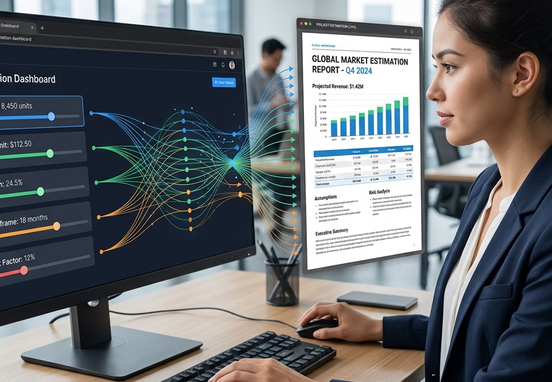
Manual document processing represents a major operational bottleneck for scaling enterprises. When sales divisions rely on staff to manually compile service variations, configure pricing metrics, and format custom layout files, client turnaround times drop significantly. In high-velocity business-to-business environments, a delay of even a few hours when delivering a project quotation provides competitors with an immediate window to capture the contract.
Automating this administrative vector involves building a server-side document generation engine that links public web selection interfaces directly to automated rendering modules. When a visitor adjusts configuration sliders, chooses line items, or dictates project metrics on your digital portal, the system must process these inputs as a structured data package. This package is instantly validated, passed to a headless layout engine, and compiled into a secure, downloadable PDF estimate within milliseconds.
Relying on generic drag-and-drop third-party middleware tools to run these heavy document compilation workflows introduces massive usage taxes and deep security exposures. These external automation platforms extract recurring transactional premiums that penalize your enterprise for scaling its digital acquisition numbers. Taking complete ownership of your infrastructure involves moving past intermediate plugins and writing direct, native code paths to process corporate calculations safely.
Core Architectural Layers of a Custom Document Engine
A sustainable automated PDF generation pipeline is built on an explicitly decoupled four-tier framework. If any of these operational tiers are tightly coupled to your primary web server runtime, a single high-volume utilization spike will quickly trigger resource exhaustion and crash your client-facing applications.
- The Frontend Selection Matrix: A highly responsive user interface that captures user preferences, computes preliminary balances locally, and packages metadata into clean JSON arrays.
- The Ingestion and API Transaction Layer: An ultra-fast server-side endpoint that authenticates incoming payloads, validates data structures, and writes the tasks straight into an asynchronous queue broker.
- The Headless Rendering Pipeline Cluster: An isolated pool of serverless worker nodes or background microservices whose sole responsibility is pulling tasks from the queue and rendering HTML templates into PDF documents.
- The Persistent Vault and Storage Layer: A secure cloud object storage repository that stores the compiled PDF files and distributes them to clients via low-latency content delivery networks (CDNs).
By separating data collection entirely from active document rendering, you insulate your primary digital assets from compute drops. To establish a solid understanding of how these backend components coordinate data streams securely, engineers should review the fundamental mechanisms of web integrations to ensure your data transfer layers follow modern request-response standards flawlessly.
Structural Mapping of Web Inputs to Document Schemas
A resilient document engine must never trust the raw numerical parameters transmitted straight from a browser client. In an open web environment, malicious actors can easily manipulate frontend JavaScript values to submit negative line-item costs, exploit pricing decimals, or inject hazardous script tags into string blocks. The ingestion layer must treat all client-side inputs as completely unverified.
When the web selection payload arrives at your backend API, it must pass through strict schema enforcement guardrails. The system checks data types, matches line-item IDs against your internal master pricing databases, and re-computes all financial values on the server side. This architecture guarantees that the final PDF estimate reflects authentic corporate pricing structures regardless of any frontend code modifications executed by the user.
To protect your relational systems from silent corruption and ensure absolute data consistency, your backend validation layers must operate with multi-tiered precision. Implementing an aggressive, self-monitoring validation pipeline based on the principles explained in detecting system errors and automating data validation provides your engineering teams with the technical guardrails needed to intercept malformed strings, log format discrepancies, and keep bad data out of core business tables.
The Asynchronous PDF Rendering Loop
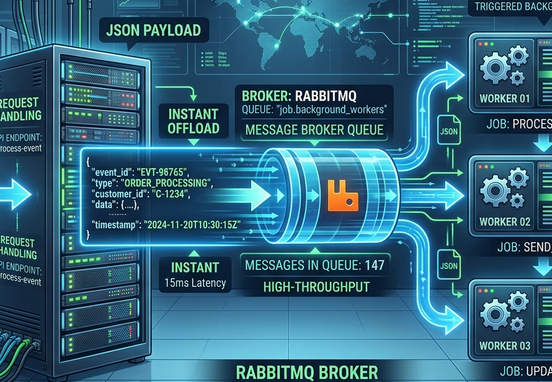
Achieving true platform longevity demands that document compilation execute completely outside your primary application thread. When the validation engine approves an incoming selection payload, the endpoint writes the raw JSON string directly into a high-speed message queue broker. The web server immediately returns a success status code and a unique tracking token to the user's browser, allowing the client interface to remain responsive while the background workers handle the heavy processing.
An independent pool of asynchronous background worker daemons monitors the message queue. A worker pulls a single task payload from the queue, locks the transaction state to prevent duplicate processing, and extracts the target HTML layout template. The engine injects the verified business data into the layout wrapper, initializes an isolated headless rendering engine, compiles the document object model (DOM) vectors, and exports the data stream directly to your secure cloud vault.
The comprehensive flowchart below illustrates the exact execution path of a decoupled document generation pipeline, showing how frontend selections travel through secure queues to compile PDFs without blocking web threads:
[User Completes Selections on Frontend UI]
                       │
                       ▼  (1. Transmits Raw Selection JSON Payload)
   [Primary Ingestion API Endpoint Gate]
                       │
                       ▼  (2. Executes Strict Server-Side Re-Calculation)
  [Validate Payload Schema & Line Items]
                       │
         ┌─────────────┴─────────────┐
         ▼ (Validation Fails)        ▼ (Validation Passes)
   [Reject Input HTTP 400]     [Publish Record to Asynchronous Message Queue]
   [Log Integrity Exception]                 │
                                             ├─► (Frees Front-End UI Thread Instantly)
                                             │
                                             ▼
                              [Asynchronous Worker Daemon Core]
                                             │
                                             ▼
                              [Extract Target HTML & CSS Layout Template]
                                             │
                                             ▼
                              [Compile DOM Elements via Isolated Headless Engine]
                                             │
                                             ▼
                              [Stream Binary Vectors to Secure Cloud Object Vault]
                                             │
                                             ▼
[End: Release Row Locks, Update Order Ledger to "Compiled", Generate CDN Link]
Managing Memory Footprints in Asynchronous Pools
Headless web renderers consume considerable chunks of server memory when opening virtual browser views to capture PDF vectors. If your background worker daemons fail to recycle these virtual viewport instances properly, your servers will encounter rapid memory leaks that stall adjacent operations. Your automation logic must be explicitly engineered to initialize isolated sandbox tasks that completely purge their transient memory stacks immediately upon document delivery.
Headless Browser Pools vs. Stream Generators
Selecting the correct document generation methodology is a critical engineering decision that dictates your system's processing speed, compute costs, and layout capabilities. Organizations must evaluate whether their corporate templates require advanced CSS print typography layouts or prioritize high-velocity processing speeds.
| Performance Evaluation Layer | Headless Browser Clusters (e.g., Puppeteer, Playwright) | Structural Stream Canvas Generators |
|---|---|---|
| Compute Overhead | High; requires running full virtual browser instances across background nodes. | Minimal; executes direct mathematical vector calculations within native code threads. |
| Layout Fidelity | Absolute perfection; supports full modern CSS grids, custom fonts, and intricate vectors. | Restrictive; requires explicit layout coordinate plotting; complex styling is difficult to maintain. |
| Execution Velocity | Medium (500ms - 2500ms per document compilation loop). | Blazing fast (10ms - 50ms per document compilation loop). |
| Template Redesign Agility | High; front-end developers can edit plain HTML and CSS files without modifying core code. | Low; layout changes require developers to rewrite low-level programmatic coordinate functions. |
For enterprises that manage highly detailed corporate design guides and require complex grid layouts, deploying containerized headless browser pools is the most functional strategy. To prevent these resource-heavy clusters from overloading your server architecture during high-volume periods, your background workflows must be built around deterministic design patterns. Grounding your integration networks in robust trigger-action logic ensures your system resources remain idle until an authentic task payload is verified, keeping your compute spending optimized.
Mitigating Render Timeouts and System Failures
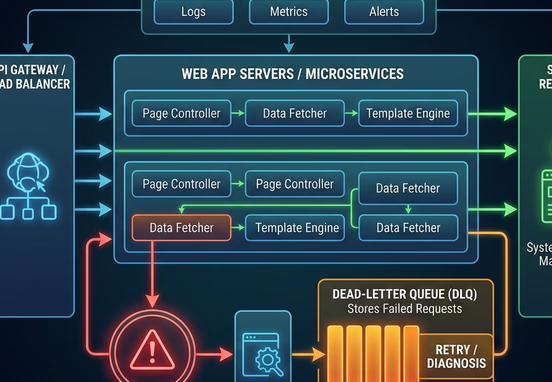
When background worker nodes communicate with external font registries, asset servers, or cloud storage networks, they are highly vulnerable to network timeouts and hardware drops. If an asset cloud server experiences a sudden drop while a worker is compiling an estimate layout, an unhandled script error can bubble up, locking server memory and crashing your asynchronous worker array.
Building a resilient, high-availability document network requires setting up defensive error controls that safely isolate script exceptions and run automated fallback routines. Implementing a self-healing pipeline framework driven by the bulletproof web pipeline: how custom error controls and smart fallbacks prevent system blackouts provides your development teams with the structural blueprints needed to safely contain rendering exceptions, store failed payloads within secure dead-letter queues, and execute intelligent retry loops automatically when connection channels recover.
Systems Architecture Tip
Always enforce strict local timeout thresholds across your headless rendering engines. If a document compilation loop fails to complete its vector export within a defined period (such as 5000 milliseconds), the background worker must instantly terminate the isolated viewport, dump the raw payload string into an error vault, and return a clean default placeholder layout to protect system stability.
Hardening Security, Token Shields, and Compliance Boundaries
Because estimate PDFs frequently contain sensitive corporate pricing parameters, custom discount matrices, and personal consumer identifiers, these files represent a high-value target for digital data mining. Storing compiled documents within publicly open cloud buckets or generating un-guessable URL links introduces severe data privacy liabilities and violates global data protection compliance rules like GDPR and CCPA.
Securing your document infrastructure requires wrapping all generation endpoints in strict cryptographic credential shields. Integrating advanced protection frameworks like those detailed in how token shields keep system authentication keys secure guarantees that your background workers can retrieve secure storage credentials, sign outbound payloads, and write binary streams to your vaults without ever exposing master security tokens to persistent text logs or developer sandboxes.
Furthermore, your cloud storage vault must be configured to block all public inbound traffic completely. When a client requests access to their compiled PDF estimate, your backend web application must validate their active session permissions, generate a temporary, time-bounded cryptographic access signature, and issue a secure redirect URL that expires automatically within minutes. This architecture ensures your corporate intelligence assets remain protected against unauthorized scanning tools.
Bypassing Middleman Integration Platforms for True Structural Scale
Relying on expensive third-party automation software or visual plugins to coordinate your document workflows introduces severe financial vulnerabilities and limits your engineering agility. These no-code systems charge variable tier-based transaction fees that quickly scale into a heavy premium on business growth as your digital acquisition volumes expand.
Building proprietary, direct-to-destination system pipelines allows your enterprise to eliminate these middleman platform fees completely while drastically reducing network processing delays. Moving your automation loops to independent server-side code paths ensures that you can successfully bypass the Zapier tax to achieve complete data ownership, secure absolute control over your operational logs, and protect long-term corporate growth.
Hardening Systems Architecture for Long-Term Digital Growth
Automatically generating custom estimate PDFs from web selections completely removes manual sales friction, accelerates your business conversion pipelines, and ensures total accuracy across all client agreements. By isolating document rendering within asynchronous worker loops, deploying strict server-side validation filters, and protecting your data vaults with cryptographic signature guards, you build a secure, high-performance web architecture that scales smoothly alongside your corporate goals.
Designing, securing, and maintaining these advanced server-side rendering networks demands specialized backend engineering, deep relational database mapping, and precise serverless orchestration. Partnering with professional platform architects ensures your custom integration paths operate with maximum velocity and complete data safety.
For enterprises focused on taking absolute ownership of their digital infrastructure and achieving peak operational efficiency, utilizing professional custom workflow and systems automation services provides the technical expertise needed to deploy secure, high-performance automated document pipelines that eliminate middleman platforms, safeguard critical information assets, and protect long-term digital growth.