


Custom Website vs Google Sites: Why Free Tools Actively Hurt Corporate Brand Authority
Every business wants to save money. When you are building a digital presence, the temptation to use a free tool like Google Sites is massive. It is fast, it costs nothing upfront, and it is backed by one of the biggest tech companies on earth.
However, for a corporate brand, choosing a free website builder is one of the most expensive mistakes you can make.
Your website is your digital headquarters. It is the first place a potential client, investor, or partner goes to check your credibility. If that headquarters looks like a cookie-cutter template built in an afternoon, your brand authority takes an immediate hit.
Below is a detailed breakdown of why free tools like Google Sites actively damage corporate brand authority, and why custom website development is the only real choice for a growing business.
The Core Difference: What You are Actually Getting
Before diving into the damage free tools can cause, it helps to understand exactly what these two options are.
- Google Sites: A basic, no-code webpage builder designed for internal projects, school presentations, or simple team dashboards. It lives within the Google Workspace ecosystem and relies on heavily restricted, pre-built components.
- Custom Website Development: A digital asset built from scratch specifically for your business. It uses clean code, tailor-made designs, and scalable architecture designed to match your precise brand guidelines and business operations.
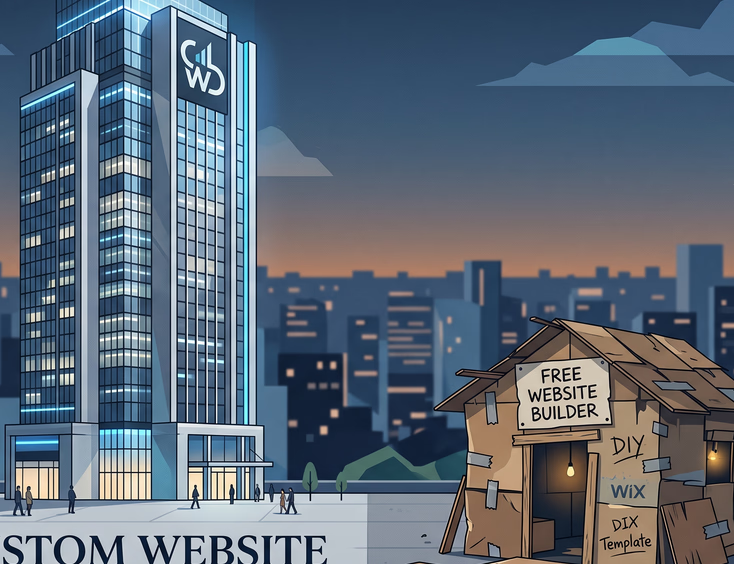
The Reality Check: Google Sites was never built to host multi-million dollar corporate brands. It was built for quick, internal collaboration. Using it as your public facing corporate website is like trying to run a commercial shipping business with a golf cart.
1. Visual Identity and the "Template Trap"
When a high-value client visits your website, they expect to see a reflection of your corporate capability. Free tools force you into design boundaries that make your business look small.
Complete Lack of Brand Individuality
Google Sites offers a handful of basic themes. These themes use standard layouts that cannot be deeply modified. If you use them, your website will look exactly like thousands of other low-budget sites across the web. Corporate authority requires a unique identity. When your site looks generic, your business feels generic.
Rigorous Layout Restrictions
On a custom website, elements can be placed exactly where they need to be to guide a user toward a sale or inquiry. On Google Sites, you are forced onto a rigid grid system. You cannot adjust padding, change complex column structures, or create unique visual elements that capture attention.
Limited Typography and Styling
Your corporate brand likely has specific brand guidelines, including custom fonts and color palettes. Google Sites limits your font selections to standard web-safe fonts or a small selection of Google Fonts. If your exact corporate font isn't supported, your brand consistency breaks down instantly.
- Custom Sites: Offer infinite design freedom, pixel-perfect layout control, and total alignment with your existing brand guidelines.
- Google Sites: Offer a "paint-by-numbers" setup where you cannot color outside the incredibly small lines.
2. The Subdomain and URL Dilemma
Trust is the foundation of corporate authority. Nothing kills trust faster than a messy, unprofessional web address.
The Footprint of Free Platforms
By default, a free Google Site comes with a URL that looks like this: [sites.google.com/view/yourcompany](https://sites.google.com/view/yourcompany). To a sophisticated corporate client, this URL screams that your business is either struggling financially or not established enough to own its own digital real estate.
The Hidden Issues with Custom Domains on Free Tools
You can connect a custom domain (like yourcompany.com) to a Google Site, but the underlying infrastructure remains obvious. Savvy users and technical auditors can easily look at the source code or page headers and see that the site is hosted on a free Google platform.
Loss of Subdomain Flexibility
As a corporate entity, you may eventually need complex subdomain structures for different arms of your business, such as portal.yourcompany.com or investors.yourcompany.com. Setting up these deep, secure configurations on a basic builder is either incredibly frustrating or completely impossible.

3. The Invisible Wall: Technical SEO Crucial Deficiencies
You cannot build corporate authority if your target audience cannot find you on Google. Free website builders place a hard ceiling on your Search Engine Optimization (SEO) capabilities.
Zero Access to the Root Code
To rank for highly competitive corporate keywords, your website needs to be perfectly optimized under the hood. Google Sites does not give you access to the HTML, CSS, or backend code. This means you cannot implement advanced technical SEO fixes that search engines demand.
Missing Schema Markup and Structured Data
Structured data (Schema) tells search engines exactly what your business does, where you are located, and what products you offer. It allows your site to appear with rich snippets in search results. Google Sites does not support custom schema implementation, leaving you at a massive disadvantage against competitors with custom sites.
Restricted Meta Information
While you can add basic page titles and descriptions, you lack fine-grained control over Open Graph tags (which control how your pages look when shared on social media like LinkedIn), canonical tags (which prevent duplicate content issues), and custom robots.txt files.
Poor Mobile Optimization Control
Google Sites layouts are automatically responsive, but you have no control over how they respond. A layout that looks acceptable on a desktop might stack awkwardly on a mobile device, cutting off text or pushing your call-to-action buttons below the fold where no one will see them.
4. Performance, Speed, and User Experience
In the corporate world, time is money. A slow, clunky website drives prospects directly into the arms of your competition.
| Performance Metric | Custom Developed Website | Google Sites / Free Builders |
|---|---|---|
| Page Load Speed | Fully optimized, lightweight code for lightning-fast delivery. | Dependent on Google's generic shared servers, often bogged down by heavy scripts. |
| Core Web Vitals | Built specifically to pass Google’s strict performance metrics. | Frequently fails advanced visual stability and loading benchmarks. |
| User Flow Control | Tailored pathways designed to convert specific buyer personas. | Rigid structures that force users through unnatural navigation paths. |
| Interactive Elements | Supports custom calculators, dynamic tables, and live data feeds. | Limited to static text, basic images, and standard YouTube embeds. |
The Core Web Vitals Problem
Search engines explicitly penalize websites that perform poorly on Core Web Vitals (metrics that measure loading speed, interactivity, and visual stability). Because you cannot optimize the underlying scripts or leverage advanced caching strategies on Google Sites, your performance scores are completely out of your hands.

5. The Functional Brick Wall: Zero Scalability
A successful corporate brand changes over time. Your website needs to grow alongside your operations. Free tools are built like concrete boxes; they cannot expand.
No Custom Database Integration
If your business needs to showcase a dynamic catalog of products, a complex directory of team members across multiple offices, or a searchable database of case studies, Google Sites fails completely. You are forced to manually build every single page, which becomes an administrative nightmare as you scale.
The App Integration Nightmare
Modern corporate marketing relies on a stack of software tools: CRMs (like HubSpot or Salesforce), advanced analytics engines, marketing automation systems, and custom lead-capture forms.
- Free platforms restrict you to basic embed codes that often break or look terribly out of place.
- Custom websites allow for seamless API integrations, ensuring that data flows perfectly from your website directly into your sales pipeline without leaks.
No E-Commerce or Portal Capabilities
If you ever want to sell digital assets, offer client portals for secure document downloads, or run an internal training hub for staff, you cannot do it natively within a free tool. You would have to patch together multiple third-party services, creating a fragmented, unprofessional experience for your users.
6. Security, Compliance, and Data Ownership
Corporate entities handle sensitive data. Operating on a free platform introduces significant compliance and security risks that can compromise your brand’s reputation.
The Illusion of Complete Security
While Google's servers are highly secure against brute-force hacking attacks, you sacrifice control over your own data environment. You do not own the hosting space. If Google decides to change its terms of service, discontinue features, or alter access rules, your corporate asset is at immediate risk.
Compliance and Regulations
If your business operates under regulations like GDPR, CCPA, or HIPAA, you must have absolute control over how user data is collected, stored, and processed.
- With a custom website, you can select exact server locations, implement custom cookie consent workflows, and ensure database encryption matches industry regulations.
- With Google Sites, you are bound by Google’s standard data collection policies, which may not comply with the strict regulatory requirements of your specific industry.
Lack of True Backup Systems
If a team member accidentally deletes a critical section of your Google Site, or if an account is compromised, your recovery options are severely limited. Custom websites feature automated, off-site daily backups, allowing you to restore your complete corporate digital asset with a single click if something ever goes wrong.
7. The Psychology of the Corporate Buyer
Corporate buying cycles are long, expensive, and involve multiple stakeholders. Decisions are made based on risk mitigation. A cheap website signals high risk.
[Prospect Visits Free Site]
       │
       ▼
[Notices Rigid Design & Limited Features]
       │
       ▼
[Perceives Low Business Capability / High Risk]
       │
       ▼
[Exits Site & Chooses Established Competitor]
Risk Aversion in B2B Environments
When a corporate buyer looks at a vendor, they ask themselves: "Is this company stable? Will they be around in five years? Do they invest in their own operations?" A Google Site suggests that you are cutting corners. If you cut corners on your own website, a prospect will assume you will cut corners on their project too.
The Pricing Power Paradox
It is incredibly difficult to pitch high-ticket corporate services or premium products when your digital storefront looks amateurish. A custom website establishes the premium positioning required to justify enterprise-level pricing. A free website actively devalues your offering before you even hop on a discovery call.

8. What Does a Custom Website Actually Solve?
Investing in custom website design and development isn't just about avoiding the downfalls of free tools. It is about building a proactive business tool that drives revenue and cements your market position.
Built Around Your Unique Sales Funnel
Every corporate entity has a specific way they acquire customers. A custom website maps out this exact journey. Whether you need to drive users toward a high-value whitepaper download, a software demo, or a direct enterprise consultation, the entire interface is engineered to maximize that specific conversion rate.
Total Intellectual Property Ownership
When you invest in a custom developed website, you own every single line of code, every design asset, and every database record. You can move your site to any hosting provider in the world, scale it infinitely, or sell it as a proprietary asset if your corporation undergoes an acquisition or merger.
Unmatched Technical Performance
Custom sites are built using modern web development frameworks that load instantaneously, handle massive spikes in traffic without crashing, and provide smooth transitions that delight users. This creates a polished, high-end impression that aligns perfectly with corporate excellence.
9. The Financial Math: The True Cost of "Free"
Let's look at the financial reality of choosing a free tool over a professional, custom digital asset.
- The Cost of Google Sites: $0 upfront.
- The Hidden Cost of Google Sites:
- Lost enterprise contracts because your brand looked unestablished.
- Hundreds of hours wasted trying to make a basic template perform advanced tasks.
- Thousands of dollars spent on future rebranding and rebuilding when you inevitably outgrow the platform.
- Zero organic search traffic due to technical SEO restrictions.
The Opportunity Cost Formula
If your average corporate contract value is $20,000, and your unprofessional website turns away just three potential clients a year, using that "free" tool actually cost your business $60,000 in lost revenue annually.
In contrast, a custom developed website is an upfront capital investment that pays dividends for years by continuously attracting, engaging, and closing high-value accounts.
Summarizing the Decision
Choosing between a custom build and a free tool like Google Sites comes down to your ambition. If your company is a side hobby or an internal team sharing basic notes, a free tool is a sufficient utility.
But if you are building a serious brand designed to dominate modern markets, command premium pricing, and build actual enterprise value, a free tool is a massive liability. It actively degrades your credibility every hour it stays live.
Stop compromising the identity you have worked hard to build. Upgrading to a custom-developed web infrastructure built for enterprise growth is how you protect your authority, unlock operational scalability, and secure long-term revenue.
Ready to Leave Google Sites?
You shouldn't feel like you're trying to build a modern digital storefront using nothing but rigid cardboard boxes.
Get Your Custom Website Today