

The Multi-Million Dollar Leak: How to Detect System Errors and Automate Data Validation

The most damaging financial drains in modern enterprise systems rarely announce themselves with catastrophic server crashes or database blackouts. Instead, they operate as silent, microscopic discrepancies hidden deep within unvalidated data pipelines. A missing character in an international currency field, an unhandled null variable during a high-volume checkout sync, or a type-casting mutation across loosely coupled APIs can easily cause a system to process incorrect pricing, skip ledger entries, or drop fulfillment steps completely. Over months of high-velocity operations, these untracked mutations compound into significant financial leakages that directly erode corporate profitability.
Many companies mistakenly assume that if their web applications are running without throwing explicit fatal runtime exceptions, their business logic must be performing perfectly. This operational blind spot allows bad data to bypass superficial integration layers, corrupting core relational databases and muddying corporate intelligence. Resolving these structural vulnerabilities requires moving beyond reactive troubleshooting and deploying an aggressive, multi-layered automated data validation architecture. By enforcing strict programmatic guardrails at every point of ingestion, you convert your technical infrastructure into a self-monitoring asset that actively protects business capital.
Relying on generalized data-routing plugins or unmonitored visual builders frequently aggravates these data leaks, as these intermediary platforms tend to swallow structural errors silently to maintain uptime. When data inputs are unvalidated at the front-end, the backend suffers from severe technical debt. For organizations handling continuous data onboarding, establishing strict database boundaries begins by eliminating messy spreadsheet habits to guarantee that incoming files are completely clean before they interact with internal microservices.
The Three Tiers of Enterprise Data Validation
A sustainable defensive data strategy treats validation as a multi-stage filtering protocol rather than a singular checkout rule. Before an external payload is permitted to write to an internal production database, it must pass through three distinct checking layers. If a dataset fails at any phase of this progression, the execution thread must be terminated instantly, the record isolated, and a localized exception log generated for immediate diagnostic review.
Dividing your validation workflows into explicit layers protects system resources by rejecting corrupted, malicious, or poorly formatted payloads at the absolute edge of your architecture. This structural separation prevents un-sanitized code mutations from propagating down-stream into long-term transactional tables.
1. Syntactic Validation (Structure and Type Verification)
Syntactic validation serves as your system’s first line of defense, evaluating the structural layout, encoding format, and primitive data types of an incoming network payload. This layer verifies that JSON payloads are mathematically well-formed, string variables conform to predefined length limitations, numbers match explicit integer or decimal constraints, and mandated fields are present. If a front-end form submits an alphanumeric string into a column designed strictly for numeric transaction IDs, the syntactic validation layer drops the packet within milliseconds before running any database connections.
To minimize the processing overhead of these primary checks, software architects should enforce strict payload limitations at the point of ingestion. Restricting fields solely to the essential parameters required to complete a transaction streamlines processing and heavily reduces your security attack surface. Adhering to the core principles of data minimization ensures your system pipelines handle only verified, structurally necessary attributes, minimizing data noise and protecting consumer privacy at scale.
2. Semantic Validation (Business Logic and Range Boundaries)
Once a payload passes syntactic structural checks, it advances to semantic validation, which tests the data points against real-world business constraints and mathematical ranges. A value might be syntactically perfect—such as an integer where an integer is expected—but semantically impossible within your business model. For example, if an e-commerce order request passes an item quantity parameter of negative five, or a subscription engine receives a billing day value of forty-two, syntactic filters will pass it, but semantic rules must flag and block the transaction.
3. Contextual and State-Machine Validation
The final and most complex filtering layer is contextual validation, which evaluates data payloads against the active state of your broader software ecosystem. This tier requires checking the incoming transaction against existing relational tables to confirm historical consistency. If an external API attempts to execute a refund payload against an order ID that was never marked as successfully paid, or tries to apply a discount code that has expired inside your CRM ledger, contextual validation rules intercept the action to prevent ledger corruption.

Designing the Automated Ingestion and Guardrail Pipeline
A resilient web architecture protects database integrity by keeping incoming data ingestion completely decoupled from your core processing threads. The primary web endpoint serves exclusively as an ultra-fast data receiver. It intercepts incoming request strings, verifies signatures, runs basic syntactic checks, commits the raw data to a persistent high-speed message broker, and returns an immediate success response to the sender, ensuring front-end interfaces remain completely responsive.
The comprehensive semantic and contextual validation routines run asynchronously downstream within dedicated background worker nodes. If a background worker discovers an evaluation failure or a business rule contradiction, the error-handling logic isolates the thread and halts the processing sequence, protecting internal ledgers from corrupt updates.
The technical flowchart below illustrates how an incoming data payload travels through multi-tiered validation guardrails, isolates anomalies automatically, and routes clean records to active production engines:
[Incoming Web Request Payload]
               │
               ▼
  [Edge Syntactic Check Layer]
               │
               ├─► (Type/Length/Format Invalid: Reject HTTP 400 Drop Request)
               │
               ▼ (Data Structurally Valid)
  [Commit Raw Payload to Asynchronous Message Queue]
               │
               ├─► (Frees Front-End Web Server Resources Instantly)
               │
               ▼
  [Asynchronous Worker Thread Extracts Message]
               │
               ▼
  [Semantic Logic Gate: Evaluate Range Boundaries]
               │
               ├─► (Range Mismatch: Halt Execution & Trigger Exception Log)
               │
               ▼ (Data Logically Valid)
  [Contextual Validation: Query Relational Ledger State]
               │
               ├─► (State Conflict: Route Record to Exception Matrix)
               │
               ▼ (Data Fully Authenticated)
  [Execute Safe Production Write & Release Row Locks]
Eliminating Race Conditions in Asynchronous Validation
When multiple background workers process interrelated validation strings concurrently, they risk encountering race conditions where two threads attempt to modify or validate the identical database asset simultaneously. To prevent duplicate billing or inventory allocation errors during high-volume campaigns, your validation engine must enforce strict row-level database locking directives. Utilizing explicit isolation queries guarantees that a targeted database row is locked the exact millisecond validation begins, forcing competing threads to wait until the active transaction completes and releases the lock safely.
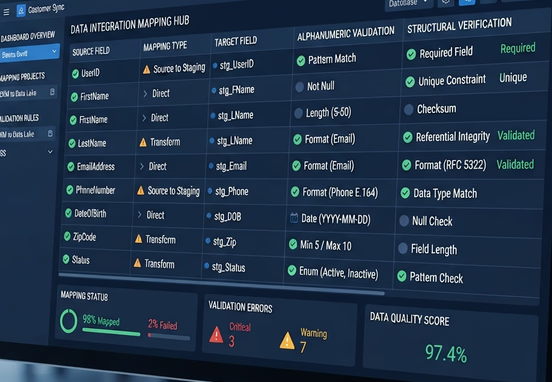
The Structural Data Verification Matrix
To ensure absolute consistency across decentralized software services, engineering teams must maintain a centralized, clear mapping matrix that outlines exactly how data properties are verified, what failure boundaries exist, and what automated recovery events trigger when a parameter deviates from expected business standards.
| Targeting Field Name | Explicit Primitive Type | Enforced Business Boundaries | Automated Recovery Action upon Exception |
|---|---|---|---|
transaction_amount | Integer (Stored in Cents) | Must be greater than zero; cannot exceed max single-charge transaction limit. | Immediate thread termination; reject invoice update; flag profile for fraud audit. |
customer_email | String (RFC 5322 Standard) | Maximum length 254 characters; must pass strict regex pattern validation match. | Sanitize string whitespace; strip illegal characters; reject if pattern remains broken. |
discount_code | Alphanumeric | String must exist inside active coupon ledger; current UTC timestamp must be valid. | Strip code from payload; re-calculate total balance at base price; log adjustment code. |
inventory_sku | String | Must match an existing, active product record within the local warehouse database. | Isolate payload; trigger real-time stock alert; push order state to back-office review. |
billing_cycle_days | Integer | Explicit range constraint between minimum 1 and maximum 365 calendar days. | Force value reset to standard default interval; append structural system alert note. |

Defensive Failure Containment and Exception Management
When an automated validation pipeline flags a corrupted payload or identifies an internal data discrepancy, the application code must handle the exception with absolute containment. Allowing a script error to bubble up unhandled through your execution chain will lock up critical system resources, exhaust database connections, and create unexpected system blackouts that impact unrelated business modules.
Building self-healing web ecosystems requires constructing isolated runtime boundaries that safely absorb exceptions and redirect broken assets into isolated diagnostic vaults without interrupting the wider web application. Implementing a resilient framework driven by the bulletproof web pipeline: how custom error controls and smart fallbacks prevent system blackouts provides your engineering teams with the technical blueprints needed to maintain continuous platform uptime and manage unexpected processing exceptions gracefully.
System Architecture Tip
Always route un-validated or rejected data payloads to a dedicated, isolated dead-letter queue (DLQ) rather than purging the records from your servers completely. Preserving the raw, broken JSON strings within a secure vault allows your software development teams to audit structural bugs, run diagnostic post-mortems, and re-inject modified payloads safely once underlying edge-case flaws are resolved.
Furthermore, because enterprise transactions occasionally require custom handling paths that drift from standard automated sequences, your pipeline code must feature distinct tracking rules to document irregularities without corrupting core application ledgers. Developing dedicated logging protocols and reviewing how to document exceptions when an order deviates from the standard web workflow ensures that custom corporate agreements, shipping overrides, and atypical checkout pipelines are audited with complete transparency without destabilizing the core validation logic.
Real-Time Monitoring, Anomaly Detection, and Long-Term Integrity
Enforcing strict data validation at the point of ingestion is only half the battle; maintaining long-term data integrity requires continuous, real-time monitoring of your production databases to detect logical drift and structural anomalies. An automated anomaly detection engine operates as an asynchronous background utility that sweeps database tables on a continuous loop, checking for mathematical variations, broken foreign key references, or suspicious volume spikes that might indicate an internal system leak.
To safeguard your corporate records completely from catastrophic hardware errors or unhandled system corruptions, your validation architecture must be supported by automated, high-frequency data backup schedules. Integrating automated maintenance workflows designed to automatically back up business data and system logs every night guarantees that your organization can restore its transactional data to a verified, uncorrupted state instantly if an edge-case script error ever slips past your primary validation guardrails.
Moving away from fragile, multi-hop middleware aggregators and visual tools gives your security teams complete, unmediated control over these diagnostic pipelines. Transitioning to custom, independent server-side integrations allows scaling enterprises to eliminate arbitrary usage taxes, maximize processing velocities, and retain absolute ownership over their system logging environments. Organizations that realize their technical platforms are outgrowing basic visual tools can successfully future-proof their operations by actively bypassing the Zapier tax to secure total platform sovereignty.
Eradicating Capital Leaks via Advanced Systems Engineering
Deploying an automated data validation pipeline is an absolute operational necessity for any scaling enterprise focused on protecting its profit margins and ensuring long-term platform stability. By eliminating silent data mutations, enforcing strict multi-layered filtering guardrails, and managing exceptions inside secure boundaries, you insulate your critical business platforms from software vulnerabilities and secure complete control over your digital revenue channels.
Designing, securing, and scaling these advanced data validation frameworks requires specialized backend software engineering, strict relational database coordination, and deep system mapping. Partnering with professional software architects ensures your verification pipelines are engineered to handle complex enterprise workflows with absolute data accuracy and total security.
For corporations focused on taking absolute ownership of their digital infrastructure and maximizing operational performance, utilizing professional custom workflow and systems automation services provides the technical expertise needed to deploy secure, high-performance data pipelines that eliminate capital leaks, protect sensitive information assets, and support long-term digital growth.