

Bypassing the Zapier Tax: 5 Signs a Growing Business Has Outgrown Basic Automation Plugins

Early-stage enterprises frequently adopt visual, no-code integration tools to stitch together disparate cloud platforms during initial launch phases. These visual builders and basic automation plugins serve a vital role when validating a business model, allowing operations teams to map out simple data transmissions without waiting for dedicated software development cycles. This architectural choice is highly functional when transaction volumes remain minimal and workflow logic is completely linear.
As an organization experiences real market scale, these temporary connection layers quickly transform into severe operational bottlenecks. The structural vulnerabilities of third-party automation software present themselves through inflated subscription bills, hidden data processing limits, unpredictable execution delays, and unhandled system failures. This transition point marks the boundary where a company outgrows generic data bridges and must invest in custom, sovereign data infrastructure.
Continuing to run high-volume enterprise operations through low-tier, visual automation middleware introduces an unnecessary recurring expense commonly known as the Zapier tax. Bypassing this operational premium involves migrating your core integration loops from external visual interfaces into native, server-side code pipelines. Recognizing when your technical infrastructure has reached its breaking point is critical to protecting your corporate profitability, ensuring long-term platform stability, and maintaining absolute control over your business data.
Sign 1: The Ballooning Operational Bill (The Task Fee Scalability Wall)
The most immediate and undeniable indicator that your enterprise has outgrown generic automation plugins is the exponential rise in your monthly software subscription invoices. Most visual integration platforms utilize a usage-based pricing model that bills your organization based on the total volume of individual tasks executed across their cloud servers. While this fee model appears negligible when running a few hundred transactions per month, it penalizes your business directly for scaling its sales operations.
In a standard no-code environment, a single customer order rarely consumes just one task. Ingesting a web form submission, creating a contact card within an internal CRM, formatting a line-item invoice, pushing a status notification to a company communication channel, and logging the event in a spreadsheet can easily consume five to ten tasks per transaction. If your business scales to processing thousands of orders monthly, your execution counts scale into the hundreds of thousands, forcing your organization into premium pricing tiers that extract thousands of dollars annually for basic data routing.
| Total Monthly Orders | Average Steps Per Flow | Total Monthly Tasks Incurred | Estimated Middleware Platform Tax | Custom Native Serverless Compute Cost |
|---|---|---|---|---|
| 500 | 6 Steps | 3,000 Tasks | $30 - $49 / month | Less than $0.05 / month |
| 2,500 | 6 Steps | 15,000 Tasks | $100 - $150 / month | Less than $0.25 / month |
| 10,000 | 8 Steps (Enriched) | 80,000 Tasks | $300 - $450 / month | Less than $1.50 / month |
| 50,000 | 10 Steps (Enterprise) | 500,000 Tasks | $1,200 - $1,800 / month | Less than $7.50 / month |
By replacing these visual data layers with proprietary backend code deployed on modern serverless cloud environments, your transactional compute costs drop to near zero. Custom integrations communicate directly with core APIs, running calculations within milliseconds and bypassing the artificial volume markups imposed by external software vendors. Transitioning to direct server-side pipelines allows scaling organizations to heavily optimize their financial parameters, ensuring you actively lower your cost per transaction while freeing up capital to invest back into core product engineering.

Sign 2: Brittle Task Chains and Unhandled Cascading Outages
Visual automation tools operate on highly generalized code structures designed to accommodate the lowest common denominator of web applications. Because these platforms prioritize visual simplicity over structural depth, they lack the robust error-handling mechanisms required to manage real-world web exceptions safely. When an external software provider updates its API schema or experiences a temporary network drop, a multi-step visual chain will typically break mid-execution, leaving your data in a fractured, half-processed state.
This structural vulnerability causes expensive cascading outages across your operational ecosystem. For instance, if step four of a six-step automation chain fails due to a temporary network timeout, the visual middleware platform often drops the remaining payload entirely without rolling back the previous three operations. Your operations staff are then forced to manually audit database rows, isolate unfulfilled orders, and clean up duplicate records within your internal software systems to fix the systemic desynchronization.
Operational Strategy Tip
If your team spends more than two hours per week manually restarting failed automation loops, re-running dropped webhooks, or fixing out-of-sync database rows across your business tools, your platform has officially outgrown basic plugins. Your architecture requires deterministic error boundaries written directly in native application code.
Building a secure, enterprise-grade digital environment requires implementing absolute error containment layers that safeguard data integrity during unexpected hardware interruptions. Deploying custom, server-side data infrastructure based on the bulletproof web pipeline: how custom error controls and smart fallbacks prevent system blackouts provides your engineering teams with the technical blueprint needed to safely isolate script failures, log system exceptions locally, and run automated data validation loops without dropping critical customer payloads.
Sign 3: Critical Data Ownership and Compliance Blind Spots
Routing your sensitive corporate data through third-party integration platforms introduces substantial data compliance liabilities into your enterprise. When a customer executes a purchase or submits an inquiry on your website, their personal identifiers, financial data points, and proprietary communication text are transmitted to the middleware vendor's servers before reaching your destination database. The external vendor parses, processes, and frequently logs copies of these raw JSON strings within their cloud data centers.
This lack of structural isolation poses severe regulatory alignment risks, particularly for scaling organizations navigating strict international data privacy rules like GDPR, CCPA, or HIPAA. Entrusting your operational data pipeline to an intermediate software broker means your business compliance posture is entirely dependent on that vendor's internal security controls and data retention policies. If the intermediary platform suffers a data breach or an interior configuration exploit, your company remains legally liable for the exposure of your consumers' private records.
Transitioning away from visual integration plugins to direct, proprietary code paths ensures your business retains absolute sovereignty over its digital intelligence. Constructing independent, server-to-server data pipelines allows your security officers to enforce field-level encryption, restrict storage geographies, and eliminate external logging vectors. Reviewing an architectural primer like why custom api pipelines guarantee data ownership (and the critical features to look for) helps insulate your core assets from intermediate vulnerabilities while establishing deep operational transparency across your entire digital network.
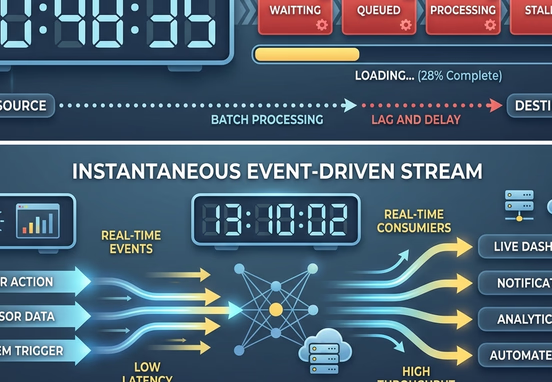
Sign 4: High System Latency and Lack of Real-Time Event Handling
Many basic automation plugins and visual tools do not operate on true, real-time data streaming frameworks. Instead, they rely on scheduled background checking routines known as API polling to monitor for system updates. This means that when a customer updates an administrative file or submits an urgent service ticket on your digital portal, the visual middleware tool waits for its next scheduled interval—which can range from 5 to 15 minutes depending on your subscription tier—before pulling that information into your operational systems.
This built-in processing delay degrades the user experience and slows down internal fulfillment cycles. In a high-velocity market, waiting fifteen minutes to route an enterprise lead, update an active inventory balance, or process a cancellation request creates damaging operational frictions that drop conversion rates. When you attempt to shorten these checking intervals within visual builders to achieve real-time performance, you quickly breach external API rate limits, triggering automated account blocks from your primary software tools.
The structural flow diagram below illustrates how an optimized, custom event pipeline completely eliminates the latency, data steps, and middleware taxes introduced by old-fashioned visual automation tools:
[Legacy Fragmented Middleware Setup]
[Web Interface Event] ──> [API Polling Check (5-15 Min Delay)] ──> [Middleware Data Center] ──> [Target ERP Ledger]
                                                                                                    │
                                                                                (Accumulated Per-Task Billing Tax Incurred)

[Sovereign Custom Data Pipeline]
[Web Interface Event] ────────────────────────────────────────────────────────────────────────────> [Target ERP Ledger]
                                 │
                                 ├─ (Instantaneous Push via Secure Micro-Payload)
                                 ├─ (Zero Latency Execution via Event-Driven Code)
                                 └─ (100% Free of Third-Party Middleware Processing Fees)
Achieving true, sub-second data synchronization across your digital assets requires abandoning legacy polling patterns and engineering direct, push-based communication lines. Integrating high-speed, event-driven architectures driven by custom webhooks enables your systems to broadcast structured information packages the exact millisecond an event occurs. This operational shift removes processing latency entirely, eliminates wasteful server check loops, and ensures your systems scale cleanly without hitting linear cost barriers.
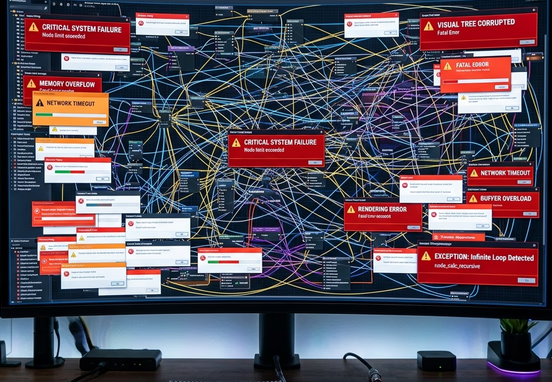
Sign 5: Reaching the Structural Limits of Conditional Logic Boundaries
Visual automation interfaces are explicitly engineered to handle straightforward, single-direction operational sequences. While they can accommodate elementary filtering and basic conditional splitting, they collapse under the weight of complex enterprise workflow demands. As your organization grows, your data pipelines must frequently evaluate multi-layered business rules, manage divergent operational pathways, track long-term state changes, and run advanced data transformations simultaneously.
Attempting to build these advanced conditional matrices inside a visual editor results in a tangled, unmaintainable web of nested visual blocks that are nearly impossible to audit, document, or test safely. Visual tools lack true programmatic loops, advanced array manipulation utilities, row-level database locking mechanisms, and native sandboxes for testing system logic. When your operations require complex array parsing or multi-tier database evaluations, relying on visual plugins forces your team to resort to messy, unsecure script patches that introduce deep technical debt.
Building a sustainable, high-performance web architecture demands that your automation paths be anchored in deterministic, clean code patterns. Establishing your software integrations around native trigger-action logic provides your development teams with complete programming freedom. This structural independence allows your engineers to write highly optimized conditional branches, execute parallel data transformations, and deploy self-healing system state machines that scale smoothly alongside your enterprise operations.
Deploying Sovereign Systems Architecture for Long-Term Scale
Migrating your growing business away from fragile visual plugins and eliminating the recurring Zapier tax is an essential milestone in your enterprise maturity timeline. Taking complete ownership of your data infrastructure by deploying proprietary, direct-to-destination API pipelines removes artificial scaling taxes, protects sensitive customer records from third-party interception, and ensures your internal platforms function at maximum speed with total reliability.
Designing, securing, and maintaining these advanced, direct-to-destination system architectures requires specialized backend software engineering, strict database coordination, and deep system mapping. Partnering with professional software architects ensures your migration from no-code tools to custom cloud pipelines is executed seamlessly without interrupting your active revenue operations.
For enterprises focused on taking absolute ownership of their digital infrastructure and achieving peak operational efficiency, utilizing professional custom workflow and systems automation services provides the technical expertise needed to deploy secure, high-performance direct API pipelines that eliminate middleman platforms, minimize processing overheads, and build long-term structural value for your growing business.