

Custom Website vs Link-in-Bio Tools (Carrd & Linktree): Stop Sending Your Traffic to Other Brands
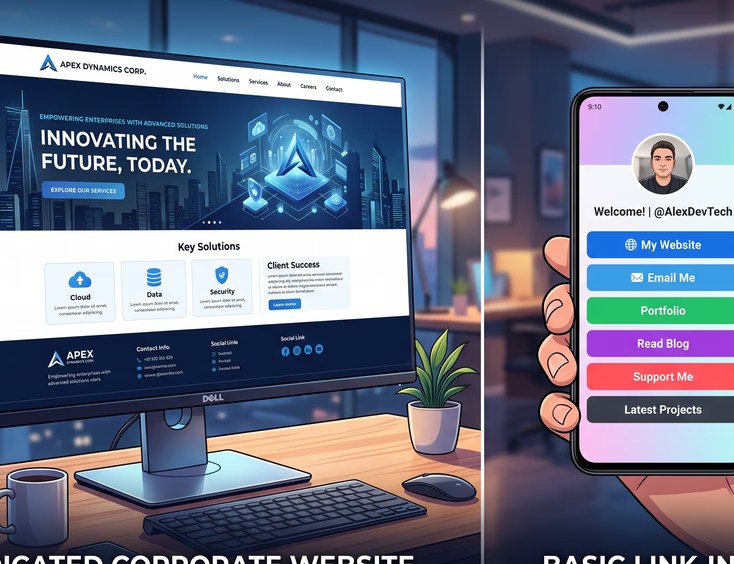
You are building your business on rented land. Every time you point a potential customer, client, or follower to a tool like Linktree or Carrd, you are actively giving away your most valuable digital asset: website traffic.
These tools are built for convenience. They offer a fast way to put a link in your social media bio. But that convenience comes at a massive cost to your brand, your search engine rankings, and your bottom line. You are sending people away from your world and into a standardized, limited environment controlled by another company.
Here is a complete breakdown of exactly why relying on landing page builders and link-in-bio tools hurts your business, and why owning a custom website is the only way to protect your digital real estate.
The Problem with Link-in-Bio Tools (Linktree)
Linktree and similar tools serve one basic function: they hold a list of links. They were created to solve a specific problem on platforms like Instagram that only allow one link in a profile. However, businesses have started using them as a replacement for an actual website. This is a critical mistake.
You Are Promoting Their Brand, Not Yours Look at the URL of a standard Linktree. It says "linktr.ee/yourname". You are not sending people to your business. You are sending them to Linktree’s business. Every click you generate builds their domain authority, not yours.
Traffic Leaks Are Built Into the Design At the bottom of almost every link-in-bio page is a button that says "Create your own Linktree." This is a traffic leak. Your hard-earned social media followers click your link to learn about your products, but they get distracted by the tool itself. You are acting as a free billboard for another software company.
Zero Design Identity A brand is built on consistency. Colors, fonts, spacing, and imagery all matter. With a tool like Linktree, you are forced into a rigid grid of buttons. Even on paid plans, the customization is minimal. Your page looks exactly like the pages of millions of other users, including teenagers, hobbyists, and massive corporations. There is no way to stand out.
High Bounce Rates A "bounce" happens when someone visits a page and leaves without taking action. Link-in-bio tools suffer from massive bounce rates. People click the link, see a boring list of buttons, get overwhelmed, and close the window. Because there is no context, no engaging copy, and no compelling imagery to hold their attention, they leave.
The Problem with One-Page Builders (Carrd)
Carrd is often seen as a step up from a basic link tree. It allows you to build single-page websites. It looks slightly more professional and offers more design flexibility. But it is still a temporary fix, not a long-term business solution.
The "One Page" Limit Kills Growth Carrd is designed to be a single page. If your business grows, you cannot easily add a dedicated blog, a robust online store, or complex service pages. You are forced to cram all your information onto one scrolling page. This creates a cluttered, overwhelming experience for the user.
Domain Name Confusion While you can connect a custom domain to a paid Carrd account, many users stick with the free version, leaving them with a ".carrd.co" URL. Just like Linktree, this looks unprofessional. It signals to potential customers that you are not willing to invest in your own business infrastructure.
Limited Functionality Carrd is great for displaying static text and images. It is terrible for running a real business. If you need a booking system, a dynamic portfolio, an e-commerce checkout, or a client portal, Carrd cannot handle it effectively. You end up linking out to a dozen different third-party tools, creating a messy, disjointed experience for your customers.
The Speed Illusion Carrd pages load fast because they are simple. But as you try to force the tool to do things it was not designed for—like adding heavy images, embedding videos, or linking third-party widgets—the performance drops. You have no control over the underlying code to fix these speed issues.
Search Engine Optimization (SEO) Destruction
SEO is how people find you on Google. If you want free, organic traffic from search engines, you cannot rely on landing page tools. They actively prevent you from ranking.
Building Authority on the Wrong Domain Google ranks websites based on "domain authority." The more traffic, backlinks, and content a domain has, the higher it ranks. When you use a free Linktree or Carrd URL, you are pouring all your social media traffic into their domain. You are helping them rank higher on Google, while your actual brand remains invisible.
No Room for Content Google reads words to understand what a page is about. Link-in-bio tools have almost no words. They are just buttons. Carrd pages have more words, but since everything is on one page, Google gets confused. It does not know if the page is about your consulting services, your new book, or your podcast. A custom website allows you to create separate pages for every topic, making it easy for Google to rank you for specific searches.
Metadata Limitations Metadata is the hidden text that tells search engines what your page is about. It controls what shows up in Google search results (the blue link and the description below it). Custom websites give you total control over the metadata for every single page, image, and blog post. Landing page tools restrict this heavily. You get one global title and description, making it impossible to target multiple search terms.
The Backlink Blackhole A backlink is when another website links to yours. This is the strongest signal to Google that your site is important. If a blogger writes about your business and links to your Linktree, that SEO value goes entirely to Linktree. You gain zero long-term search value from that mention.

Data Ownership and Analytics Failure
To grow a business, you need to understand your audience. You need data. Renting a landing page means giving up control of that data.
Basic, Pointless Metrics Tools like Linktree give you "vanity metrics." They tell you how many people clicked a link. That is not enough information to run a business. You do not know where those people live, what kind of phone they use, how long they stayed on the page, or what they did after clicking.
The Missing User Journey With a custom website, you can track the entire user journey. You can see that someone landed on your homepage, read your "About" page, looked at three different products, and then abandoned their cart. This allows you to fix problems in your sales process. On a one-page tool, there is no journey. It is a dead end.
Retargeting Nightmares If someone visits your website and leaves, you can run ads to them on Facebook or Google using a "pixel" (a piece of tracking code). While some paid landing page tools let you add a pixel, the data is heavily restricted. Because the user is technically on a third-party platform, the tracking is easily blocked by privacy updates. On a custom website, you control the server and the code, giving you the most accurate tracking legally possible.
Who Owns the Audience? When you rely on third-party platforms, you do not own your audience. If Carrd or Linktree goes offline, changes their rules, or deletes your account by mistake, your entire digital storefront vanishes in a second. When you own a custom website, you own the database, the customer list, and the traffic data. No one can take it away from you.
The Psychology of Brand Trust
People buy from brands they trust. The digital tools you use send immediate, subconscious signals to your customers about the health and legitimacy of your business.
The "Side Hustle" Stigma Fair or not, using a generic link-in-bio tool signals that your business is a hobby. It looks like a side hustle. If you are charging premium prices for your services or products, a basic landing page destroys your credibility. Customers think, "If they cannot afford a real website, how good can their service be?"
The Professional Standard A custom website shows that you are established. It proves you have invested time, money, and effort into your business. It provides a sense of permanence. When a potential client visits a fast, beautifully designed custom website, their trust in your brand instantly increases. They are more likely to submit an inquiry, make a purchase, or hand over their email address.
Security Concerns When people click a link on Instagram and are taken to a third-party site full of random buttons, they get skeptical. Phishing scams and spam links often use these exact tools. A custom website with a proper SSL certificate (the little padlock next to your domain name) reassures visitors that they are in a safe, secure environment.
Design and Conversion Rate Optimization (CRO)
Getting traffic is only half the battle. Converting that traffic into paying customers is the goal. Landing page tools fail completely at conversion rate optimization.
Friction in the Sales Funnel A good website guides the user naturally toward a single goal: buying a product, booking a call, or joining a list. Every element is placed intentionally to remove friction. Link-in-bio tools do the opposite. They present the user with a massive list of equal choices. When faced with too many choices, the human brain freezes. This is known as decision fatigue. They click nothing and leave.
Lack of Context and Copywriting People need to be persuaded to click a link. They need to know what is in it for them. A standard landing page tool only gives you enough space for a few words per button. You cannot use compelling copywriting. A custom website allows you to use headlines, bullet points, testimonials, and video to sell the click before the user ever has to make a decision.
Mobile Optimization on Your Terms While tools like Carrd are mobile-friendly, they use generic breakpoints. This means the layout simply squishes down to fit a phone screen. A custom website allows for true mobile optimization. You can hide certain elements on mobile, change font sizes specifically for smaller screens, and redesign the navigation menu so it is actually usable with a thumb.
Visual Storytelling Your brand has a story. You need high-quality images, carefully chosen colors, and specific layouts to tell that story. Rented tools force your story into their predetermined boxes. A custom website is a blank canvas. You design the environment to match the exact emotion and message you want your brand to convey.

The Trap of "Cheap and Easy"
The main reason businesses avoid custom websites is the perceived cost and effort. They choose the "cheap and easy" route. But this is a mathematical fallacy.
The Subscription Bleed Linktree and Carrd offer free versions, but to remove their branding or add basic features, you have to pay a monthly or yearly fee. Over two to three years, you end up paying hundreds of dollars. What do you have to show for it? Nothing. You still do not own the asset. You are just renting space.
The Cost of Lost Opportunities This is the biggest hidden cost. If a generic landing page costs you just one high-ticket client a month because you looked unprofessional, that tool is not "free." It is costing you thousands of dollars in lost revenue. A custom website acts as a 24/7 sales representative, actively capturing leads that a cheap tool would lose.
The Inevitable Migration Every successful business eventually outgrows a one-page tool. It is guaranteed. When that day comes, the migration process is painful. You have to rebuild your SEO from scratch, update every single link on your social media profiles, and retrain your audience on where to find you. Building a custom website from the beginning prevents this massive future headache.
What Real Ownership Looks Like (The Custom Website Advantage)
Moving away from rented tools means taking full control of your digital presence. When you invest in a custom website, the dynamics of your business change completely.
Absolute Control Over the Code With a custom website, there are no artificial limits. If you want a specific animation when someone scrolls, you can have it. If you want to integrate a complex third-party software directly into your page, you can do it. You are not waiting for a platform to release a new feature; you can build it yourself.
A Centralized Digital Hub Your custom website becomes the undisputed center of your business. All your marketing efforts—social media, email campaigns, podcast appearances, and physical flyers—point back to a single destination that you own. This centralizes your traffic, compounds your SEO authority, and creates a clear, undeniable home for your brand.
Scalability Without Friction A custom website grows exactly as your business grows.
- Need a blog to capture search traffic? Add it in minutes.
- Launching physical merchandise? Install an e-commerce platform.
- Starting a private membership group? Build a secure login portal. The foundation is already there. You simply build new rooms onto your digital house instead of trying to move to a new house every time you need more space.
True Asset Value A business is valued based on its assets. A custom website with steady traffic, strong SEO rankings, and an active customer database is a highly valuable, sellable asset. A Linktree account has absolutely zero resale value. When you build a custom site, you are putting money back into your own pocket by increasing the total valuation of your company.
The Technical Reality of Custom Builds
Understanding the underlying mechanics of a custom site shows exactly why it outperforms landing page tools in every metric.
Server Independence When you use a shared tool, you share their server space. If their server goes down because another user went viral, your site goes down too. With a custom website, you choose your hosting provider. You can select premium, dedicated hosting that ensures your site stays lightning-fast and online, regardless of what anyone else is doing.
Advanced Caching and Speed Custom websites allow for complex speed optimization. You can implement caching (storing a static version of your site so it loads instantly for returning visitors), minify code, and serve images through a Content Delivery Network (CDN). These technical tweaks are impossible on locked platforms, but they are essential for keeping impatient users from clicking the "back" button.
Custom API Integrations An API allows two pieces of software to talk to each other. If you want your website to automatically send a text message to your phone when someone fills out a contact form, and then instantly add that person to a specific email sequence, you need custom API integrations. Landing page builders offer basic connections, but custom websites allow for infinite automation, saving you hundreds of hours of manual labor.
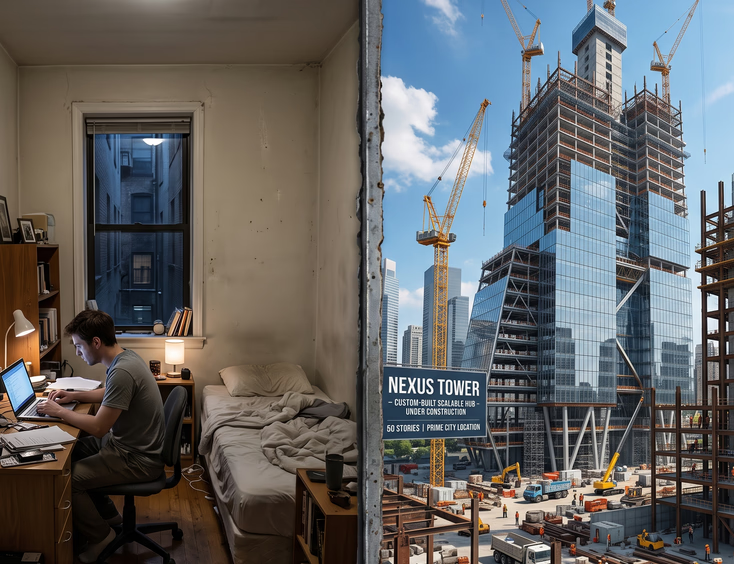
Breaking Down the Features: Rented vs Owned
Content Management Systems (CMS)
- Rented Tools: You get a static editor. You change text in a box, and it updates on the page. It is simple but highly restrictive.
- Custom Website: You get a robust CMS. You can categorize content, tag posts, create custom post types (like a portfolio or a recipe directory), and manage thousands of pages effortlessly without touching a single line of code once it is set up.
User Roles and Permissions
- Rented Tools: You log in, or you do not. Giving your virtual assistant or a freelancer access means handing over your main password.
- Custom Website: You can create specific user roles. You can allow a writer to publish blogs, but prevent them from changing the site design. You can allow an accountant to view sales data, but block them from editing customer profiles. This is basic security that rented tools ignore.
Global Styles vs Individual Tweaks
- Rented Tools: Changing a button color often changes every button on the page. You cannot easily make one specific button stand out without breaking the entire layout.
- Custom Website: You dictate the global rules, but you can override them at any time. You can design a completely unique landing page for a specific ad campaign that looks entirely different from your homepage, all while remaining on your own domain.
Why Social Media Platforms Hate Your Custom Website
There is a reason social media platforms heavily restrict links. Instagram, TikTok, and Twitter want to keep users on their platforms for as long as possible so they can show them more ads.
The Outbound Link Penalty Platforms actively suppress the reach of posts that contain links taking people off the app. Link-in-bio tools were a workaround, but platforms have adapted. They now open these links in "in-app browsers."
The In-App Browser Trap When someone clicks your Linktree inside Instagram, it does not open Safari or Chrome. It opens Instagram’s custom browser. This browser is slow, clunky, and often breaks tracking pixels. It also keeps the user trapped inside the social media app.
Escaping the App Environment A custom website fights back against this. Because you control the code, you can use scripts that prompt users to "Open in System Browser" or design pages that function flawlessly even inside the restricted in-app environment. You can capture their email address quickly, securing a direct line of communication that social media algorithms cannot touch. Once you have their email, you no longer need the social platform to reach them.
The Exact Moments You Are Losing Money
You might think a basic tool is "good enough for now." But here is exactly where the money is bleeding out of your business every single day you delay building a real website.
The Comparison Shopper A potential client is looking for a service. They open your profile and your competitor's profile. Your competitor has a fast, sleek custom website with testimonials, a clear service breakdown, and an easy booking form. You have a Carrd page with three generic buttons. The client closes your page immediately. You just lost a sale without ever knowing the person existed.
The Media Opportunity A journalist or podcaster is looking for an expert in your field. They want to link to your website in their show notes or article. If they see a Linktree, they will often skip you and find someone else. Media professionals need to link to authoritative sources. Rented domains are not authoritative. You lose the free press and the valuable backlink.
The Missed Search Intent Someone goes to Google and types "local [your service] near me." Because you do not have a custom website with localized SEO, you do not show up. A competitor gets the click. You lose a hot lead who was actively holding their credit card, ready to buy.
Rethinking the "Link in Bio" Strategy
If you have a custom website, you do not need a third-party link-in-bio tool. You simply build a dedicated, hidden page on your own website.
The Custom Link Page Strategy Instead of sending traffic to "linktr.ee/yourbrand", you send them to "yourbrand.com/links".
Immediate Benefits of the Custom Link Page
- You capture 100% of the domain authority.
- The user is instantly immersed in your actual brand colors, fonts, and navigation.
- Your tracking pixels fire accurately, recording the visit for future ad retargeting.
- If they want to learn more, they don't have to click another link; they simply tap the menu bar and explore your full website.
Eliminating the Middleman By creating a links page on your own domain, you eliminate the middleman. You cut out the software company that is standing between you and your customer. The path from social media to your checkout page becomes shorter, cleaner, and entirely under your control.
The Final Reality of Digital Business
Running a premium business on generic landing page tools is like operating a luxury storefront out of a cardboard box. Your product might be elite, but your presentation destroys your credibility.
A custom website is not an expense—it is critical business infrastructure. It is the only digital asset you own completely free of algorithm shifts, platform updates, and third-party constraints.
Every day you dump hard-earned traffic into Carrd, Linktree, or rented templates, you build their business instead of your own. You are burning SEO rankings, muddying your brand, and bleeding revenue through invisible friction points.
Protecting your digital real estate requires real ownership. Stop settling for rented space and claim your territory with a custom web asset built exclusively to scale your revenue.
Ready to Leave Link-in-Bio Tools?
Stop pinning your unique business to a generic digital bulletin board that looks exactly like everyone else's.
Get Your Custom Website Today