

Trigger-Action Logic: The Foundation of Sustainable Web Automations

Enterprise automation frameworks often disintegrate under scale because they are constructed on fragile, unmonitored scripts rather than structured architectural primitives. At the absolute core of every sustainable digital system lies a deterministic design pattern known as trigger-action logic. This structural framework dictates that a system must remain completely dormant until a highly specific, verifiable event—the trigger—occurs within the environment. Once authenticated, this event immediately kicks off a series of calculated, isolated operations—the actions.
When web automations fail, the root cause is rarely a total blackout of the underlying servers. Instead, systems collapse due to architectural drift, unhandled data mutations, and racing conditions within poorly mapped execution loops. By anchoring your development strategy in strict trigger-action logic, you build decoupled pipelines where every event is tracked, every state transition is logged, and every operational consequence is completely predictable. This intentional engineering discipline converts erratic software behaviors into a transparent, self-healing digital infrastructure.
Building sustainable systems requires moving past visual drag-and-drop builders that hide structural errors behind friendly user interfaces. True operational scale demands that your engineers write clean, direct communication routines that interface natively with your core business platforms. Organizations can build a foundational understanding of how these back-end components establish secure, unmediated handshakes by analyzing the fundamental mechanisms of web requests to eliminate brittle software middleware completely.
The Structural Components of Trigger-Action Architecture
A sustainable automation pipeline is built on a clear three-part foundation: the event trigger, the conditional evaluation matrix, and the execution action payload. If any of these components are poorly defined, the entire pipeline becomes unstable. The trigger serves as the immutable data source, capturing a verified state shift within an application, such as an e-commerce checkout completion, an updated inventory field, or a client onboarding signature.
The conditional evaluation matrix functions as the system's gatekeeper, inspecting the incoming trigger data payload against explicit business rules before allowing the engine to allocate compute resources. If the payload values satisfy the structural constraints, the pipeline routes the data to the final phase: the action payload. The action executes isolated writes, mutations, or data updates across downstream operational ledgers.
Triggers as Deterministic State Changes
Triggers must never be abstract or ambiguous; they must represent a definitive, point-in-time mutation within a database. In web architecture, triggers generally present themselves in two primary formats: schedule-based inputs and event-based payloads. Schedule-based inputs rely on internal server clocks to evaluate system states at fixed intervals, while event-based payloads trigger instantly when a real-world user interacts with your system.
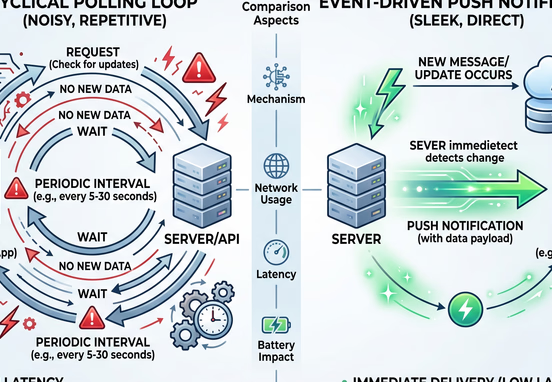
To build an efficient pipeline, event-based triggers should always be prioritized over continuous checking routines. Setting up a native event-driven architecture using custom webhooks ensures that your web application ingests incoming data streams instantly without exhausting system bandwidth on repetitive, empty database queries.
Actions as Idempotent Computations
The actions triggered by your automation pipeline must be engineered as idempotent operations. Idempotency guarantees that if a network glitch causes the exact same trigger payload to hit your server multiple times, the final state of your database remains identical to a single execution. Without strict idempotency boundaries, duplicated webhook events will result in catastrophic errors, such as double-billing invoices, multiplying client account records, or dispatching repetitive notification emails to users.
The Event-Driven Advantage: Webhooks vs. Polling Loops
Relying on old-fashioned data synchronization patterns like API polling degrades application speed and spikes operational expenses. Polling forces your application servers to actively query external endpoints on a continuous loop, asking if new data is available. This pull-based mechanism creates an expensive compute loop where up to 95% of outbound requests return zero updates, wasting CPU performance and causing unnecessary latency.
Switching to a push-based model using trigger-action logic completely eliminates this digital waste. The external application holds the data until a milestone is met, then instantly broadcasts the payload directly to your listener endpoint. This operational shift reduces your hosting overhead, guarantees zero-latency data transfer, and insulates your business platforms from external API rate limitations.
| Operational Layer | Brittle Polling Architecture | Sustainable Trigger-Action Pipeline |
|---|---|---|
| Compute Utilization | High; constant outbound API hits regardless of actual data changes. | Ultra-low; system resources remain completely idle until an event fires. |
| Data Synchronization Speed | Delayed; bound entirely to the arbitrary interval schedule of the loop. | Instantaneous; data transfers happen within milliseconds of the real-world event. |
| API Boundary Protection | Vulnerable; easily breaches external platform caps due to repetitive checks. | High; strictly consumes network resources when an authentic payload exists. |
| Fault Isolation Scope | Low; a failure mid-loop stalls the entire sequential querying process. | High; every event runs as an isolated thread that fails gracefully without systemic drops. |
Conditional Evaluation and Multi-Branch Action Matrices
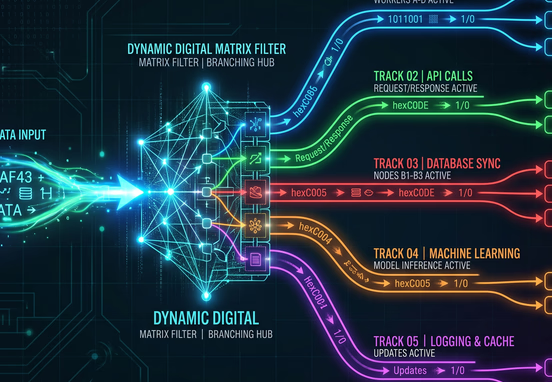
Advanced web automations require complex workflows that extend far beyond a basic, single-step pipeline. As business processes expand, a single event trigger must often kick off divergent, multi-layered operations based on the unique attributes contained within the initial payload. Designing this complex architecture requires building a highly structured conditional evaluation matrix directly into your backend code.
The system ingests the raw JSON payload, routes it through an isolated filtering layer, and evaluates the parameters using deterministic logic gates. If a parameter fails validation, the execution path terminates cleanly, preventing corrupt or irrelevant data from mutating downstream applications. If it passes, the pipeline fans out the data to parallel, asynchronous worker threads that execute specific workflows concurrently.
The flowchart below demonstrates how a single web form trigger is captured, evaluated through conditional logic filters, and dispatched across a multi-branch action matrix:
[Web Form Submission Event Captured]
                 │
                 ▼
    [Extract Raw JSON Payload]
                 │
                 ▼
  [Validate HMAC Cryptographic Signature]
                 │
                 ├─► (Signature Invalid: Drop Payload & Log Alert)
                 │
                 └─► (Signature Valid: Advance to Conditional Matrix)
                               │
                               ▼
            [Evaluate Payload Attribute: "Lead Type"]
                               │
                 ┌─────────────┴─────────────┐
                 ▼ (Value = "Enterprise")    ▼ (Value = "SMB")
        [Filter: ARR > $50k]           [Filter: ARR < $50k]
                 │                           │
           ┌─────┴─────┐                     ▼
           ▼           ▼ (Validation Fails) [Action: Route to CRM Queue]
   (Validation Passes) [Action: Route]       [Action: Trigger Email]
           │
           ▼
   [Action: Route to Executive Slack]
   [Action: Enrich Profile via API]
   [Action: Dispatch SMS to Account Exec]
Managing Complex State Machines Safely
When an automation pipeline handles multi-step operations, your system must track the state of the workflow continuously using a persistent database layer. If an action fails on step three of a five-step sequence, the system must not restart the entire pipeline from scratch upon recovery. Implementing an explicit state machine allows your automation engine to save progress logs at every milestone, ensuring it can resume precisely where the interruption occurred.
Mitigating System Failure through Strict State Boundaries
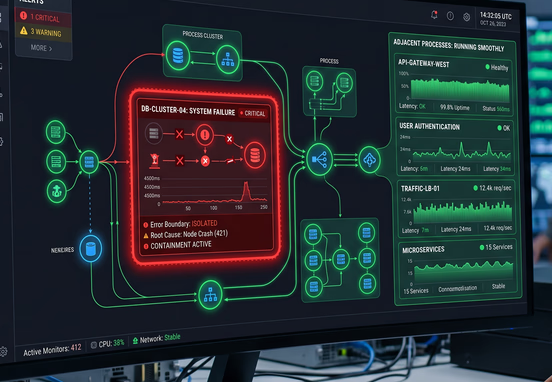
A sustainable automation network must be engineered to anticipate system exceptions. When a downstream application experiences a service blackout or an API endpoint returns a database connection error, your trigger-action pipeline must isolate that failure immediately. If your system lacks explicit error boundaries, a single failed action script can trigger a cascading error that stalls your entire application server.
Building self-healing systems involves deploying robust error management protocols across your entire web architecture. Implementing custom error controls and smart fallbacks provides your engineering teams with the architectural blueprints needed to safely isolate exceptions, maintain application uptime, and ensure absolute data consistency during unexpected network drops.
Systems Architecture Tip
Always decoupling your trigger ingestion from your action execution by using an intermediate message broker queue. This guarantees that if a downstream API fails, the trigger payload remains safely preserved in the queue, allowing the system to retry the action once the destination system comes back online.
Bypassing Intermediate Middleware for Architecture Longevity
Relying on external drag-and-drop integration tools to manage corporate workflows introduces massive security exposures and heavy financial liabilities. These third-party applications charge variable per-execution fees that penalize your enterprise for scaling, while locking your proprietary business logic inside a closed, proprietary environment that you do not own and cannot thoroughly audit.
True data sovereignty requires building direct, native API integrations that communicate straight with your internal databases. Enterprises that realize they are outgrowing basic automation plugins can successfully migrate their pipelines to dedicated, serverless environments to gain complete control over their transactional lifecycles, eliminate recurring middleman taxes, and heavily secure their enterprise intelligence.
Furthermore, building independent pipelines ensures that your proprietary data paths are completely insulated from third-party system vulnerabilities. Designing direct integrations based on why custom api pipelines guarantee data ownership (and the critical features to look for) enables your security officers to maintain strict compliance with global privacy regulations while maximizing operational speeds.
Engineering Sustainable Automations at Scale
Transitioning your enterprise away from fragile, unmonitored integration scripts and moving toward structured trigger-action logic is a critical step toward establishing total digital independence. By anchoring your automation workflows in deterministic design patterns, you eliminate system downtime, maximize data accuracy, and build an agile technical architecture that scales smoothly alongside your business operations.
Designing, securing, and scaling these direct-to-destination system networks demands deep software engineering expertise, precise system mapping, and rigorous quality assurance testing. Partnering with specialized automation developers ensures your system pipelines are engineered for maximum uptime, speed, and long-term security.
For organizations focused on taking complete ownership of their digital infrastructure and driving peak operational efficiency, utilizing professional custom workflow and systems automation services provides the technical expertise needed to deploy secure, high-performance trigger-action pipelines that eliminate middleman platforms, safeguard critical information assets, and protect long-term digital growth.