
How Token Shields Keep System Authentication Keys Secure
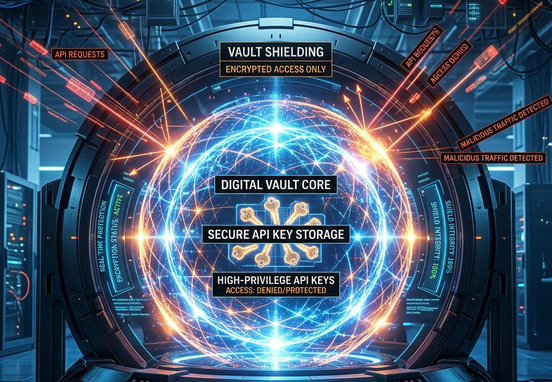
The security of an enterprise web infrastructure hinges entirely on how effectively it isolates its authentication credentials. When multi-system networks communicate, they utilize high-privilege API keys, bearer tokens, and cryptographic secrets to pass through system firewalls. If these credentials are exposed to unauthorized environments, the entire corporate ecosystem is compromised. Malicious actors can exploit exposed credentials to hijack backend tools, download proprietary consumer records, and execute damaging data-wiping commands.
Many engineering teams inadvertently expose their authentication keys by hardcoding them directly into application code bases, storing them in plaintext configuration files, or leaving them viewable within distributed repository logs. Once a high-privilege token is committed to a shared repository, it becomes a permanent liability that can easily leak during code audits or system compromises. Eliminating these structural vulnerabilities requires deploying a localized, hardened abstraction layer known as a token shield architecture.
A token shield decouples active software processes from the raw secret values themselves. Instead of allowing web applications to read plaintext keys directly from environment configurations, a shield framework abstracts credential storage into an isolated, encrypted hardware vault. The web application receives temporary, low-privilege reference tokens that must pass through strict runtime validation checks before granting short-lived access to target external platforms.
The Structural Mechanics of a Token Shield Architecture
A robust token shield operates by converting static, high-value credentials into dynamic, single-use or heavily time-bounded access payloads. The core engine is built on an isolated server node completely separated from the public-facing web infrastructure. When your primary website engine needs to transmit data to an external CRM or automated billing portal, it never handles the master API key. Instead, the application makes an internal request to the shield engine, passing along strict contextual metadata.
The token shield evaluates the incoming internal request against localized identity parameters, verifies that the thread is executing within authorized network boundaries, and retrieves the necessary master key from an encrypted memory cluster. The shield engine then signs the outbound network payload on behalf of the application, completely preventing the web framework from directly exposing the core authentication keys to transient application memories or unsecure system logs.
- Isolated Storage Cryptography: Secures all master access credentials at rest using high-grade field-level encryption algorithms, ensuring keys remain unreadable even if the underlying physical disks are compromised.
- Dynamic Key Abstraction: Swaps static authentication values for randomized reference strings that contain zero semantic meaning to potential intruders sniffing local network traffic.
- Ephemeral Runtime Windows: Configures token validation parameters to expire automatically within short, predefined time windows, rendering intercepted tokens completely useless within minutes.
- Outbound Signature Proxies: Intercepts outbound web requests, appends the necessary security headers on a protected server layer, and prevents plaintext keys from ever sitting inside application-side memory stacks.
The Token Shield Request Authorization Loop
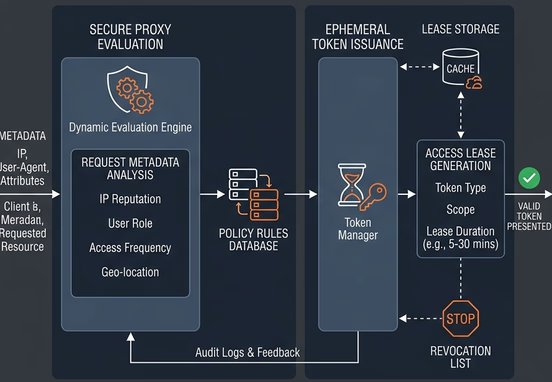
The operational lifecycle of a token shield relies on a strict, event-driven verification pipeline. When a background worker or web controller triggers an external database update, it must first obtain a temporary execution lease from the local vault proxy. The vault proxy inspects the request parameters, validates that the operation matches the application's current security posture, and dynamically issues a tokenized access block.
To ensure absolute system safety, the shield must log every single access attempt across an immutable local file network. If a process attempts to request a credential outside of regular operating schedules or from an unverified internal IP address, the token shield intercepts the execution thread, denies access to the key pool, and immediately dispatches an urgent system alert to your security operations team.
The flowchart below demonstrates how a token shield safely isolates master API keys, evaluates incoming internal requests, and appends necessary authentication headers on a secured proxy layer:
[Application Worker Triggered]
               │
               ▼  (1. Requests Temporary Lease with App Metadata)
[Token Shield Local Vault Proxy]
               │
               ▼  (2. Evaluates Contextual Security Rules)
  [Identity & Network Verification]
               │
               ├─► (Verification Fails: Terminate Thread & Log Security Alert)
               │
               ▼ (Verification Passes)
[Decrypt Master Key in Isolated Memory Storage]
               │
               ▼  (3. Compiles Signed Payload Headers)
 [Outbound Encryption Signature Proxy] ──> 4. Intercepts Outbound Traffic
               │
               ▼  (5. Transmits Fully Authenticated Payload)
[Target External Software Platform API]
Safeguarding Local Validation Threads
When a token shield issues an ephemeral runtime lease, the application code must process the resulting payload asynchronously within an isolated scope. Forcing web servers to store decrypted access tokens inside global variables or long-lived system caches creates dangerous physical exploit vectors. Enforcing strict thread-level containment ensures that if a single web process encounters a fatal script crash, the transient memory footprint containing the access block is completely purged from your server.
Least-Privilege Scoping and Cryptographic Access Matrices
A common failure point in enterprise architectures is utilizing a single master API key to govern all integrations across an entire software ecosystem. If your website uses the exact same high-privilege credential to pull product inventory counts and delete customer profiles, a vulnerability in your public storefront exposes your entire back-office ledger to total manipulation. A sustainable token shield mitigates this risk by enforcing strict role-based access control (RBAC) matrices across all key stores.
By implementing granular, least-privilege scoping, your development team restricts every integration token to the absolute minimum volume of endpoints required to fulfill its specific task. If a script's sole responsibility is routing prospective web form inputs, its abstracted token payload is strictly blocked from executing read or delete actions against adjacent financial or user profile tables.
| Application Identity | Requested Data Endpoint | Permitted HTTP Methods | Enforced Token Scope Limits |
|---|---|---|---|
| Storefront Inventory Worker | /api/v1/inventory/* | GET | Read-only inventory array access; completely blocked from price updates. |
| Lead Form Processor | /api/v2/contacts | POST | Insert-only record creation; zero permission to read or modify existing entries. |
| Client Invoicing System | /api/v1/billing/invoices | GET, POST, PATCH | Complete ledger management; isolated strictly to billing tables within single business unit. |
| HR Onboarding Script | /api/v3/employees/* | GET, POST | Profile initialization parameters; zero permission to alter core payroll routing. |
To manage these complex permissions matrices cleanly without building fragile script wrappers, your foundational integration code must be anchored in clear, deterministic logic patterns. Building your software bridges around native, highly resilient data structures driven by trigger-action logic provides your development teams with the structural boundaries needed to enforce consistent scoping rules across every automated workflow event.
Designing an Automated Key Rotation Pipeline
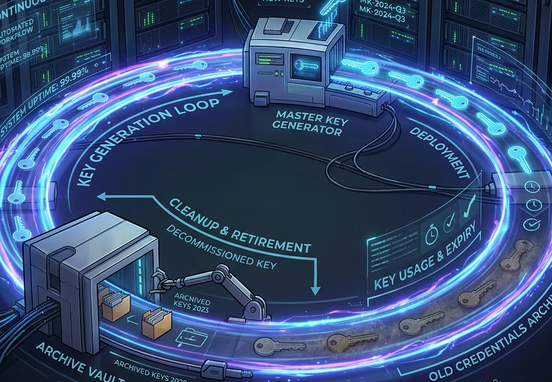
Even the most heavily encrypted access token becomes a security liability if it remains unchanged for years. If an old API credential accidentally leaks into an old backup file or is cached within an un-monitored log server, it remains an active backdoor into your company infrastructure until it is explicitly revoked. Mitigating this risk requires building an automated, zero-downtime key rotation pipeline that swaps master credentials on a continuous, scheduled loop.
An automated rotation pipeline uses scheduled worker routines to generate a new master key at the provider level, update the internal token shield storage vault, verify the new credential passes local connectivity tests, and instantly deprecate the old key string. This entire sequence must execute seamlessly without requiring manual developer configuration updates or triggering connection drops across your active user portals.
Security Architecture Tip
Always configure your key rotation pipeline to maintain a short overlapping grace window where both the newly generated token and the immediately previous credential remain simultaneously valid. This layout ensures that any long-running asynchronous worker threads can complete their active network operations without encountering sudden authentication failures mid-transit.
Building these advanced automated lifecycles directly within your operational infrastructure allows you to protect your business data sovereignty while actively maintaining a highly secure custom subscription engine or transactional billing framework completely free of third-party software interferences.
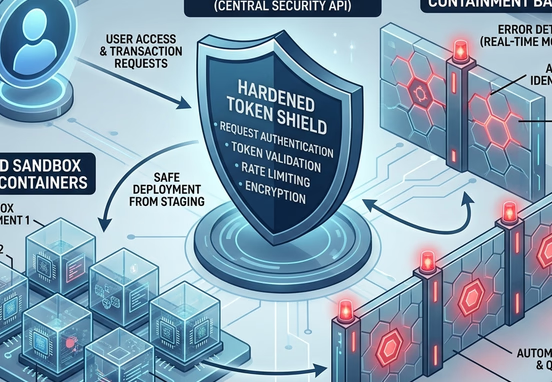
Interlocking Token Shields with Sandbox Environments and Fault Protections
A token shield architecture must be thoroughly verified across all stages of your software delivery pipeline to ensure that test environments never accidentally execute actions using live production credentials. If a developer runs a local testing script that mistakenly loads live API keys from an unsecure environment file, the script will mutate real-world business assets, resulting in severe data corruption.
To prevent these accidental data drops, engineering teams combine token shields with completely isolated testing containers. Learning how developers safely test automated web networks in sandbox environments provides your software teams with the technical blueprint needed to create secure local mock servers that safely simulate key validation checks without any risk of production data exposure.
Furthermore, because token shields introduce an additional checkpoint into your network routing path, your system must feature robust error-containment boundaries to manage connection timeouts gracefully. If the shield engine experiences a localized hardware delay or an external API provider encounters a sudden blackout, your core web application must handle that exception safely without dropping user transactions.
Building these defensive, self-healing system layers requires deploying specialized error management protocols across your entire software infrastructure. Implementing the bulletproof web pipeline: how custom error controls and smart fallbacks prevent system blackouts provides your engineering teams with the architectural frameworks needed to securely buffer payloads, isolate script exceptions, and execute intelligent retry loops automatically when connection channels encounter temporary drops.
Bypassing Third-Party Exploits to Secure True Data Sovereignty
Relying on generic external data aggregators or visual integration plugins to move company data means trusting those external vendors to protect your master authentication credentials. When you save a high-privilege API token inside a third-party visual builder, that token resides within an external database environment that your security teams cannot control, audit, or thoroughly harden. If that integration vendor suffers a major security breach, your system backdoors are immediately exposed.
True digital security requires moving past intermediate data brokers and engineering proprietary, direct-to-destination system pipelines. Transitioning to independent server-side architectures allows your security officers to take absolute ownership of your corporate security posture, maximize data processing speeds, and insulate your business from external platform risks. Organizations that recognize they are outgrowing basic visual tools can successfully protect their intellectual property by actively bypassing the Zapier tax to achieve long-term platform stability.
By taking absolute control of your programmatic pipes, you ensure that sensitive corporate data points are processed strictly within your own secure perimeter. Building independent connections and understanding why custom api pipelines guarantee data ownership (and the critical features to look for) helps secure your core assets from intermediate vulnerabilities while establishing deep operational compliance across your entire digital network.
Hardening Enterprise Infrastructure for Long-Term Security
Deploying a custom token shield architecture completely removes the risks associated with plaintext credential storage, hardcoded keys, and third-party data exposure. By abstracting master credentials into isolated vaults, enforcing granular least-privilege scoping, and automating your key rotation cycles, you build an agile, high-security data network that scales cleanly alongside your business operations.
Designing, securing, and maintaining these advanced cryptographic system shields requires specialized backend software engineering, precise systems orchestration, and rigorous penetration testing. Partnering with professional platform architects ensures your security frameworks are engineered to withstand complex modern exploits with absolute safety.
For enterprises focused on taking absolute ownership of their digital infrastructure and maximizing platform security, utilizing professional custom workflow and systems automation services provides the technical expertise needed to deploy secure, high-performance token shields that eliminate middleware vulnerabilities, safeguard critical information assets, and protect long-term digital growth.