

The Bulletproof Web Pipeline: How Custom Error Controls and Smart Fallbacks Prevent System Blackouts

Enterprise web applications routinely collapse under high utilization spikes because their underlying networks lack defensive runtime boundaries. When an internal application tries to update a database or talk to an external API, it expects a flawless response. When that communication pathway drops out, an unhandled exception propagates back through the execution thread, locking server resources and causing a systemic outage.
Preventing these catastrophic system failures requires moving beyond basic error logging frameworks and engineering a resilient web pipeline. A bulletproof data network assumes that every network hop, external server integration, and database query will eventually fail. By embedding explicit error control boundaries and automated fallback routines directly into your backend code base, you insulate your primary digital assets from external vulnerabilities and maintain operational continuity.
Many organizations inadvertently construct brittle data environments by relying on generic third-party middleware configurations that offer minimal error management. When an intermediate application layer stalls, it drops data payloads invisibly, creating massive synchronization discrepancies between front-end interfaces and back-office databases. Shifting to direct, proprietary server-side architectures allows engineering teams to deploy structured error controls, ensuring you maintain absolute operational stability even during severe external infrastructure drops.
The Anatomy of an Unhandled Exception Cascade
To build a self-healing web network, you must first understand how a single unhandled script error escalates into a complete application blackout. In a standard synchronous web setup, when a customer submits a request, the server executes a sequential list of operations. If step three in that sequence involves communicating with an external customer platform that happens to be experiencing a network timeout, the application server hangs while waiting for a connection response.
Without explicit timeout rules and try-catch protective wraps, the server thread remains open indefinitely, consuming memory and locking active database rows. As concurrent users continue to access the system, open connection threads rapidly accumulate, exhausting your web server's available thread pool. Within minutes, the entire application engine drops offline, returning generic gateway timeout messages to every user across your digital ecosystem.
The Core Ingestion and Isolation Pipeline
A bulletproof web architecture protects system stability by strictly decoupling incoming data ingestion from downstream processing. When an event fires, the primary ingestion listener validates the request payload, writes the raw string instantly into a high-speed message queue, and immediately returns a success code to the sender. This step ensures that network latency or downstream failures never block your user interface threads.
Once the data payload is securely held within your local message queue, asynchronous worker processes pick up the task to run the necessary mutations. If a worker encounters an unhandled exception during execution, the error containment logic isolates that specific processing thread, pushes the failed payload into a dead-letter queue for diagnostic review, and allows the remaining concurrent workers to clear the primary queue without interruption.
The flowchart below illustrates how an optimized custom error pipeline safely intercepts, isolates, and routes failed transaction payloads without interrupting the wider web application:
[Incoming Event Transaction Payload]
                     │
                     ▼
       [Primary Ingestion Listener]
                     │
                     ├─► (Validates Payload & Returns HTTP 200 OK Instantly)
                     │
                     ▼
       [Push Raw Payload to Message Queue]
                     │
                     ▼
         [Asynchronous Worker Thread]
                     │
                     ▼
         [Execute Database Mutation]
                     │
            ┌────────┴────────┐
            ▼ (Execution Safe)▼ (Execution Exception Interrupted)
      [Commit Write]    [Trigger Catch-Block Containment Layer]
      [Purge Queue]           │
                              ▼
                        [Isolate Affected Thread Environment]
                              │
                              ▼
                        [Extract Payload & Write to Error Ledger]
                              │
                              ▼
                        [Initiate Graceful Fallback Logic Matrix]
                              │
                              ▼
                        [Route Broken Asset to Dead-Letter Vault]
Designing Idempotent Catch Blocks
When catch blocks execute fallback routines or prepare data for automated retries, your application logic must be explicitly engineered to be idempotent. Idempotency guarantees that if an error handling sequence runs multiple times on the exact same dataset, it yields the identical system state without creating duplicate records. This capability is critical for preventing double-billing errors or multiplying user records within your internal database layers.
Implementing Smart Fallbacks and Degraded Operation States
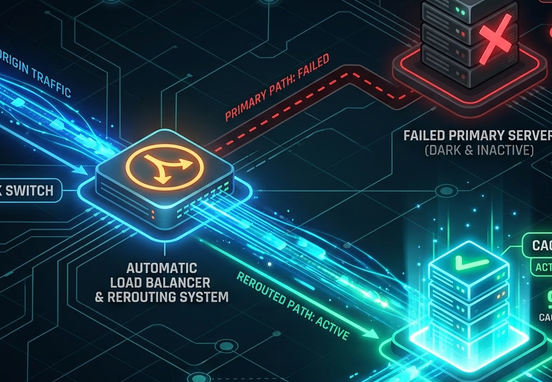
True application resilience does not require every feature to work perfectly all the time; it requires your system to fail gracefully by entering structured, degraded operational states. If your primary relational database hits its connection limit or an external search engine goes offline, your pipeline should automatically drop back to secondary, read-only cache layers or localized storage engines. This mechanism keeps your core user interface functional while tech teams resolve the underlying root cause.
| Active Component | Primary Operational Pathway | Custom Automated Fallback Logic | Business Preservation Impact |
|---|---|---|---|
| Payment Processing Gateway | Real-time token clearing via primary processor API endpoints. | Securely capture transaction token, route payload to localized queue, queue for delayed retry. | Preserves active checkout conversions; eliminates customer cart abandonment. |
| Inventory Engine | High-velocity live database lookup across global warehouse tables. | Fallback to high-speed local memory cache holding state configurations from one hour prior. | Maintains product display visibility; prevents checkout pages from dropping offline. |
| Customer CRM Sync | Synchronous push using real-time event-driven connection frameworks. | Dump lead metadata into isolated transactional table; tag row for delayed asynchronous batch sweep. | Prevents customer web forms from locking up; insulates front-end from CRM dropouts. |
| Document Generation Engine | Server-side PDF generation tools compiling files dynamically. | Issue localized temporary web access page; queue background renderer to deliver document via email. | Eliminates network execution timeouts; protects web server memory allocations. |
Deploying these graceful degraded states across your web assets ensures that your internal systems continue to function reliably under stress, allowing you to anchor your entire enterprise framework in highly stable trigger-action logic to handle complex data processing loops safely.

Asynchronous Retries and Exponential Backoff Metrics
When a custom system pipeline encounters a temporary network dropout or a soft server decline, executing an immediate, aggressive retry loop will exhaust your network bandwidth and trigger automated firewall blocks. A bulletproof error management pipeline utilizes asynchronous background retries governed by strict exponential backoff metrics and randomized jitter calculations. This approach ensures your application retries connections intelligently without overloading strained resources.
Exponential backoff logic tells the system worker thread to wait progressively longer after each successive failure event before attempting to reconnect to the destination API node. For example, if the initial failure window waits two seconds, the subsequent intervals scale to four, eight, and sixteen seconds. Injecting randomized jitter into this mathematical equation varies the retry timeline slightly across concurrent workers, preventing thousands of stalled processes from hammering your internal endpoints at the exact same millisecond.
Architecture Strategy Tip
Always cap your automated retry sequences at a maximum of three to five attempts over a twenty-four-hour timeline. If a network node fails to respond after five structured attempts, the system must permanently stop processing that specific thread, mark the ledger record as blocked, and immediately escalate the asset to your internal engineering team for manual intervention.
Integrating these self-healing capabilities directly within your data processing layers helps safeguard company assets while allowing you to detect system errors and automate data validation before bad data corrupts your core business tables. Furthermore, routing your streaming events through native, secure push channels like custom webhooks provides your web ecosystem with the low-latency communication needed to process transactional errors without intermediate data dependencies.
Localized Logging, Real-Time Diagnostic Auditing, and Data Backups
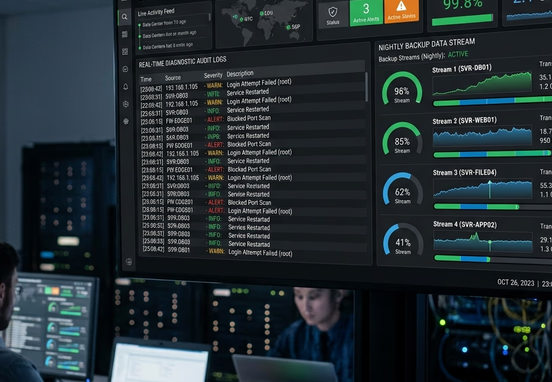
Building a bulletproof web pipeline requires complete structural transparency across your entire digital architecture. When your error controls isolate a failed execution thread, the application must log the precise system state, network headers, database queries, and stack traces into a dedicated, localized event vault. This data collection ensures your development teams can audit performance metrics and resolve edge-case vulnerabilities before they impact your broader operations.
Relying on external aggregation platforms to monitor your system health introduces substantial data privacy concerns, as these third-party platforms ingest raw error logs that frequently contain unmasked client profiles or financial variables. Transitioning to custom, internal logging engines guarantees your organization retains absolute control over its digital forensics while mitigating compliance risks. Organizations that realize they are outgrowing basic visual management plugins can successfully deploy sovereign architectures by actively bypassing the Zapier tax to achieve complete platform independence.
To secure your data assets completely against catastrophic hardware failures or database corruptions, your pipeline architecture must pair custom error controls with high-frequency automated backup routines. Establishing automated maintenance frameworks to automatically back up business data and system logs every night guarantees that even if a critical infrastructure cluster encounters an unrecoverable failure, your system can restore its operational ledgers to a verified state instantly without risking permanent data loss.
Hardening Your Digital Infrastructure for Ultimate Uptime
Transitioning your enterprise infrastructure away from fragile, unmonitored script structures and deploying a custom web pipeline with robust error controls is an essential requirement for long-term scalability. By isolating system exceptions, enforcing intelligent fallback paths, and managing your processing queues asynchronously, you eliminate the threat of unexpected system blackouts and protect your operational efficiency.
Designing, securing, and maintaining these advanced, self-healing data networks demands specialized backend engineering, deep architectural mapping, and rigorous quality assurance testing. Partnering with professional software architects ensures your systems are engineered to navigate unexpected runtime exceptions with absolute safety.
For enterprises focused on taking absolute ownership of their digital infrastructure and maximizing platform uptime, utilizing professional custom workflow and systems automation services provides the technical expertise needed to deploy highly secure, bulletproof web pipelines that eliminate middleman software fees, protect sensitive information assets, and support sustainable business growth.