

Custom Website vs AI Builders (Including Wix ADI): Why Algorithms Can’t Write Copy or Design UX

The promise of modern artificial intelligence website builders sounds like magic: type a short prompt, wait thirty seconds, and watch an entire digital storefront appear out of thin air. Tools like Wix ADI, Durable, and Framer AI have changed the conversation around web design. They promise to eliminate coding, erase design friction, and write all your marketing text with a single click.
But there is a massive gap between a website that exists and a website that sells.
AI website builders do not actually create anything from scratch. Instead, they act as high-speed sorting machines. They scan a rigid library of pre-built layouts, pick a color palette based on basic rules, and pull generic text blocks from large language models. The result is a fully functional web page that looks exactly like thousands of other pages on the internet.
For a hobbyist or a weekend side-project, this speed is a massive win. For a business trying to stand out in a crowded market, win customer trust, and drive revenue, it is a fast track to blending into the background.
How AI Builders Actually Construct Your Site
To understand why automated platforms fall short, you have to look under the hood. Platforms like Wix ADI (Artificial Design Intelligence) rely on predictive logic to assemble pages.
- The Questionnaire Phase: The tool asks for your business name, industry, and style preference (e.g., "Clean," "Bold," or "Professional").
- The Layout Selection: The algorithm matches your industry to a pre-set structural template. If you select "Real Estate," it pulls the standard real estate layout from its database.
- The Asset Drop: It inserts stock imagery based on your keywords and populates text boxes with generalized industry sentences.
[User Prompt: "Local Bakery"]
       │
       ▼
[AI Algorithm] ────► Scans Fixed Layout Database ────► Pulls "Food/Retail" Template
       │
       ▼
[Generates Generic Text + Stock Pastry Images] ────► Final Assembled Page
This process is called assembly, not design. True web design works in the exact opposite direction. It starts with your unique business goals, maps out your specific customer journey, and builds a visual interface around those unique variables. AI builders force your unique business identity into a pre-designed box.
The Copywriting Problem: Why Algorithms Write for Everyone and Appeal to No One
The text on your website is the engine of your sales process. It explains what you do, why you are better than the competition, and why a customer should hand over their hard-earned money.
AI writers work by predicting the most statistically probable next word in a sentence. Because they train on vast amounts of existing internet data, they are designed to produce the most average response possible.
The Trap of "Average" Marketing Text
When an AI writes copy for your website, it pulls from millions of other websites in your industry. This creates a loop of corporate buzzwords and empty phrases. You end up with a website full of sentences like:
- "We offer world-class solutions for your business needs."
- "Innovative strategies tailored to unlock your full potential."
- "We are committed to delivering excellence and driving synergy."
These sentences feel safe, but they say absolutely nothing. They fail to mention your specific process, your unique perspective, or the concrete benefits your customers experience. When your text sounds like every other company in your niche, you lose your competitive edge.
The Absence of Customer Empathy
Effective copywriting requires deep emotional empathy. You must understand the exact frustration your customer feels at 2:00 AM when they need your service.
The Human Contrast: An AI knows that a plumbing website needs the word "pipe." A human copywriter knows that a homeowner with a flooded basement is panicked about property damage and needs to see a massive, reassuring "We arrive in under 45 minutes, guaranteed" headline the second they land on the page.
Algorithms cannot feel empathy, stress, pride, or relief. Because they cannot experience these emotions, they cannot write text that triggers them in your target audience.
The Inability to Conduct Real Competitive Analysis
An AI builder cannot call your past five clients to ask why they chose you over your biggest local competitor. It cannot browse your competitor's Google reviews to find out what their customers hate, allowing you to position your business as the perfect alternative. Human copywriters build messaging strategies based on market gaps; AI builds messaging based on market averages.

The UX/UI Trap: Aesthetics Without Strategy
User Experience (UX) is the science of how a website feels and functions, while User Interface (UI) is how it looks. A beautiful website that is confusing to navigate is just an expensive digital painting. AI builders excel at creating clean visual layouts, but they fail completely at strategic user experiences.
User Paths Are Not One-Size-Fits-All
Every business has a distinct conversion goal. A high-ticket B2B consulting firm needs a website that builds deep educational trust over multiple long-form pages before asking for a consultation call. A local junk removal service needs a fast, friction-free one-page site focused entirely on a phone number and an instant booking form.
AI tools apply uniform, rigid user flows to entire industries. They do not know if your specific audience prefers to read detailed case studies or watch short video breakdowns. They simply place elements where they traditionally go on standard web templates.
The Illusion of Clean Design
AI platforms are highly visual. They use white space, clean grids, and modern fonts to make a site look great on day one. But this design is fragile.
- Content Distortion: The moment you replace the AI’s short placeholder text with your actual product descriptions, the layout often breaks, text overlaps, or the visual balance vanishes.
- Accessibility Failures: Algorithms frequently miss critical web accessibility rules, such as color contrast ratios for visually impaired users or proper screen-reader navigation tags.
- The Mobile Breakdown: While AI sites claim to be fully responsive, their automated mobile translations often result in awkward text wrapping, massive un-skippable blocks of space, and hidden call-to-action buttons that kill mobile conversions.
Head-to-Head Comparison: Custom Agency Build vs. AI Builders
To see the long-term impact on your business growth, it helps to compare the foundational elements of both approaches side by side.
| Strategic Feature | AI Builder Platform (e.g., Wix ADI) | Custom Agency Design & Development |
|---|---|---|
| Messaging & Copy | Generated via historical averages; heavy use of generic industry buzzwords. | Crafted through customer interviews, competitor analysis, and brand positioning. |
| Visual Identity | Based on fixed layout configurations and standard font/color pairings. | Developed from scratch to reflect your unique brand personality and values. |
| Conversion Focus | Rigid, standard paths that assume every buyer follows the exact same journey. | Optimized layouts built around your specific target customer's buying behaviors. |
| SEO Architecture | Basic technical setups with bloated, automated code structures underneath. | Lean, hand-coded frameworks optimized for speed, search crawling, and custom schema. |
| Scalability | Hard ceiling on features; restricted to the platform's app store ecosystem. | Infinite growth potential; can integrate with any API, custom software, or data pipeline. |
| Data Ownership | Your site is locked into their ecosystem; cannot easily export to a new host. | You own 100% of the code, assets, and design files forever. |
The Invisible Technical Debt of Automated Platforms
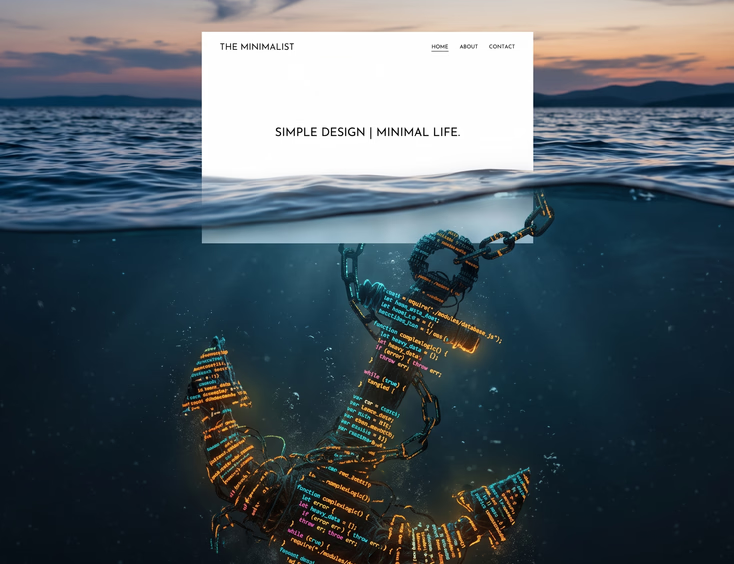
When you build on an automated platform, you pay a hidden tax that doesn't show up on your monthly invoice. In the software world, this is known as technical debt. It refers to the future problems you create when you choose an easy, automated shortcut today over a correct, long-term solution.
Bloated Source Code and Slow Page Speeds
For an AI builder to be flexible enough for anyone to use, its underlying code framework must include instructions for every single possible scenario. When a user visits your simple AI-generated page, their web browser still has to download thousands of lines of unnecessary code running in the background.
This code bloat dramatically slows down your website's loading speed. Search engines like Google prioritize fast-loading websites, especially on mobile devices. A two-second delay in page loading speed can cause your bounce rate to spike by over 100%, driving potential clients right back to the search results.
[Custom Code] ──────► Lean & Direct ──────► Fast Load Time ──► Happy User + High Google Rank
[AI Builder Code] ──► Bloated Framework ──► Slow Load Time ──► Lost User + Poorer Google Rank
The Closed Ecosystem Lock-In
Imagine your business grows rapidly over the next two years. You decide to launch a proprietary customer portal, integrate a custom loyalty program, or sync your site with an advanced enterprise CRM system.
With an AI builder, you hit a hard technical wall. You are restricted to what their specific plugin marketplace allows. If the platform does not support your specific tool, you cannot build a workaround. Your only option at that stage is to discard the entire website and pay to build it completely from scratch with a professional development team.
The Human Strategy Process: The Work That Happens Before Design
The biggest difference between an automated tool and an expert design team is what happens before a single pixel is placed or a single line of code is written. An AI starts building instantly because it has no strategy to consider. A professional digital agency spends weeks uncovering the core truths of your business.
Step 1: The Discovery Workshop
A human team digs deep into your business operations. They interview your leadership team to learn:
- Which of your services offers the highest profit margin?
- What are the most common objections your sales team hears from prospective buyers?
- Who is your absolute ideal customer, and what makes them click "buy"?
Step 2: Information Architecture Strategy
Instead of dropping standard navigation headers (Home, About, Services, Contact) onto a page, a UX strategist maps out information based on user intent. They group information logically so users can find the answers to their questions with the absolute fewest clicks possible.
Step 3: Psychology-Driven Wireframing
Wireframes are black-and-white structural blueprints of your website. Designers use them to organize information hierarchically. This ensures that the most compelling proof points—like case studies, reviews, data points, and guarantee statements—are placed exactly where your users' eyes naturally look as they scroll down the screen.
Search Engine Optimization: Beyond the Meta Tag
Many business owners believe that SEO is simply a matter of filling out a few keyword boxes provided by their website builder. While those basic configurations matter, true search visibility runs much deeper.
Search engines want to deliver the absolute best answer to a user’s search query. They evaluate your content using a framework known as E-E-A-T: Experience, Expertise, Authoritativeness, and Trustworthiness.
AI builders struggle heavily with the E-E-A-T framework:
- Duplicate Perspectives: Because AI writers scrape existing content, your text offers no new insights. Search engine crawlers can easily recognize generic text patterns and will rank unique, firsthand expert insights much higher.
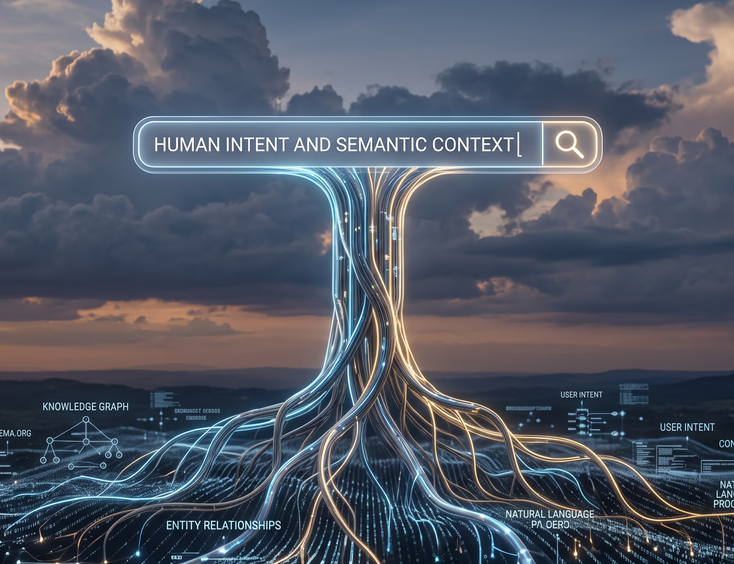
- Weak Schema Implementations: Advanced SEO requires structured data (schema markup) coded directly into your page templates. This code tells search engines exactly what your data means (e.g., distinguishing a product price from a phone number). AI systems use automated, generalized schemas that rarely match the precise needs of your local business setup.
- Poor Internal Linking Logic: A human SEO strategist intentionally links your blog posts, service landing pages, and case studies together to pass authority across your site. AI tools lack the contextual awareness to build these strategic internal networks naturally.
The True Cost of a Cheap Digital Presence
It is incredibly easy to justify using an AI builder when you look at upfront costs. A subscription to an automated builder costs a fraction of the investment required to hire a professional website design and development agency.
But you must calculate the opportunity cost. This is the amount of revenue you lose out on by choosing the cheaper option.
A Real-World Conversion Example: Consider a service-oriented business where the average client contract is worth $5,000.
- The AI Website Approach: The site looks clean but generic. It gets 1,000 visitors a month, but converts just 0.5% of them due to average copy and a confusing user flow. That results in 5 leads, or $25,000 in potential monthly business.
- The Custom Agency Approach: The site features highly targeted copy, lightning-fast speeds, and a frictionless mobile layout. It gets the same 1,000 visitors, but converts them at a modest 3% rate. That results in 30 leads, or $150,000 in monthly business.
By saving a few thousand dollars upfront on your web build, you could easily leave six figures of potential revenue on the table every single month. Your website isn't an administrative overhead cost; it is your 24/7 digital sales representative. If you send a generic, robotic representative out to meet your clients, you will get generic, minimal results.
Finding Your Path: When AI is Enough vs. When You Need an Agency
To be completely direct, there are specific scenarios where an AI builder is perfectly acceptable. Understanding where your business sits on this spectrum prevents you from making an expensive misstep.
When an AI Website Builder Makes Perfect Sense:
- The Concept Validation Stage: You are testing a brand-new business idea and need to see if anyone is even interested before spending capital.
- The Single-Event Page: You need a simple informational landing page for a local charity run, a wedding, or a temporary weekend gathering.
- The Digital Business Card: Your business operates 100% on personal word-of-mouth referrals, and you simply need a web page that confirms your phone number and address exist.
When a Custom Agency Build is Mandatory:
- You Are Scaling Ad Spend: You are paying hard earned money for Google or Meta ads. Sending paid traffic to an unoptimized, low-converting AI layout wastes your ad budget.
- You Operate in a Competitive Niche: You need to stand out against dozens of local or national competitors who offer similar services.
- You Have a Long or Complex Sales Cycle: Your customers require education, deep trust, and structured proof before they commit to buying from you.
- You Rely on Organic Search Traffic: You want your business to rank consistently at the top of Google searches for high-intent industry terms.
The Human Verdict
Algorithms process data, generate drafts, and speed up mechanical tasks. They are efficiency tools, nothing more.
A high-performing website is not a mechanical product. It is your brand’s digital home, a psychological journey for your prospects, and a custom marketing engine built to drive revenue.
Algorithms cannot understand human emotion, analyze market nuances, or craft a distinct brand voice. They build cheap webpages in seconds, but they cannot build a brand that resonates. To turn casual clicks into loyal customers, you need human strategy, human insight, and a fully custom website engineered to convert.
Ready to Leave AI Builders?
You shouldn't have to fight a blind robot just to make your business stand out from a sea of identical clones.
Get Your Custom Website Today