

Data Minimization: A Guide to the Essential Information Web Forms Actually Need

Corporate digital operations frequently suffer from a systemic fixation on data accumulation. For years, marketing teams, analytics divisions, and product managers have operated under the unverified assumption that collecting more user data points invariably yields better business intelligence. This unmonitored data hoarding manifests prominently within public web interfaces, where web forms are routinely bloated with dozen-field conversion gates asking for job titles, corporate headcounts, geographic zip codes, phone numbers, and arbitrary consumer preferences.
This structural bloat introduces severe operational friction and technical debt across your digital ecosystem. Every additional input field embedded within a public web form directly degrades conversion rates, increases user abandonment metrics, and multiplies the surface area for data serialization errors. From an engineering perspective, processing extensive, unvalidated form payloads creates massive database overhead and vulnerabilities. Unchecked strings must be continuously parsed, sanitized, stored, and protected across your entire multi-system infrastructure network.
True platform scalability demands a strict commitment to data minimization. Data minimization is an intentional engineering framework that dictates an organization must only collect, process, and retain the absolute minimum volume of user data necessary to complete a specific transactional milestone. By executing an aggressive audit of your front-end ingestion systems and stripping out non-essential input parameters, you transform fragile, over-engineered web forms into streamlined, high-speed data pipelines that maximize application security, lower hosting overhead, and improve the user conversion landscape.
The Compliance and Security Imperatives of Minimal Ingestion
Operating an enterprise web framework that continuously ingests non-essential personal identifiers creates massive compliance liabilities and financial risks. Under modern international regulatory structures such as the General Data Protection Regulation (GDPR) in Europe and the California Consumer Privacy Act (CCPA), data minimization is no longer a design preference—it is an absolute statutory requirement. These regulatory structures enforce the principle that personal data must be adequate, relevant, and strictly limited to what is necessary in relation to the purposes for which they are processed.
If your enterprise website collects and stores user phone numbers or physical home addresses simply to deliver a basic digital product newsletter, your organization is operating in direct violation of global privacy mandates. In the event of an external regulatory audit or a customer Subject Access Request (SAR), your engineering teams must map, compile, or permanently delete every single historical string instance across your entire database cluster. This manual compliance auditing consumes significant engineering hours and introduces deep operational overhead.
Furthermore, every non-essential data parameter you store within your production ledgers represents an active vulnerability waiting to be exploited during a data breach. If an external threat actor executes a SQL injection exploit or compromises a public-facing cloud storage bucket, the severity of the financial leak is determined entirely by your historical ingestion choices. If your database contains only randomized reference IDs and masked metadata strings, the impact of the exploit is neutralized. If your database is filled with plaintext phone numbers, personal titles, and geographical metrics, your company faces multi-million dollar regulatory penalties and immediate brand erosion.
Shifting to a minimalist ingestion architecture enables your security officers to maintain an airtight compliance posture while drastically shrinking your corporate data attack surface. To achieve complete platform independence and protect critical information assets from external exposures, organizations must decouple their data paths from third-party systems. Designing direct, native pipelines and analyzing why custom api pipelines guarantee data ownership (and the critical features to look for) provides your technical teams with the foundational mechanics needed to enforce absolute data minimization boundaries across your entire application architecture.
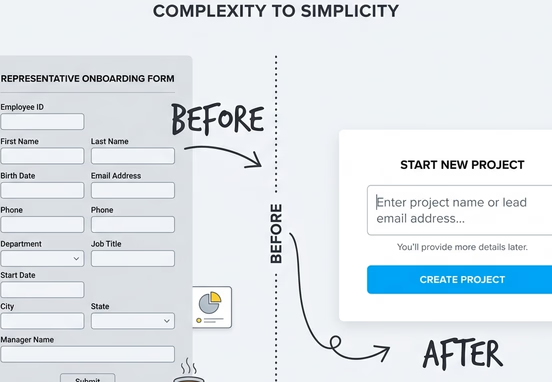
Engineering the Minimalist Web Form Blueprint
Transitioning to a high-performance minimalist interface requires removing all non-essential inputs from your active web forms. Your development team must audit every lead capture wall, e-commerce checkout loop, and client onboarding portal to separate structural data dependencies from visual noise. If an input field cannot be linked directly to an immediate, automated server-side action, it must be permanently purged from the front-end user code.
The table below outlines the core differences between traditional, bloated enterprise data forms and optimized, minimalist ingestion layers built for long-term scalability and security compliance:
| Intended Business Workflow | Legacy Bloated Ingestion Setup (High Friction) | Optimized Minimalist Blueprint (Zero Waste) | Primary Structural Replacement Mechanism |
|---|---|---|---|
| B2B Lead Generation Gate | Full Name, Job Title, Company Name, Employee Count, Corporate Budget, Phone Number, Country. | Corporate Email Address Only. | Asynchronous Enrichment API Lookup using the domain suffix of the verified email payload. |
| E-Commerce Checkout Loop | Billing Address, Shipping Address, Credit Card Number, Expiration Date, CVV Security Code, Phone, Account Notes. | Encrypted Third-Party Payment Token, Single Verified Shipping Destination String. | Abstracted Payment Gateways passing secure, tokenized validation strings to internal queues. |
| Client Support Portal | Customer Name, Account ID, Ticket Urgency Level, Operating System Version, Browser Type, Full Text Description. | Account ID Vector, Categorized Issue Type Dropdown, Upload Field for Structural Log Files. | Automated Session Token Parsing extracting system metadata directly from active user headers. |
| User Account Initialization | Username, First Name, Last Name, Date of Birth, Gender, Password, Password Confirmation String. | Verified Email Address, Unique Alphanumeric Cryptographic Passkey. | Native WebAuthn protocols or isolated authentication handlers passing unique user hashes. |
By standardizing these minimalist form layers across your web assets, you drastically simplify your back-end database operations. Eliminating unstructured data entries prevents input text from corrupting active relational tables. Ensuring your incoming strings are completely sanitized and well-formed allows you to easily run automated validation routines, helping you detect system errors and automate data validation before bad data corrupts your downstream business software.

The Minimization Ingestion and Enrichment Architecture
Enforcing data minimization on the front-end does not mean your operations teams must operate completely without contextual business intelligence. Instead of forcing human users to manually type their corporate profile parameters into an eleven-field form, your engineering teams must leverage automated background enrichment pipelines. The web form acts as an ultra-lightweight ingestion gate that captures a single, verified primary identifier—such as a corporate email address—and hands that parameter to an isolated background processing network.
The ingestion engine processes the micro-payload, commits it instantly to an asynchronous message broker queue, and releases the front-end interface thread within milliseconds. A downstream background worker process extracts the single parameter from the queue, executes an outbound API request to a trusted, specialized data enrichment service, parses the returning structured JSON payload, and appends the necessary business parameters straight to your internal CRM ledger.
The technical workflow diagram below demonstrates how a minimalist, single-field web form captures user intent and utilizes asynchronous enrichment streams to safely populate back-office databases behind the scenes:
[User Submits Web Form: Single Input Field]
                     │
                     ▼
       [Primary Ingestion Endpoint]
                     │
                     ├─► (Validates Email Format & Returns HTTP 202 Instantly)
                     │
                     ▼
       [Push Raw Micro-Payload to Queue]
                     │
                     ▼
        [Asynchronous Worker Process]
                     │
                     ▼
       [Query Enterprise Data Enrichment API]
                     │
         ┌───────────┴───────────┐
         ▼ (Enrichment Match)    ▼ (No Match Found)
   [Parse Structured JSON] [Set Standard Default Flags]
         │                       │
         └───────────┬───────────┘
                     │
                     ▼
   [Execute Contextual Business Rule Matrix]
                     │
                     ▼
   [Commit Secure, Enriched Record to CRM Ledger]
   [Release Relational Database Row Locks Safely]
Managing Asynchronous Enrichment Latency Safely
When offloading data compilation to background enrichment workers, your system architecture must treat the incoming data stream as potentially un-synchronized. If a downstream worker takes several seconds to pull enrichment metrics from an external API, your internal platforms must not stall while waiting for the response. The system must process the core user interaction using the primary token immediately, allowing the background data enrichment loop to update the secondary ledger attributes asynchronously without blocking active business lifecycles.

Core Strategies to Modernize Data Ingestion Pipelines
Implementing a data minimization framework requires your development team to deploy advanced programmatic alternatives that replace manual user inputs with automated, server-side data extraction routines.
- Leverage Secure IP Geolocation Buffers: Stop asking users to manually select their country, state, or timezone from a drop-down menu. Your server-side ingestion scripts can parse the incoming connection's IP address against a localized database to extract geographic metrics with complete privacy protection.
- Deploy Relational Cross-Reference Keys: Instead of forcing users to type their internal account numbers or corporate contract details during support inquiries, utilize active session tokens to look up the primary key relations directly within your relational database mapping files.
- Transition to Single-Field Full Name Inputs: Split-field forms that require separate inputs for titles, first names, middle initials, and last names introduce severe array tokenization problems. Utilize a single input field for full name parameters and store the string as an atomic unparsed token.
- Enforce Strict Character Limitation Envelopes: Set absolute maximum byte allocations across every form field on the client side. Restricting text fields to precise limits prevents malicious actors from transmitting massive string blocks designed to trigger database buffer overflows.
To ensure these modern data extraction steps execute without affecting your application speed, your integration paths must be built on high-speed, event-driven communication protocols. Shifting away from slow, polling-based database operations and deploying custom webhooks provides your web applications with the low-latency, point-to-point data streaming needed to process transactional updates instantly, entirely removing intermediate middleware bottlenecks.
Platform Architecture Strategy Tip
Never allow external lead enrichment scripts or third-party tracking pixels to execute directly within your user's client-side browser interface. Ingest the single field via your custom backend code first, then run your data compilation loops server-side. This keeps your web pages loading exceptionally fast while completely insulating your customer's browser environment from third-party script vulnerabilities.
Furthermore, building your automation pathways around native, direct-to-destination server code loops helps protect long-term digital growth while ensuring your technical layers can safely bypass third-party software markups. Enterprises that discover their visual no-code integrations are becoming too complex and expensive can scale their data operations sustainably by actively bypassing the Zapier tax to secure total platform sovereignty and eliminate middleman subscription fees completely.
Defensive Error Boundaries and Ingestion Safety Controls
Shrinking your web form architectures down to essential input fields heavily reduces system bugs, but your backend pipelines must still feature robust runtime boundaries to manage unexpected network drops or API timeouts gracefully. If an external enrichment provider experiences a service blackout or returns a malformed response payload, your core web application must handle that exception safely without dropping the primary customer transaction.
Building a resilient, high-availability data infrastructure requires separating data collection from active background execution threads. Implementing a defensive system architecture based on the bulletproof web pipeline: how custom error controls and smart fallbacks prevent system blackouts provides your engineering teams with the technical blueprints needed to safely contain script exceptions, store unverified payloads within secure message queues, and maintain continuous user interface uptime during unexpected hardware drops.
To secure your minimized data environment completely against catastrophic database corruptions or sudden hardware drops, your system must run continuous, automated maintenance operations. Setting up automated backend schedules to automatically back up business data and system logs every night guarantees that even if an edge-case script configuration error creates a data mismatch, your organization can restore its relational ledgers to a verified state instantly without risking permanent corporate intelligence loss.
Achieving Total Digital Freedom through Data Minimization
Transitioning your enterprise web infrastructure away from bloated data-collection forms and adopting a strict data minimization framework is an essential milestone in building a modern, high-security technical ecosystem. By eliminating non-essential fields, deploying automated server-side enrichment pipelines, and processing transactional data inside secure boundaries, you eliminate compliance risks, boost user conversion rates, and protect your digital infrastructure from data breach liabilities.
Designing, securing, and scaling these advanced, minimalist data ingestion pipelines requires deep expertise in systems engineering, relational database coordination, and international privacy regulations. Partnering with specialized system architects ensures your user interfaces and backend networks are engineered to run with maximum velocity and complete data safety.
For corporations focused on taking absolute ownership of their digital infrastructure and achieving peak operational efficiency, utilizing professional custom workflow and systems automation services provides the technical expertise required to deploy secure, high-performance data pipelines that eliminate middleman platforms, safeguard critical information assets, and protect long-term digital growth.