

Why Custom API Pipelines Guarantee Data Ownership (And the Critical Features to Look For)

When a scaling enterprise routes its core corporate data through third-party integration platforms, it unwittingly signs away absolute control over its digital intelligence. Many operations leaders treat integration middleware as neutral, invisible plumbing that merely moves structural data points from point A to point B. In reality, these intermediate software layers act as data aggregators that parse, manipulate, and frequently store copies of your customer profiles, financial transaction logs, and operational milestones within their external server environments.
This operational setup presents a deep structural vulnerability for companies managing proprietary processes or heavily regulated customer data. Entrusting your data pipeline to an external software vendor means your organization is completely exposed to that vendor’s systemic data breaches, abrupt pricing adjustments, and unexpected service infrastructure changes. True data ownership requires total control over the architecture that moves your information, ensuring that no external platform can view, extract, or restrict access to your enterprise intelligence.
Eliminating these operational vulnerabilities involves transitioning away from pre-built data brokers and engineering proprietary, direct-to-destination system pipelines. By taking control of your technical infrastructure, you eliminate recurring usage caps and prevent external vendor environments from intercepting critical operations. This intentional architectural choice ensures your business avoids artificial scaling barriers while actively bypassing the Zapier tax to secure complete data sovereignty.
The Hidden Structural Risks of Third-Party Data Handling
Relying on intermediary integration systems introduces a critical point of failure into your application stack. When a customer fills out an invoice request or updates their shipping profile on your digital storefront, that data payload is rarely passed directly to your primary database. Instead, the middleware platform ingests the raw request, stores it temporarily within an internal log file, matches the payload to a visual data schema, and then dispatches it to your destination software.
During this multi-step handling process, your sensitive corporate data is exposed to an environment you do not own and cannot audit. If the intermediary platform suffers a hardware failure, an interior configuration error, or an enterprise-wide security compromise, your operational data pipeline halts completely. Furthermore, retrieving historical processing logs from these third-party platforms becomes increasingly difficult as your transactional volume expands, forcing your data analysis teams to work with incomplete sets of information.
To understand the core communication paths that govern these interactions without intermediate software wrappers, technical teams must analyze the foundational rules of web systems. Reviewing a direct technical primer like what is an api? a jargon-free guide to web integrations provides a clear understanding of the native request-response frameworks required to establish direct, unmediated communication channels across your entire software ecosystem.
| Operational Vector | Third-Party Integration Middleware | Custom Proprietary API Pipelines |
|---|---|---|
| Data Storage Sovereignty | Retained within external vendor data centers; subject to vendor retention policies. | Kept entirely within your isolated cloud infrastructure and local corporate databases. |
| Payload Interception Risk | High; data is parsed and logged by intermediate servers before reaching the destination. | Zero; data moves via encrypted server-to-server paths directly to target application nodes. |
| Scalability & Cost Control | Linear cost increases based on execution volume, webhook counts, or data throughput. | Fixed computing overhead; scales cleanly without arbitrary tier taxes or per-row fees. |
| Audit Path Transparency | Limited to the specific dashboard views and export features provided by the platform vendor. | Complete, granular historical event logging across all localized database fields. |
| Compliance Alignment | Dependent on third-party data processing agreements and external security certificates. | Direct control over hardware location, encryption keys, and internal security protocols. |

The Architecture of Sovereign Data Distribution
Constructing custom API pipelines replaces intermediate data brokers with secure, direct server-to-server handshakes. In a sovereign data model, your website's application backend communicates straight with target platforms through explicitly defined, encrypted network requests. There are no intermediate analytical platforms mapping your data objects or tracking your customer lifecycles behind closed doors.
This architecture ensures that your internal data payloads are structured, transmitted, and validated strictly within your organization's security boundaries. Sensitive information such as financial variables, medical records, or proprietary corporate logic is processed instantly, written to secure transactional tables, and purged from transient server memory the exact millisecond the communication cycle concludes.
The technical workflow diagram below demonstrates the structural difference between an unsecure, multi-hop intermediate architecture and a streamlined, sovereign custom API pipeline:
[Unsecure Multi-Hop Middleware Pipeline]
[Customer UI] ──> [Third-Party Middleware Server] ──> [External Storage Cloud] ──> [Target Database]
                         │                                    │
                         └─ (Payload Parsed & Logged)         └─ (Vendor Access Risk)

[Sovereign Direct-to-Destination Custom Pipeline]
[Customer UI] ───────────────────────────────────────────────────────────────────> [Target Database]
                         │
                         ├─ (Encrypted TLS Server-to-Server Handshake)
                         ├─ (HMAC Verification Passed Automatically)
                         └─ (Zero External Storage or Middleman Logging)
Eliminating Latency Through Direct Pipelines
Every intermediate server hop that a web request makes adds unnecessary network latency and increases the risk of data drops. By deploying custom pipelines, you establish direct communication paths that process data transformations within milliseconds. This speed improvement directly optimizes the user experience on your front-end applications, eliminating the processing delays that often occur when visual integration tools try to handle heavy, concurrent user actions.
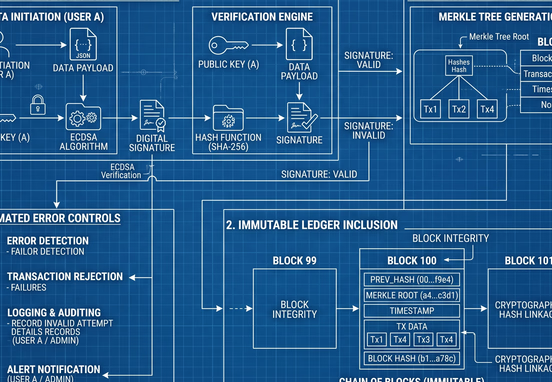
Critical Features to Demand in a Custom API Pipeline
Building a proprietary pipeline requires setting up explicit architectural features that guarantee security, maintain data integrity, and provide complete visibility into your system logs. A poorly engineered custom connection can expose internal endpoints to external exploits if it lacks standard validation protocols. To ensure your independent infrastructure remains secure and functional as your business scales, your technical development team must implement several core capabilities into the pipeline's code base.
Security Architecture Tip
Always enforce strict transport layer encryption (TLS 1.3) across all custom API pipeline paths. This ensures that even if a network packet is intercepted during transit between internal systems, the underlying business data remains completely unreadable to unauthorized entities.
1. Cryptographic Signature Validation and Payload Verification
A sovereign API pipeline must never accept incoming data blindly. To prevent malicious actors from targeting your public web hooks or executing unauthorized data injections, your endpoints must require cryptographic signature validation. Using Hash-based Message Authentication Codes (HMAC) allows your receiving server to mathematically confirm that an incoming data packet was generated by an authorized platform and has not been altered in transit.
2. Immutable Local Event Ledgering and Audit Controls
True data ownership requires maintaining an independent, un-compromised historical log of every single transactional event that traverses your network. Your system pipeline should write every incoming and outbound payload string directly into an immutable database table before initiating any downstream processing steps. This local ledger ensures your engineering team can troubleshoot data anomalies, run historic system replays, and verify records without relying on an external vendor's support portal.
3. Automated Error Ingestion and Smart Fallback Routing
A robust data pipeline must feature built-in resilience mechanics to handle unexpected network drops or destination platform outages gracefully. If an external system encounters a temporary blackout while your pipeline is attempting to deliver a data payload, your code must capture that failure state, isolate the affected record within a secure internal queue, and execute automated retry loops using staggered back-off intervals. This prevents data loss and maintains absolute system consistency during external hardware interruptions.

Strategic Adherence to Global Compliance Structures
Operating a scaling business requires strict alignment with rapidly evolving data privacy frameworks across multiple international jurisdictions. Frameworks such as GDPR in Europe, CCPA in California, and HIPAA in healthcare environments impose heavy financial penalties on organizations that fail to control exactly where their customer data is routed, processed, and stored. Utilizing unverified third-party integration tools introduces massive regulatory compliance blind spots into your organization.
Building direct, custom system pipelines removes these compliance risks by giving your data security officers absolute visibility into your system architecture. Because your development team controls every line of code that handles the transmission payloads, you can implement precise field-level data masking, enforce geographic hosting restrictions, and execute definitive user data purge cycles instantly upon request.
To maintain this level of precision as system connections grow, your foundational code must match changing international data rules. Taking time to align custom web data pipelines with global privacy rules ensures that your business architecture remains structurally compliant, insulates your company from regulatory liabilities, and protects consumer confidentiality at scale.
Furthermore, a truly compliant enterprise requires automated monitoring systems that continuous verify data paths are behaving exactly as intended. Ensuring your technical infrastructure can withstand rigorous corporate evaluations involves learning how automated audit trails keep a growing business audit-ready. This strategic integration provides your compliance officers with complete, real-time logging validation across your entire digital environment.
Scaling Your Enterprise with Independent Systems Architecture
Migrating your organization away from fragile, multi-hop middleware configurations and deploying sovereign API pipelines is a critical step toward establishing complete digital independence. Removing intermediate brokers eliminates hidden transaction premiums, protects your sensitive intellectual property, and gives your engineering teams the freedom to build tailored workflows unconstrained by third-party software rules.
Designing, securing, and maintaining these advanced data networks requires deep software engineering expertise, precise system mapping, and rigorous testing protocols. Partnering with specialized developers ensures your custom integrations are engineered for maximum reliability, speed, and long-term security.
For enterprises focused on taking absolute ownership of their digital infrastructure and maximizing operational efficiency, utilizing professional custom workflow and systems automation services provides the technical expertise needed to build secure, high-performance API pipelines that eliminate middleman markups, protect critical records, and secure long-term operational freedom.