

How to Automatically Back Up Business Data and System Logs Every Night

Rellying on manual interventions to protect corporate data infrastructure introduces severe vulnerabilities into an enterprise environment. Human error, unexpected operational distractions, and forgotten schedules inevitably result in gaps within data preservation sequences. When a catastrophic database corruption, ransomware attack, or server failure occurs, missing even a single day of transaction records can result in devastating financial losses and regulatory penalties.
Establishing a fully automated, nightly backup architecture is the only sustainable strategy for safeguarding core business assets and system logs. By systematically offloading production state records and system telemetry during off-peak hours, engineering teams create a reliable safety net that minimizes data loss. This practice transitions data protection from a high-risk operational chore into a resilient, background system protocol.
Constructing an infrastructure capable of handling high-volume nightly replication requires an optimized, decoupled pipeline that operates independently of primary web servers. Organizations can systematically secure their state histories by deploying enterprise-grade workflow and systems automation services that programmatically manage backup routing, validation, and storage tiering. This structural reinforcement ensures continuous business availability without placing additional strain on administrative resources.
Deconstructing Backup Topologies: Snapshots, Incrementals, and Log Retention
Selecting the appropriate data preservation methodology requires balancing the speed of data recovery against available storage capacity. Forcing the system to execute massive, monolithic database dumps every single night consumes excessive bandwidth and degrades disk IOPS. Technical leaders must combine varied operational backup techniques to construct a balanced, highly responsive recovery ecosystem.
Production data architectures generally split preservation tasks into distinct layers: full system snapshots, incremental block updates, and transaction log archives. Full snapshots preserve the exact state of a system at a specific timestamp, establishing the baseline foundation for all subsequent recovery operations. Incremental updates focus exclusively on modified blocks or rows created after the last save event, drastically reducing required transport times.
| Backup Methodology | Operational Mechanics | Storage Footprint Impact | Target Recovery Objective |
|---|---|---|---|
| Full Database Snapshot | A complete replication of all tables, schemas, and configurations. | High; demands significant disk capacity per iteration. | Baseline disaster recovery and primary system replication. |
| Incremental Block Sync | Captures only the modified data blocks generated within the last 24 hours. | Low; optimizes bandwidth by ignoring unchanged records. | Rapid nightly state preservation for active platforms. |
| Write-Ahead Log (WAL) | Continuous sequencing of individual write events executed in real time. | Moderate; grows relative to transactional volume. | Point-in-time recovery to exact minutes before a crash. |
System logs require a separate architectural strategy than structured business data databases. While database backups track transactional history, system logs capture operational behaviors, security events, and software exceptions. Preserving these logs every night provides the underlying data necessary to debug system anomalies and maintain comprehensive corporate accountability.
Engineering the Nightly Automation Pipeline Architecture
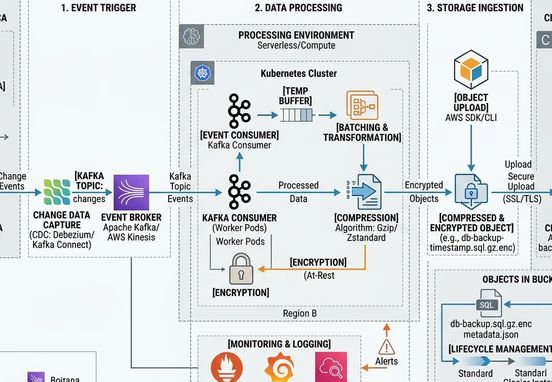
An enterprise-grade nightly backup engine must be designed to execute when application usage hits its daily lowest threshold, typically between 02:00 and 04:00 local server time. The automation sequence operates on an event-driven loop controlled by specialized system schedulers or cloud cron engines. To protect application availability, the entire backup workflow must be completely decoupled from active user checkout flows and primary API endpoints.
The execution sequence begins by initiating a low-priority read-replica or leveraging storage-layer volume snapshots rather than executing heavy queries directly against the primary production instance. This structural boundary prevents table lockouts and performance degradation for active global users. The system isolates the targeted dataset, compresses the payload using high-velocity algorithms like Zstandard, and prepares the object for secure transit.
Once the payload is compressed, the architecture passes the file to an isolated transport coordinator that handles network routing and cryptographic checksum generation. If the wide-area network experiences a sudden drop during transfer, the coordinator pauses the flow and manages retries dynamically. This resilient logic pattern mirrors the architecture required for constructing a the bulletproof web pipeline how custom error controls and smart fallbacks prevent system blackouts across modern distributed environments.
Here is the underlying logic framework that governs the automated nightly ingestion, compression, verification, and distribution process:
[ Scheduled Clock Trigger: 02:00 AM ]
                  │
                  ▼
     [ Target Environment Isolation ]
                  │
        ┌─────────┴─────────┐
        ▼                   ▼
 [ Read-Replica DB ]   [ System Log Directory ]
        │                   │
        ▼                   ▼
 [ Raw Data Dump ]     [ Log File Consolidation ]
        │                   │
        └─────────┬─────────┘
                  │
                  ▼
     [ Multi-Threaded Compression ]
                  │
                  ▼
     [ Generate SHA-256 Checksum ]
                  │
                  ▼
     [ Secure Transport Layer ] ───► (TLS 1.3 Tunnel to Target Bucket)
                  │
                  ▼
     [ Automated Integrity Verification ]
                  │
        ┌─────────┴─────────┐
        ▼                   ▼
     [ MATCH ]          [ MISMATCH ]
        │                   │
        ▼                   ▼
 [ Cold Tier Commit ]   [ Pipeline Halt & Emergency Alert ]
Cryptographic Shielding and the 3-2-1 Storage Strategy
A backup archive is a high-value target for malicious actors because it contains a consolidated replica of the company's entire data history. Storing unprotected, clear-text database dumps inside public cloud storage buckets is an immense security liability. Organizations must enforce strict cryptographic boundaries that secure data assets both while traveling across networks and when resting inside storage drives.
All data payloads leaving production servers must be wrapped inside encrypted TLS 1.3 tunnels during transit. Upon arrival at the storage destination, the files must be immediately sealed using AES-256 encryption keys managed through isolated key management systems (KMS). Access to these encryption keys must be governed by strict IAM parameters, ensuring no single server profile possesses the authority to both write backups and delete historical archives.
To achieve true disaster resilience, organizations must enforce the classic 3-2-1 backup strategy through automated distribution rules:
- Maintain 3 Copies of Data: Keep one active production database and at least two distinct backup replicas.
- Utilize 2 Different Media Types: Store archives across separate infrastructure profiles, such as local server volumes and isolated cloud object buckets.
- Keep 1 Offsite Location: Ensure at least one comprehensive backup copy resides in an entirely separate geographic cloud region or isolated account network.
Managing these distributed storage endpoints securely across cross-border zones requires structural familiarity with how to connect multiple global office databases into one secure logic network without opening security perimeter vulnerabilities. Enforcing geographic isolation protects the global enterprise from regional data center blackouts or catastrophic localized infrastructure failures.
Automating Integrity Verification: Why Unverified Backups Will Fail You
The most dangerous flaw in a data protection strategy is assuming a backup file is functional simply because an automation script completed without throwing an error code. Countless engineering teams have suffered severe data loss because their automated routines generated empty, corrupted, or structurally incomplete backup files for months without detection. A backup architecture is completely useless unless its restoration path is continuously and programmatically verified.
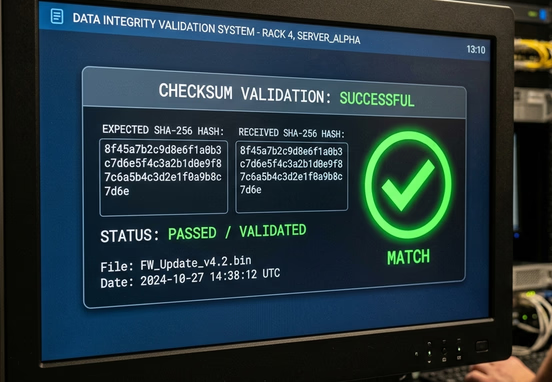
To guarantee absolute recovery viability, the nightly pipeline must execute automated checksum match tests immediately following payload transmission. The storage server calculates a unique SHA-256 hash of the received object and compares it directly against the originating server's hash signature. Any variation between these two values indicates data corruption during transport, triggering an immediate alert and forcing a pipeline replication retry.
Beyond basic file validation, advanced enterprise systems routinely provision temporary sandbox environments to test true execution viability. The automation engine automaticallyspins up an isolated container, applies the newly generated nightly snapshot, runs a suite of basic schema validation queries, and confirms the database achieves a healthy state. Once verification is successful, the container is destroyed, and the backup is officially flagged as verified.
Operational Warning: Never overwrite your previous day’s verified backup snapshot until the current night's payload has fully passed its schema validation checks. Maintaining a rolling queue of historical states prevents a silent database corruption error from permanently destroying healthy archives.
Managing Storage Bloat and Log Retention Policies
Retaining every single daily backup snapshot and verbose system log indefinitely will quickly lead to massive storage overhead and exponential infrastructure hosting penalties. As the digital enterprise grows, unthrottled retention paths accumulate terabytes of non-essential records that provide no active business value. Engineering teams must programmatically restrict their storage footprints by implementing clean lifecycle management logic.
Organizations can avoid performance drag and unexpected infrastructure costs by actively deploying the lean database how auto-archiving and clean automation logic prevent storage overages across all persistent environments. The nightly backup framework must include automated data tiering paths that systematically transition files based on their exact age. For instance, daily snapshots can be retained for 14 days, consolidated into weekly summaries for two months, and subsequently moved to hyper-compressed, low-cost cold storage layers for long-term archiving.
System log files require aggressive, programmatic log rotation strategies to keep disk usage controlled. Active application logs should be rotated out every 24 hours, compressed into historical archives, and evaluated by automated data filtering scripts. This automated cleanup process ensures that your high-speed production drives maintain maximum operational space for incoming user transactions.

Continuous Compliance Auditing and Incident Reporting Alignment
Modern corporate compliance frameworks mandate strict record-keeping protocols regarding how consumer data is preserved, secured, and audited. Running unmonitored backup systems without comprehensive historical trails leaves the business exposed during mandatory financial and cybersecurity reviews. Every automated backup execution must generate an immutable, audit-ready confirmation entry.
To achieve this level of transparency, system developers must ensure that their background processing infrastructure integrates smoothly with automated tracking platforms. Technical leaders can learn the mechanics of how automated audit trails keep a growing business audit-ready to create permanent, tamper-proof logs of all data preservation events. These tracking logs document the exact timestamps of execution, file size profiles, validation states, and the specific identities of administrators who interacted with the data layers.
Maintaining continuous log tracking also plays an essential role in rapid incident response coordination. If an external security anomaly occurs, having instantly accessible, hourly consolidated log histories allows forensic teams to pinpoint the precise vector of entry and isolate the compromise within minutes. This speed is vital for minimizing data exposure and meeting strict regulatory notification deadlines.
Step-by-Step Blueprint for Implementing Enterprise Nightly Backups
Establishing a reliable, automated data preservation ecosystem requires a methodical approach to infrastructure configuration. Engineering teams should execute this structured integration plan to secure their live production platforms:
- Inventory All Data Stores: Identify every primary database, system log folder, and media asset repository across all operational environments.
- Configure Dedicated Read-Replicas: Isolate backup query actions from primary user environments to prevent application performance lag during high-volume data dumps.
- Provision Isolated Cloud Buckets: Establish separate, secure target repositories wrapped in strict IAM permissions and geographic separation rules.
- Implement Cryptographic Key Management: Deploy automated AES-256 key rotation policies to shield backup files from unauthorized external discovery.
- Code the Event-Driven Cron Logic: Set up low-priority background triggers to launch execution routines during off-peak operational windows.
- Integrate Automated Verification Checks: Build programmatic SHA-256 validation and automated container restoration checks directly into the post-transport sequence.
- Establish Real-Time Alert Channels: Connect pipeline status tracking to internal dev messaging platforms to catch optimization drops immediately.
Securing the Long-Term Continuity of Corporate Assets
Transitioning to a fully automated, verified nightly backup framework safeguards an enterprise application against unpredictable software crashes and systemic failures. By enforcing strict encryption boundaries, automatic validation loops, and dynamic storage data tiering, engineering teams protect the core foundation of their digital infrastructure.
Ultimately, data protection is a core operational requirement that demands absolute engineering precision. Organizations that commit to robust lifecycle automation eliminate systemic vulnerability, lower technical debt footprints, and guarantee their digital operations remain fully optimized to support continuous, global scale.