

The Ultimate Guide to Custom Webhooks: Speed, Security, and Why They Outperform Polling

Web platforms that rely on continuous, manual-style checking loops to update data consume excessive server resources and introduce damaging operational latency. In standard application environments, platforms traditionally exchange data using an architectural pattern known as API polling. This setup forces your internal system to constantly query an external server at fixed intervals—regardless of whether any new data has been generated. The vast majority of these outbound requests return completely empty payloads, resulting in wasted compute power, high cloud infrastructure costs, and artificial delays in business workflows.
Custom webhooks solve this systemic architectural flaw by reversing the data communication loop entirely. Instead of your platform continuously asking if an update is ready, webhooks introduce a push-based model that relies on event-driven infrastructure. When a specific event occurs inside a software system—such as a successful e-commerce transaction, a completed web form submission, or a user state transition—the source application instantly packages that data and broadcasts it directly to a dedicated receiver URL on your server. This structural flip eliminates unnecessary polling loops, guarantees zero-latency data transfer, and forms the bedrock of highly efficient enterprise web operations.
Understanding how these real-time data highways interact with standard connection patterns requires a solid grasp of underlying network architecture. Organizations that are shifting away from fragmented connections can build a clear foundation by reviewing what is an api? a jargon-free guide to web integrations to understand the core request-response protocols that govern modern data architecture before engineering highly advanced event-driven systems.
The Inefficiency Problem: Why Polling Fails at Scale
API polling forces a web server to run on an arbitrary timeline rather than responding directly to real-world user interactions. In a typical enterprise environment utilizing short polling, the application engine might dispatch a database request every thirty seconds to check if a client has updated their account profile. As your customer base scales into thousands of active users, this continuous, cyclical querying mechanism builds an exponential load on your database infrastructure.
This model creates a difficult operational paradox: if you lengthen the polling interval to save server processing power, you intentionally introduce massive data delays into your system. If you shorten the iteration window to achieve real-time performance, you risk crashing your internal application stack under the weight of thousands of empty, repetitive network requests. Long polling attempts to mitigate this by holding the server connection open until data becomes available, but this approach ties up critical web sockets and exhausts system thread counts during peak traffic hours.
| Performance Metric | Traditional API Polling Model | Custom Webhook Architecture |
|---|---|---|
| Data Transmission Trigger | Scheduled time intervals (Pull mechanism) | Immediate real-world event (Push mechanism) |
| System Resource Efficiency | Extremely low; high server overhead from empty requests | High; resources are only active during actual events |
| Data Latency Window | High; tied completely to the scheduled check interval | Zero-latency; transfers happen instantly within milliseconds |
| Network Bandwidth Drain | Constant, predictable volume of wasteful data packets | Minimal; data flows only when a milestone is achieved |
| API Limit Risk Profile | Severe; easily breaches external software platform caps | Low; strictly operates within necessary payload boundaries |
The Mechanics of Event-Driven Webhook Pipelines
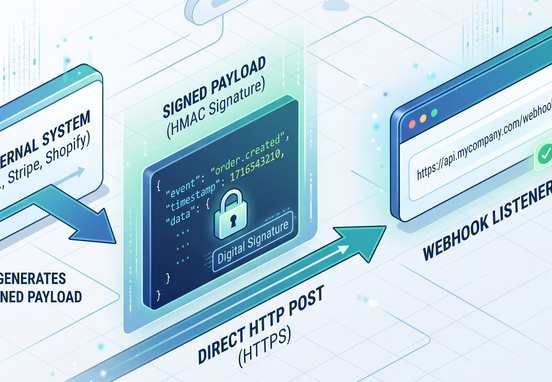
A custom webhook operates as an asynchronous, unidirectional HTTP POST request initiated by a source provider and targeted directly at a secure endpoint within your custom web application. To build an ingestion pipeline, your development team creates an un-cached listener script designed to run continuously on your web server. This script listens for incoming payloads, strips out the network headers, validates the legitimacy of the origin server, and immediately ingests the raw data stream for downstream processing.
Because webhook calls arrive as standard HTTP POST requests, the transmission contains a structured request header and an explicit JSON or XML message body. The message body holds the exact transactional metadata required to execute back-office workflows, ensuring that your application never has to reach back out to the provider to request additional context.
The flow diagram below illustrates how an event-driven webhook pipeline instantly triggers internal processing steps without wasting server cycles on continuous polling queries:
[External Software System]
           │
           ▼  (Real-World Event Occurs)
[Compile Structured JSON Payload]
           │
           ▼  (Signs Payload with Cryptographic Secret Key)
[Transmit HTTP POST Request] ────────────────────────┐
                                                     │
                                                     ▼
                                      [Secure Webhook Listener URL]
                                                     │
                                                     ▼
                                      [Verify Authorization Headers]
                                                     │
                                                     ├─► (Validation Fails: Drop Request)
                                                     │
                                                     └─► (Validation Passes: Accept Request)
                                                               │
                                                               ▼
                                              [Return HTTP 200 OK Response]
                                                               │
                                                               ▼
                                              [Push Data to Background Queue]
                                                               │
                                                               ▼
                                              [Execute Downstream Automation]
The Crucial Role of Asynchronous Ingestion
When an external platform delivers a webhook payload to your application server, your listener endpoint must prioritize speed over processing depth. The server should validate the request headers, securely save the raw payload into a high-speed message queue or cache database, and immediately return a clean HTTP 200 OK status code back to the sender.
Delivering this success response should take mere milliseconds. Your internal system can then process the complex business logic, database inserts, and email triggers asynchronously in the background using dedicated worker threads. If you force the external platform to wait while your server runs heavy internal scripts before returning a response code, the connection will frequently timeout, causing the sender to flag your endpoint as offline.
Implementing Enterprise-Grade Webhook Security
Exposing a public URL endpoint that accepts incoming data payloads requires building strict, multi-layered security protocols. Because anyone can formulate a malicious HTTP POST request and target your server, your webhook listener must actively verify the identity of the sender before allowing any payload data to interact with your internal database. Failing to secure these endpoints leaves your organization vulnerable to denial-of-service attacks, data injection exploits, and fraudulent status manipulations.
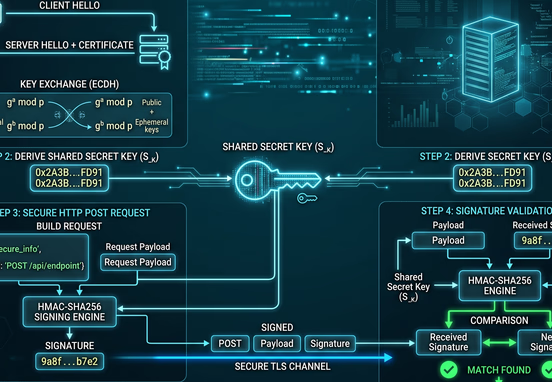
The absolute gold standard for webhook security involves implementing cryptographic payload verification using Hash-based Message Authentication Codes (HMAC). When you establish a connection with a premium service provider, the platform generates a unique, shared secret key that remains hidden from the public internet.
Security Architecture Tip
Never store your shared webhook secrets or cryptographic verification keys directly within your application code repositories. Always ingest these sensitive tokens at runtime using secure environment variables or dedicated cloud key management systems to insulate your core databases from potential repository exposures.
Standardizing the Verification Framework
When an event triggers a data transfer, the source provider computes a cryptographic hash of the entire JSON payload using the shared secret key and appends this signature directly into the HTTP request headers (often labeled as X-Hub-Signature or X-Signature). Upon receiving the packet, your custom application server replicates this mathematical process locally using its own copy of the secret key.
- Capture the incoming raw, unparsed request body string directly from the network stream.
- Locate the verification signature sent within the incoming HTTP header fields.
- Compute an independent HMAC SHA256 hash using your securely stored environment secret.
- Compare the locally generated hash against the provider's signature header using a time-constant string comparison function to neutralize side-channel timing exploits.
If the two signatures match perfectly, your engine gains mathematical certainty that the payload was generated by the authentic source and was not modified by a third party mid-transit. If the signatures diverge even slightly, your listener must immediately terminate the thread, drop the payload, and log a high-priority security alert.
Building these secure, dedicated programmatic pipes ensures your enterprise retains total control over its underlying data pipelines. Designing frameworks around why custom api pipelines guarantee data ownership (and the critical features to look for) isolates your internal environments from external middleware vulnerabilities while establishing deep operational transparency.

Building Resilient Error Controls and Retries
The public internet is inherently unpredictable. Network routing paths drop out, database servers occasionally stall under high utilization spikes, and third-party API nodes experience temporary blackouts. Because webhooks rely on a single, direct push event, your architecture must feature smart, automated error handling mechanisms to prevent data loss when your ingestion listener encounters an internal system exception.
A resilient custom webhook pipeline treats every incoming payload as an isolated transactional event that must be preserved at all costs. If your application server encounters a database lock while attempting to write a webhook record, the error handling logic must safely isolate the payload, capture the failure state, and preserve the data within a persistent fallback queue rather than allowing the execution thread to crash completely.
Developing these advanced, self-healing system pipelines requires deploying robust error management protocols across your entire web architecture. Implementing the bulletproof web pipeline: how custom error controls and smart fallbacks prevent system blackouts provides your development teams with the structural blueprint needed to isolate script failures, maintain continuous application uptime, and ensure data integrity during unexpected hardware interruptions.
Engineering a Idempotent Processing Layer
Because providers will retry sending a webhook if they do not receive an immediate HTTP 200 OK response, your backend code must be explicitly engineered to be idempotent. Idempotency means that processing the exact same webhook payload multiple times will yield the identical system result without generating duplicate database records or repeating external workflows.
- Unique Event Identifiers: Every legitimate webhook payload contains a unique event ID string generated by the provider; your system must log this ID within a dedicated cache database table before processing any logic.
- Duplicate Detection Locks: When a new payload hits your listener, query the event cache table immediately; if the event ID already exists with a status of 'completed', halt processing and return a success code instantly.
- Database Constraints: Apply strict unique constraints at the database level across business logic fields to serve as a final automated backstop against double-processing.
Integrating these reliable architectural structures across your web assets ensures that your core systems execute operational logic seamlessly, allowing you to establish a robust foundation built on trigger-action logic that automatically maintains absolute alignment across multiple software platforms.
Deploying Real-Time Webhook Architecture at Scale
Transitioning your enterprise infrastructure away from heavy, unoptimized API polling loops and moving toward modern, event-driven webhooks drastically reduces your server expenses while elevating the responsiveness of your entire platform. By removing intermediate middleware platforms and building direct, securely signed data pipelines, your business takes complete ownership of its internal architecture while paving a smooth pathway for future operational scaling.
Designing, securing, and scaling these direct event-driven networks demands specialized software engineering, advanced data mapping, and precise systems orchestration. Utilizing professional custom workflow and systems automation services empowers your enterprise to deploy highly secure, low-latency webhook ingestion pipelines that eliminate operational delays, safeguard sensitive company information, and build long-term structural value.