

How Two-Way Data Sync Keeps Websites and Back-Office Systems Aligned
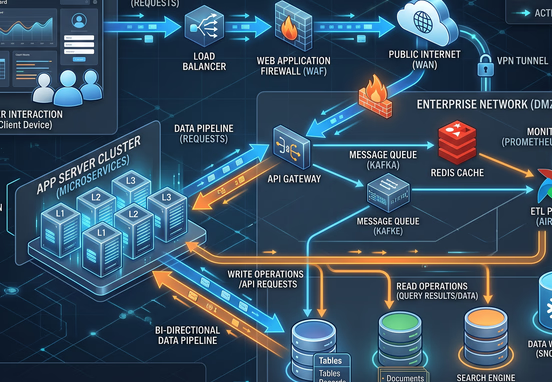
When digital user interfaces are decoupled from back-office operational systems, data fragmentation quickly threatens corporate performance. Many enterprises deploy a high-performance website to handle customer acquisitions but continue to rely on legacy internal software, enterprise resource planning (ERP) platforms, or isolated customer relationship management (CRM) engines to manage fulfillment and administration. Without a structured, real-time method to bridge these separate systems, critical operational details inevitably drop through the cracks, forcing staff to engage in costly, error-prone manual data duplication.
True digital alignment requires moving away from fragile, batch-processed updates or manual exports and establishing a robust two-way data synchronization framework. A bi-directional data pipeline guarantees that an update executed within your back-office ecosystem instantly propagates to your consumer-facing digital portal, and conversely, any customer modification on the web app immediately updates your internal ledger. This tight integration ensures that sales representatives, warehouse fulfillment crews, and digital consumers consistently interact with identical, real-time records.
Operating unaligned architectures introduces severe risks, such as accidental double-selling of constrained assets, outdated client communications, and slow order fulfillment cycles. For businesses managing hybrid operational models, learning how to sync physical inventory with custom digital storefronts represents an essential step toward stabilizing supply chains. Extending this synchronization to your entire software stack converts your isolated platforms into a single, cohesive business intelligence network.
The Core Mechanisms of Bi-Directional State Alignment
A functional two-way data sync relies on continuous, event-driven state validation rather than heavy, scheduled database updates. When an absolute state change occurs in a connected system—such as a price modification inside an internal warehouse database or a shipping profile update on a web portal—the system must treat that change as an isolated transactional event. This event must be validated, transformed to match the destination schema, and delivered across your network within milliseconds.
To achieve this level of precision without overloading your application servers, your architecture must implement dedicated, push-based communication protocols. Utilizing an event-driven framework driven by custom webhooks enables your systems to transmit micro-payloads instantly upon state mutation. This approach eliminates the massive compute overhead and network bandwidth drain caused by traditional, legacy database polling routines.
Overcoming the Infinite Sync Loop
The most significant engineering challenge when building a two-way data pipeline is preventing infinite synchronization loops. An infinite loop occurs when System A updates a record and transmits the change to System B. Upon receiving the payload, System B updates its local database, treats that update as a new mutation event, and mistakenly transmits a reciprocal update back to System A. This triggers an ongoing, circular data echo that quickly consumes server memory, locks database rows, and crashes your network.
Resolving this looping hazard requires embedding strict origin tracking and caller metadata within every single API transmission payload. Your data pipelines must be governed by deterministic execution rules. Ensuring your system components are anchored in native trigger-action logic allows developers to apply explicit filtering layers that safely intercept and terminate incoming update requests if the metadata confirms the modification originated from the sync engine itself.
Conflict Resolution Models and Data Sovereignty
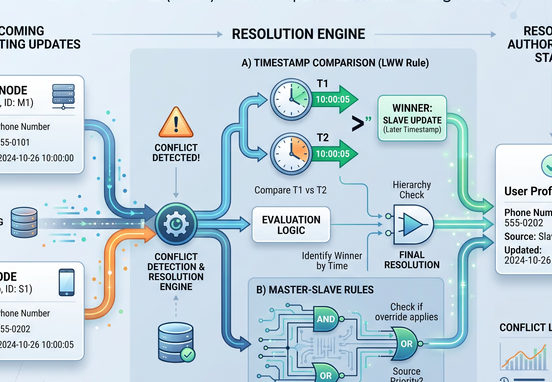
When two separate databases possess the authority to modify the same data parameters, transactional conflicts are mathematically guaranteed to occur. For example, a customer might update their telephone number inside a web portal at the exact millisecond an internal account executive modifies that same client record within the back-office CRM. If your data pipeline lacks an explicit conflict resolution model, the two systems will overwrite one another arbitrarily, leading to corrupt records and lost corporate intelligence.
Architecting a resilient bi-directional sync requires your engineering team to establish clear data sovereignty rules across every shared database field. Your architecture must determine which platform serves as the ultimate source of truth under specific operating conditions, or implement mathematical sequencing metrics to resolve overlapping updates automatically.
| Resolution Strategy | Operational Rule and Execution Logic | Ideal Use Case Strategy |
|---|---|---|
| Last-Write-Wins (LWW) | The system evaluates the network timestamps of incoming payloads and permits the most recent absolute millisecond to overwrite older data points. | Non-critical, independent customer fields like email preferences or phone numbers. |
| Master-Slave Sovereignty | The pipeline designates one specific system (e.g., the ERP) as the absolute authority; website mutations are rejected if a conflict is flagged. | Highly sensitive financial metrics, core SKU pricing data, and base ledger records. |
| Delta-Based Aggregation | Instead of overwriting an entire database row, the pipeline calculates numeric differences and appends increments or decrements. | Real-time inventory tracking, warehouse counts, and shared ledger balances. |
| Version Vector Sequencing | Every update advances an incremented version counter; payloads with lower or matching version counts are safely rejected as stale. | Multi-tier corporate account structures and complex, multi-user enterprise portals. |
Detailed Flow of a Conflict-Free Synchronization Pipeline
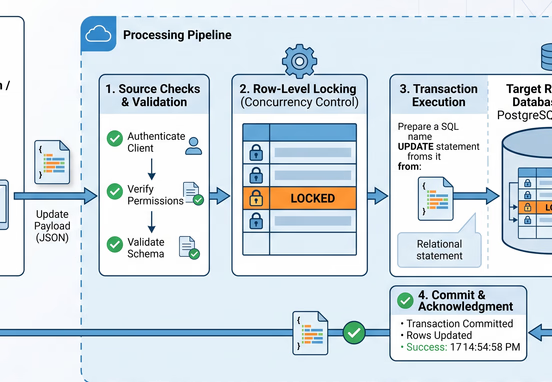
To ensure absolute database alignment, a two-way sync pipeline must operate as a highly organized, multi-tier transactional checkpoint. The data pipeline must safely capture events, acquire explicit row locks, validate unique record identifiers across a centralized cross-reference table, and check for schema changes before executing write operations.
The operational layout below demonstrates how an update initiated on an external website storefront travels through validation filters, matches back-office tracking schemas, and safely terminates to prevent infinite data loops:
[Website Event Triggered: Profile Edited]
                   │
                   ▼
  [Generate Payload with Unique Client ID]
                   │
                   ▼
  [Append Origin Source Header: "web_portal"]
                   │
                   ▼
  [Transmit Secure JSON Payload via API] ─────────────────┐
                                                          │
                                                          ▼
                                          [Back-Office Integration Listener]
                                                          │
                                                          ▼
                                          [Inspect Origin Source Header]
                                                          │
                                         ┌────────────────┴────────────────┐
                                         ▼ (If Source = "back_office")     ▼ (If Source = "web_portal")
                             [Terminate Pipeline Instantly]      [Acquire Target Database Row Lock]
                             [Log Loop Cancellation Event]                 │
                                                                           ▼
                                                                 [Query Sync Mapping Table]
                                                                           │
                                                                           ▼
                                                                 [Evaluate Vector Time Stamp]
                                                                           │
                                              ┌────────────────────────────┴────────────────────────────┐
                                              ▼ (Incoming Timestamp Is Older)                           ▼ (Incoming Timestamp Is Newer)
                                  [Reject Web Update Request]                             [Execute Local Database Update]
                                  [Log Conflict Exception File]                           [Update Sync Mapping Ledger]
                                                                                          [Release Target Row Lock Safely]
Mitigating Network Failures with Localized Queues
If an internal back-office server goes offline for routine hardware maintenance, your consumer-facing website must continue to process customer actions without interruption. A direct, unbuffered sync connection will fail during these minor infrastructure drops, causing immediate data loss. To insulate your operations from these drops, your pipeline must decouple ingestion from processing by routing all incoming data through resilient, localized message queues.
Ensuring your custom data pipelines can withstand network interruptions requires setting up robust, self-healing system frameworks. Implementing custom error controls and smart fallbacks provides your engineering teams with the technical blueprints needed to securely buffer payloads, manage database timeouts, and execute automated retry loops when external systems experience temporary blackouts.
Database Mapping Tables and Global Identifier Architecture
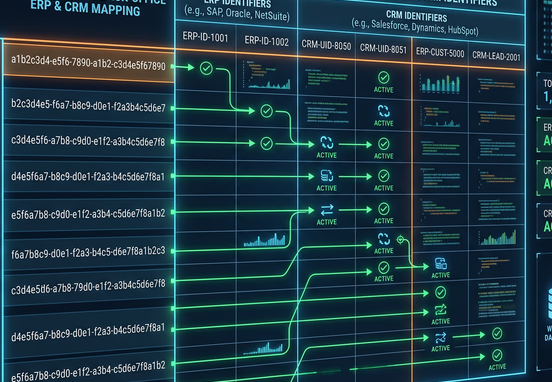
A sustainable bi-directional sync engine must never rely on matching records solely by volatile fields like customer names or email strings. Instead, the architecture must utilize a dedicated synchronization mapping table that pairs the unique database primary keys of your website with the corresponding unique identifiers of your back-office systems. This mapping table serves as the universal translation index for your data network.
System Architecture Tip
Always configure your synchronization mapping table using explicit foreign key cascading constraints and composite indexes across both system identifiers. This layout minimizes query lookups down to single-digit milliseconds, protecting your core operational databases from performance degradation during high-volume data modifications.
Structural Schema for a Sync Mapping Ledger
The mapping table operates as a lightweight, lightning-fast index file within your central cloud database. Its sole responsibility is maintaining the mathematical relationship between distinct platform entities. A standard, enterprise-grade mapping schema contains the following essential fields:
mapping_id: An internal integer serving as the primary key for the ledger row.web_entity_id: A unique UUID tracking the record inside your website's relational database.back_office_id: A unique string tracking the identical asset inside your internal ERP or CRM.entity_type: A strict categorical string indicating the data type (e.g.,customer,order,inventory_item).last_sync_timestamp: A high-precision UTC datetime record tracking the exact moment the two platforms were last verified as perfectly aligned.
When an update payload arrives at your ingestion listener, the engine queries this mapping ledger instantly to locate the exact row that requires updating in the destination system. If the lookup returns empty, the pipeline recognizes that the item represents a brand-new record and automatically triggers an initialization sequence to construct corresponding profiles across both environments simultaneously.
Eliminating Expensive Middleware Taxes on Enterprise Data
Many scaling corporations mistakenly rely on expensive third-party integration platforms or visual automation plugins to link their websites with back-office databases. While these tools allow for rapid initial prototyping, they charge aggressive tier-based usage fees that scale directly with your transaction volume. For an enterprise processing thousands of updates daily, these recurring middleman premiums quickly evolve into an expensive tax on operational growth.
Building proprietary, direct-to-destination data pipelines allows your business to eliminate these arbitrary software costs entirely while drastically lowering network latency. Direct programmatic connections ensure your data transitions straight between your core code assets and internal servers without being intercepted, stored, or restricted by an external integration vendor.
Moving away from generic third-party data handlers allows your organization to retain complete sovereignty over its intellectual property and transactional logs. Businesses that identify their platforms are outgrowing basic visual builders can successfully deploy independent code networks by actively bypassing the Zapier tax to achieve long-term financial predictability and absolute data ownership.
Securing Real-Time Synchronized Infrastructure at Scale
Maintaining deep alignment between customer-facing web platforms and back-office administrative systems is an operational necessity for modern, agile enterprises. Deploying a custom, bi-directional data pipeline eliminates manual administrative bottlenecks, protects your data assets from human entry errors, and ensures your executive teams make critical scaling decisions based on accurate, real-time metrics.
Designing, securing, and scaling these direct-to-destination synchronization networks requires precise database engineering, advanced conflict-resolution mapping, and rigorous error-boundary controls. Partnering with specialized system architects ensures your proprietary integration paths operate with maximum uptime and complete data security.
For organizations focused on taking absolute ownership of their digital infrastructure and achieving flawless operational alignment, utilizing professional custom workflow and systems automation services provides the technical expertise required to deploy secure, high-performance bi-directional pipelines that eliminate middleman software fees, safeguard sensitive intelligence, and support sustainable corporate growth.