

How Founders and Small Teams Use Automated Systems to Scale Operations

Founders and small teams frequently hit an operational ceiling that has nothing to do with product-market fit or sales demand. The true barrier to expansion is administrative friction. When a lean team spends dozens of hours moving data manually between separate applications, updating status sheets, and tracking down client assets, they become human middleware. This structural inefficiency places a hard limit on top-line growth because delivery capacity remains tightly coupled with manual human hours.
Scaling an agency, consultancy, or digital service platform requires a fundamental shift from human-dependent execution to system-dependent execution. Automated systems do not replace the unique creative, strategic, or problem-solving capabilities of a core team. Instead, they handle the predictable, repetitive, data-driven tasks that consume executive focus. By offloading these workflows, a team of three to five people can achieve the operational output typically expected from an enterprise-level department.
The Hidden Tax of Administrative Friction
Every manual task performed within a growing business carries an unstated financial and cognitive cost far beyond the immediate minutes lost. Context switching degrades cognitive focus, causing compounding delays across a team's primary responsibilities. When a developer, project manager, or founder has to stop high-impact development or strategic planning to manually provision a client portal, send a welcome email sequence, or log a payment entry, the entire organization loses momentum.
For small teams, these friction points quickly compound during periods of high customer acquisition. A process that takes fifteen minutes works passably for two clients a month, but it completely collapses when processing thirty. The manual approach introduces data fragmentation, double data entry errors, and missed deadlines. To eliminate this operational drag, teams must analyze their business operations as an interconnected software ecosystem rather than a collection of separate, isolated tools.
The Limitations of Fragmented Software Stacks
Many small teams attempt to solve operational bottlenecks by simply adding more subscription software to their business. This approach creates an unmanaged tech stack where critical business data lives in isolated silos. The project management tool does not communicate with the billing engine, and the customer relationship management platform remains entirely disconnected from the core delivery database.
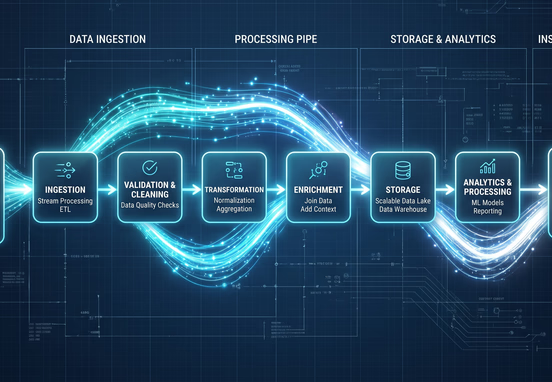
Without a central nervous system connecting these tools, information must be bridged manually by employees. This architectural weakness forces founders to act as system integrators rather than visionaries. To scale sustainably, a business must map out its backend logic and transition toward a single source of truth where data flows instantly between systems without human intervention. This shift requires understanding why scaling services requires structured workflow logic to map the entire operational pipeline from end to end.
Mapping Operational Flows for Automated Scale
Before writing custom code or deploying system pipelines, a business must outline exactly how data moves through its ecosystem. Mapping out workflows reveals redundant steps, obsolete checkpoints, and automation opportunities that can drastically reduce project delivery times. A clear operational map outlines the precise conditions under which an event occurs, who receives the data, and what system action should follow.
Lean operations rely entirely on defining precise inputs and predictable outputs. If a process cannot be documented with logical rules, it cannot be automated effectively. Teams must analyze their daily routines and divide their operational framework into distinct, programmatic stages. By breaking down service execution into structured sequences, small teams can implement automated code architecture that operates flawlessly around the clock.
| Operational Process Phase | Manual Overhead Model | Custom Automated Architecture |
|---|---|---|
| Lead Intake & Qualification | Manual review, manual follow-up emails, ad-hoc scheduling links. | Instant dynamic form validation, automated data enrichment, automated routing. |
| Client Onboarding | Generating custom contract PDFs, manual invoice creation, manual portal setups. | Webhook-triggered contract generation, automatic ledger sync, automated workspace provisioning. |
| Project Milestone Tracking | Manual status update emails, scheduled check-in meetings, manual progress logs. | Event-driven status logging, automated client feedback pipelines, real-time client portals. |
| Financial Ledger Syncing | Periodic manual data entry into accounting systems, manual tax calculations. | Real-time API-driven webhook synchronization, automated split-payment distribution. |
| Employee Task Dispatching | Weekly alignment meetings, manual task assignments in PM tools based on chats. | Live database-driven task allocation based on capacity, skills, and project status. |
Developing an Automated Lead Ingestion Engine
The front-end pipeline is often the first area where manual workflows break under organizational stress. When a prospective client submits an inquiry, every minute of delay reduces the conversion probability. A manual lead management workflow relies on an employee reviewing an inbox, validating the lead's company size, and typing out a personalized response. This slow, unoptimized process gives agile competitors an immediate advantage.
Deploying the automated lead engine completely revolutionizes this phase by applying dynamic logic directly at the point of ingestion. When a web form is submitted, the system instantly processes the data through enrichment tools to pull company revenue, employee count, and technology stacks. Based on these verified parameters, custom routing rules automatically direct the lead to the correct internal representative or instantly schedule a discovery call using specific availability logic.
Implementing Advanced Lead Routing and Onboarding Pipelines
By integrating dynamic form logic into your web entry points, you ensure that high-value opportunities are prioritized and fast-tracked instantly. The system can check specific field conditions in real-time, routing enterprise accounts into premium Slack channels while sending lower-tier prospects down automated self-service educational funnels. This systematic triage ensures that your core team members only invest time in highly qualified opportunities.
Once the prospect converts, the system shifts directly into the onboarding phase. Instead of requiring a team member to manually draft a statement of work or provision a third-party project management board, automated system pipelines execute these tasks via API webhooks. The contract is generated dynamically, the invoice is synced directly to the financial ledger, and the client's dedicated workspace is built in milliseconds.

Transitioning Past Rigid Automation Tools
As small teams scale, they frequently begin their automation journeys using off-the-shelf, no-code integrations. While these tools serve as an excellent proof of concept, growing businesses quickly encounter performance limits, expensive usage tiers, and rigid operational constraints. High transaction volumes can lead to steep monthly software bills—prompting smart operators to look into bypassing the Zapier tax before platform fees erode profit margins.
When data needs become more complex, basic plugins often struggle with multi-step logic, custom data formatting, and deep database synchronization. To maintain true data ownership and minimize recurring overhead, scaling organizations must move away from generic middleware platforms. Transitioning to custom-engineered API integrations allows businesses to escape these operational limitations and construct a robust system fully tailored to their unique processes.
Building Resilience with Custom Error Controls
A major risk of relying on basic, pre-built integration plugins is their lack of sophisticated error handling. When an automated workflow fails due to an API timeout, an expired token, or unexpected data formatting, the entire pipeline can stall silently. For a lean team, a silent failure means missed orders, angry clients, and hours spent auditing logs to find where the system broke.
This infrastructure strategy forms the foundation of the bulletproof web pipeline, ensuring that a single API glitch never causes a catastrophic business blackout or requires manual salvage operations from your team. If a primary endpoint experiences downtime, the system catches the error, logs the failure automatically into an operational dashboard, and routes the affected data packet into a secure queue for automated re-tries.
System Optimization Tip: Always segregate your operational data pipelines from external third-party dependencies. By routing critical workflows through a centralized data architecture under your direct control, you maintain uninterrupted business continuity even if an external vendor suffers a major platform outage.

Maximizing Team Output via Asynchronous Operations
The traditional method for keeping a small team aligned revolves around synchronous communication: daily standups, status updates, and review meetings. However, meetings are an incredibly expensive way to transfer information. When four or five team members spend an hour reviewing project statuses, the business loses half a day of pure production capacity.
Mastering how to eliminate status meetings by automating progress logs allows teams to transition to a highly efficient asynchronous work model. By building direct event triggers into your core development environments or production pipelines, progress logs can update automatically in real-time. When a milestone is marked complete in a database, the system automatically logs the progress update, notifies the client via an automated portal message, and requests feedback without a single internal meeting.
Optimizing Resource Allocation and Project Visibility
This level of deep systems integration ensures that every team member has perfect operational visibility without needing to ask for updates. Dashboards reflect live project metrics based on code repository commits or task updates, allowing leadership to make data-backed executive decisions instantly. Tasks are dispatched to employees automatically based on real-time spreadsheet updates or database changes, matching current workloads with team capacity dynamically.
Furthermore, this visibility extends directly to your client base. Instead of sending manual email reports every Friday afternoon, a custom web ecosystem allows clients to view live development states, track milestones, and approve deliverables through a secure, self-service dashboard. This self-sustaining communication loop vastly reduces inbound support requests, leaving your team entirely free to focus on product delivery and development scaling.
Designing Long-Term Structural Autonomy
Achieving long-term scalability requires a fundamental shift in how founders view their business infrastructure. Technology should never be an afterthought or a collection of quick fixes patched onto a fragile core. Instead, it must serve as the structural engine that drives every operational decision. Investing in custom system workflows allows a small team to remain lean, highly profitable, and completely agile in a hyper-competitive market.
When your underlying tech stack operates on clean, customized logic, your business becomes highly resilient. The need to continuously hire administrative staff to manage basic data entry evaporates, allowing you to invest capital directly into product innovation, engineering, and market expansion. True operational scale is achieved when your business workflows run flawlessly behind the scenes, leaving your team free to innovate.
Building this type of highly automated, resilient infrastructure requires deep technical expertise and structured execution. If your team is ready to eliminate administrative drag, bypass restrictive software fees, and deploy tailored digital pipelines built for scale, explore our dedicated workflow and systems automation service. We design, build, and integrate custom web ecosystems that empower lean organizations to maximize their operational output and achieve sustainable, long-term market growth.