

The Operational Map: Why Scaling Services Requires Structured Workflow Logic

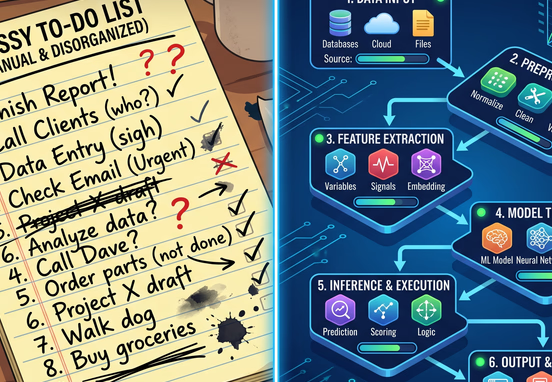
When a service-based agency or enterprise business begins to cross its initial growth thresholds, operations naturally become increasingly chaotic. In the early stages, delivery relies almost entirely on the individual skill and memory of a small team. Communication happens organically across localized group chats, emails, and shared document folders. However, as client accounts multiply, this loose approach breaks down. Tasks slip through the cracks, project delivery dates slide, and the quality of execution fluctuates wildly. This operational friction is not a personnel problem; it is an architectural flaw caused by a lack of structured workflow logic.
Service scaling fails when organizations attempt to solve operational bottlenecks by simply adding more human labor. Hiring more account managers, designers, or engineers to manage a fragmented technical infrastructure merely adds communication overhead and introduces more human error. Without a centralized, deterministic blueprint governing how data moves through your business, every new client introduces fresh complexity instead of scaling margins. True operational scalability requires a business to transition from a manual task paradigm to a strict, code-driven logic network.
An operational map functions as the engineering blueprint for an automated service delivery system. It strips away the ambiguity of traditional text-based standard operating procedures (SOPs) and replaces them with immutable code rules. When an organization accurately charts its processes into binary dependencies—where every event has an explicit, predictable trigger and a defined, automated consequence—the business isolates itself from human error. This systematic mapping transforms delivery from an unstable variable into a highly predictable utility.
Deconstructing the Three Pillars of Structured Workflow Logic
To transform an unorganized operational process into a scalable web pipeline, you must break down every task into its core technical components. No matter how complex a client-facing workflow appears on the surface, its digital infrastructure relies on three core concepts: triggers, conditional branches, and downstream actions.
When you build these operations using custom web development instead of brittle third-party integration tools, your platform processes data sequentially without data loss or synchronization lag. This structural clarity allows your engineering team to scale background operations cleanly as incoming transaction volumes grow.
- Triggers: The absolute starting point of an operational sequence. This must be a clean, distinct system event, such as a webhook payload firing from an updated contract status, a database entry confirmation, or a form submission.
- Conditional Branches: The evaluation layer where the system inspects payload variables to determine the correct pathway. This layer runs programmatic validations to check client tiers, financial boundaries, and historical parameters before routing data.
- Downstream Actions: The automated outcomes triggered by the evaluation layer. These actions can include provisioning sandboxes, generating data structures, sending automated database updates, or dispatching API calls to internal communications channels.
Mapping these foundational layers systematically prevents common operational bottlenecks. If your team is currently looking to transition from manual operations to programmatic infrastructure, exploring how to leverage trigger action logic as the foundation of sustainable web automations can provide the architectural guidance needed to stabilize your background workflows.

Translating Soft Operating Procedures into Deterministic Code
Traditional businesses usually document their processes in text files or shared wikis. While these documents outline intent, they fail to guarantee execution because they still rely on human memory and manual tracking. A document that reads "assign the onboarding task to an engineer within 24 hours" is useless if the manager is out sick or misses the notification.
Structured workflow logic changes these loose human guidelines into strict, code-driven rules. The system evaluates real-time data states continuously, completely independent of human oversight. The code snippet below demonstrates how an automated project tracking environment reads an incoming event, assesses historical variables, and assigns resources programmatically based on real-time operational capacity.
     [ Start: incomingProjectPayload ]
                    |
                    v
       /-------------------------\
      <   Is payload validated?   >
       \-------------------------/
           /                 \
          No                 Yes
         /                     \
        v                       v
 [ Throw Error ]       /-------------------------\
 (Exit Pipeline)      <   Account Tier = 'Ent'?   >
                       \-------------------------/
                           /                 \
                         Yes                 No
                         /                     \
                        v                       v
              [ Assign Dev_Node_A ]   [ Assign Dev_Node_B ]
              [ Priority = True   ]   [ Priority = False  ]
                        \                       /
                         \---------------------/
                                    |
                                    v
                     [ Build deploymentMatrix Payload ]
                     [ (ID, Timestamp, Node, Priority)]
                                    |
                                    v
                       [ Return deploymentMatrix ]
By executing these checks programmatically, your platform processes client onboarding, asset distribution, and resource assignments instantly. This automation model removes operational guesswork, allowing founders and small teams to use automated systems to scale operations effectively without needing to expand their administrative headcount.
Comparing Operational Infrastructures for Service Scaling
To appreciate the value of a custom workflow map, you must evaluate how different technical architectures handle data synchronization, exception logging, and long-term business growth.
| Operational Vector | Manual Human Checklist | Basic No-Code Plugin Layer | Custom Structured Workflow Logic |
|---|---|---|---|
| Execution Latency | Hours to days, dependent on human availability | Minutes, subject to API rate limiting and polling delays | Milliseconds, running on dedicated asynchronous runtimes |
| Data Integrity Assurance | Highly prone to transcription errors and data gaps | Brittle, susceptible to unnotified third-party API layout shifts | Absolute validation using strict schema checks and local error logs |
| System Visibility | Zero system logging; hidden within email threads | Surface-level logs that auto-delete after 30 days | Permanent, structured audit trails saved directly to master ledgers |
| Platform Licensing Cost | High indirect labor costs due to administrative drag | Escalating monthly subscription fees based on workflow volume | Flat infrastructure expenses fully owned by your company |
Assessing the Limits of Basic Multi-Tenant Automation
While basic no-code tools can handle simple data transfers for small operations, they quickly become a bottleneck for enterprise workloads. These platforms often mask configuration errors, restrict how you can customize your database logic, and create ongoing subscription costs that drain your development budget. Moving to a dedicated, custom code architecture allows your engineering team to build complex data pathways that match your exact operational needs.
Protecting Corporate Data with Secure Operational Boundaries
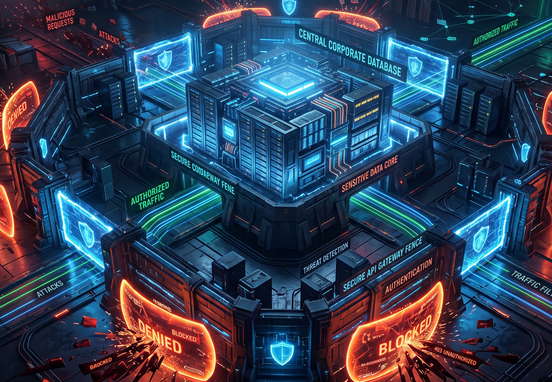
As data pipelines grow more interconnected, security cannot be treated as an afterthought. An unmapped operational architecture—where various employees use personal log-ins and unverified browser extensions to connect corporate databases—creates significant security liabilities. These fragmentation vectors open the door to unauthorized data exfiltration, unlogged workspace changes, and compliance violations.
A hardcoded operational map secures your organization by routing all data through central, authenticated API gateways. By implementing role-based access rules and protecting authentication keys at the server layer, you ensure that external users and internal staff can only access data relevant to their specific project parameters.
Furthermore, building structured internal pathways protects against system failures during high-traffic client events. If you are developing these onboarding paths, integrating the automated lead engine to enrich route and onboard web leads via dynamic form logic can provide an excellent architectural foundation for validating and securing data from the very first touchpoint.
Increasing Business Valuation Through Standardized Integration Logic
For mature companies and agencies eyeing a future sale or merger, undocumented workflows represent a significant financial liability. Buyers are hesitant to acquire companies whose day-to-day delivery relies entirely on the tribal knowledge of its founders or key team members. If the business cannot run efficiently without specific individuals manually managing its systems, its market value drops dramatically.
Conversely, a business built on a documented, custom code automation architecture represents a highly valuable asset. It proves to investors that your customer acquisition, project delivery, and financial tracking operate within a reliable, scalable system framework.
Tip: Treat your internal workflow logic just like customer-facing product code. Document your system endpoints, store your automation scripts in secure version-controlled repositories, and maintain clear visual maps of your system architecture. This discipline makes onboarding new staff seamless and directly protects your company's equity value.
When your underlying technology integrations are transparent, robust, and cleanly documented, the entire company becomes significantly more attractive to investors. Designing your business this way demonstrates exactly how documented direct web integrations increase firm valuation, turning your background workflows from an ongoing expense into a valuable corporate asset.
Future-Proofing Core Operations Against Scale Exceptions
A resilient operational map must be designed to adapt to unexpected business changes. As your service catalog expands, your automated workflows must be agile enough to handle complex transaction variations, custom pricing models, and alternative delivery tracks without requiring a full code rebuild.
Building custom, isolated systems architecture gives your business the agility to adapt to shifting market conditions. By choosing a dedicated workflow and systems automation service, your organization can replace fragile, unmapped tasks with a highly stable digital infrastructure designed for sustainable, long-term growth.
Structuring your internal systems this way removes the operational glass ceiling that holds back manual service businesses. Instead of fighting ongoing delivery fires and administrative bottlenecks, your leadership team can focus on long-term strategy, fully confident that your automated systems are executing your operational blueprint with flawless precision.