

How to Align Custom Web Data Pipelines With Global Privacy Rules

The uncontrolled proliferation of consumer data across unencrypted backend networks poses a critical operational risk for scaling enterprises. Modern digital architectures frequently ingest, move, and store user payloads without validating whether the transmission routes comply with evolving statutory restrictions. When customer data flows freely between external web interfaces and internal databases without explicit logic filters, the organization becomes highly vulnerable to regulatory enforcement and severe financial liabilities.
Aligning modern web data pipelines with international privacy mandates requires moving past basic click-wrap agreements and cookie banners. True compliance demands structural engineering that embeds privacy rules directly into the application's data transport tier. By transforming the transport pipeline into an automated compliance enforcement engine, organizations can systematically isolate sensitive information, honor data sovereignty requirements, and ensure long-term data integrity.
Building these adaptive systems involves establishing dedicated filtration frameworks that intercept, evaluate, and transform data payloads at the structural level. Rather than treating compliance as a passive database layer, engineering teams must deploy advanced workflow and systems automation services to construct self-governing data pipelines. This approach guarantees that privacy logic remains active across every single microservice and system endpoint.
The Architecture of Privacy-First Ingestion Pipelines
A compliant web pipeline operates on the absolute principle that all incoming user data is highly sensitive and inherently toxic until verified and classified. Traditional architectures pass raw form submissions directly to persistent storage arrays, creating an unmonitored pool of personally identifiable information (PII). A privacy-first infrastructure breaks this chain by decoupling the ingestion endpoint from the primary data warehouse.
This decoupled architecture utilizes an intermediate validation layer that acts as an automated gateway for all incoming payloads. When a user submits information through a web portal, the data is immediately routed to a transient processing node where encryption, tokenization, and regional filtering occur. This processing step ensures that non-compliant or unencrypted data fields never touch the core enterprise database stack.
To maximize network safety, this validation layer must use asymmetric encryption keys to protect data objects immediately upon receipt. Once an ingestion endpoint captures a payload, the system seals the records before transmitting them over internal wide-area networks. This immediate containment strategy minimizes the lateral damage of a potential server-side system breach.
Structural Payload Transformation and Tokenization
Once a data payload enters the transient ingestion layer, the pipeline must dynamically isolate and neutralize specific PII elements. This neutralization process is achieved through a combination of programmatic tokenization and irreversible cryptographic hashing. By stripping out identifying characteristics while preserving structural utility, the business can utilize transactional records without retaining regulatory liability.
Cryptographic Tokenization Strategies
Tokenization replaces clear-text identifiers, such as social security numbers, email addresses, and phone numbers, with random alphanumeric strings known as tokens. The actual correlation mapping between the token and the original clear-text data is stored in a separate, highly secure token vault. This vault is subject to rigorous access controls and isolated from standard operational databases.
Internal business applications can freely pass these tokens across various systems to trigger automated fulfillment routines without ever exposing the customer's true identity. If an analytical tool requires data verification, it references the token rather than the underlying consumer identity. This structural boundary protects the ecosystem from accidental data leaks during routine processing tasks.
Irreversible One-Way Hashing
For data fields that require validation but do not need to be reversed into their original form, the pipeline utilizes secure, one-way cryptographic hashing algorithms. For example, storing user passwords or tracking unique account behaviors can be securely achieved using SHA-256 protocols seasoned with unique, system-generated salts. This methodology allows backend systems to confirm matches accurately while ensuring that the underlying identity cannot be recovered if the database is exposed.
Here is the operational blueprint showing how a raw, non-compliant web payload is systematically intercepted, sanitized, and transformed before committing to long-term storage architectures:
[ Raw Web Input Submissions ]
              │
              ▼
    [ Ingestion API Gateway ]
              │
              ▼
   [ Transient Memory Buffer ]
              │
              ├─► [ Logic Filter: Identify Protected PII ]
              │          │
              │          ▼
              │   [ Tokenization Engine ] ──► [ Isolated Vault ]
              │          │
              │          ▼
              ├─► [ Substitute Clean Alpha-Tokens ]
              │
              ▼
 [ Schema Validation & Compliance Check ]
              │
              ├─► PASS ──► [ Encrypted Database Archive ]
              │
              └─► FAIL ──► [ Secure Quarantine Queue ]
Enforcing Structural Minimization Protocols
The most reliable strategy for maintaining absolute compliance with global privacy regulations is to stop capturing unnecessary data entirely. Every additional form field, behavioral tracking script, and profile metric an organization collects exponentially increases its systemic surface area for regulatory exposure. Engineering teams must ruthlessly audit web interfaces to enforce strict data minimization logic across all customer touchpoints.
Implementing data minimization requires developers to design web forms that request only the bare minimum information needed to complete a specific action. Organizations can learn how to restructure their consumer-facing interfaces by referencing data minimization a guide to the essential information web forms actually need to prevent operational bloat. If a data field does not directly impact fulfillment or security verification, it must be removed from the schema.
Minimization protocols must also be programmatically enforced at the database level through strict schema validation models. If an external API or third-party plugin attempts to inject unauthorized telemetry metadata into a pipeline, the system must drop those specific attributes automatically. This programmatic rejection prevents shadow data accumulation within production environments.

Jurisdictional Data Routing and Localization
Different geographic regions enforce contrasting, often conflicting legal mandates regarding how their citizens' personal data must be stored and processed. The table below details the foundational compliance frameworks that enterprise development teams must account for when engineering cross-border data transfer pipelines:
| Regulatory Framework | Primary Geographic Scope | Mandatory Storage Rules | Maximum Erasure Timeline |
|---|---|---|---|
| GDPR | European Union | Strict limits on transferring data outside the EU zone without equivalent protections. | 30 calendar days from initial request verification. |
| CCPA / CPRA | California, United States | Data selling opt-outs required; cloud storage can reside across US zones. | 45 business days upon consumer identity confirmation. |
| LGPD | Brazil | Mandates localized processing options; strict transfer protocols apply. | Immediate execution required for basic validation logs. |
To manage these contrasting requirements without maintaining entirely separate, redundant software stacks, organizations must build intelligent routing layers. These logic systems analyze incoming connection headers, IP addresses, and user profiles to determine the geographic origin of a specific data payload. Once identified, the pipeline dynamically routes the traffic to localized storage nodes.
When managing distributed systems across international boundaries, engineering teams should evaluate the architecture outlined in the guide on how to connect multiple global office databases into one secure logic network to ensure seamless synchronization. This approach allows local branches to maintain complete sovereignty over regional data while securely passing anonymized operational metrics to the global parent company.
The Automating Consent Lifecycle Mechanics
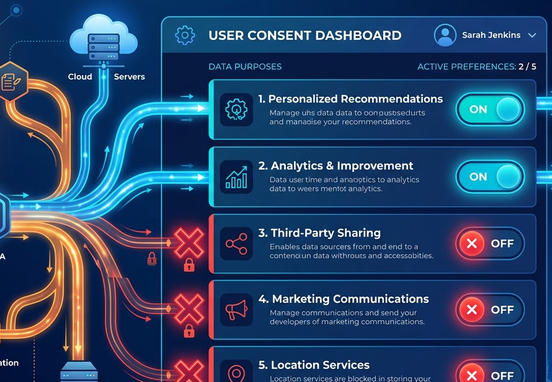
Compliance cannot be treated as a static checkbox verified only during initial user onboarding. Consent is a fluid operational asset that a consumer can modify, restrict, or completely revoke at any point. A compliant web pipeline must treat user consent preferences as dynamic variables that directly control downstream data flow in real time.
Real-Time Access Restriction Controls
When a user adjusts their privacy settings or opts out of specific data processing behaviors, the pipeline must instantly propagate those changes across all integrated systems. This instantaneous sync prevents third-party marketing tools and internal analytical engines from accessing unauthorized data vectors.
Enforcing these strict barriers at scale requires developers to understand the principles of role-based system permissions keeping sensitive data safe at scale across the enterprise network. By pairing user-defined consent states with granular application permissions, the system blocks illegitimate data access automatically.
Programmatic Right to Erasure Execution
The right to erasure, or the right to be forgotten, presents a massive technical challenge for organizations utilizing complex, relational databases. When an erasure request is validated, the system must execute a cascading deletion routine that purges the user's files from every production database, backup log, and third-party integration endpoint.
- Trigger Deletion Webhook: The system captures a verified user erasure request and broadcasts a cryptographic deletion payload to all connected service environments.
- Execute Relational Database Cascade: Main application tables locate the target user ID and remove all linked rows across operational ledgers.
- Purge Unstructured Storage Buckets: Automated scripts scour document repositories, removing PDF invoices, user profile pictures, and unindexed log entries.
- Broadcast Third-Party Purge Commands: External analytics, CRM, and marketing platforms receive structured API calls ordering the permanent deletion of the localized profile.
- Generate Cryptographic Destruction Log: The pipeline creates an anonymous, immutable receipt confirming the deletion occurred, keeping the business audit-ready.
Technical Guardrail Tip: Never allow deletion routines to completely wipe structural database rows if they are linked to essential financial accounting ledgers. Instead, rewrite the sensitive rows by substituting the customer identifiers with static "Anonymous User" markers to maintain absolute ledger balance without retaining PII.

Continuous Compliance Auditing and Incident Detection
Constructing a secure data pipeline provides little value if the engineering team cannot definitively prove that compliance rules are working properly. System configurations naturally shift over time as new features are deployed, plugins are updated, and database schemas are modified. Organizations must implement automated auditing systems that continuously scan for data leaks and validation failures.
To maintain historical proof of system alignment, developers should implement how automated audit trails keep a growing business audit-ready without creating manual work for internal engineering teams. These automated audit trails track exactly who accessed which data fields, when the access occurred, and what transformation logic was applied to the payload. These logs must be stored in an immutable write-once, read-many (WORM) format to guarantee they cannot be altered during a legal dispute.
Continuous compliance monitoring also requires real-time anomaly detection engines that flag unusual data export volumes or unauthorized access attempts. If a regional node suddenly requests thousands of tokenized identifiers within a short timeframe, the system must automatically lock down the endpoint and alert the security operations center. This rapid response minimizes the scale of data breaches before they escalate into global regulatory crises.
Future-Proofing Data Infrastructure Against Evolving Regulations
International privacy laws are constantly updated as new technologies emerge and consumer expectations shift. Building a custom web data pipeline that hardcodes specific regulatory parameters guarantees that the infrastructure will become obsolete within a few years. True engineering foresight requires designing an abstraction layer that treats privacy rules as dynamic configuration files rather than hardcoded logic parameters.
By separating the underlying data pipeline architecture from the specific compliance ruleset, developers can adjust system behaviors instantly via centralized control panels. If a new state or country passes strict localization laws, administrators simply update the system routing matrix without rewriting a single line of backend application code. This level of agility allows growing enterprises to confidently scale their digital operations globally while maintaining absolute alignment with international privacy mandates.