

The Review Engine: How to Systematically Get Five Star Ratings
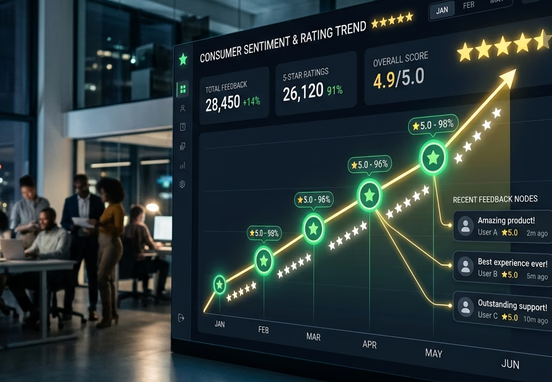
Consumer validation operates as the primary driver of digital procurement decisions in the modern commercial ecosystem. When a high-intent prospect identifies a potential B2B service provider or local enterprise, they rarely rely solely on corporate marketing claims. Instead, they actively audit peer review networks to verify operational consistency, delivery reliability, and brand credibility. A business that lacks a systematic mechanism for capturing, managing, and showcasing customer feedback is operating with a severe market liability.
Relying on ad-hoc, manual requests for customer feedback is an unsustainable operational model. When review acquisition is treated as an intermittent administrative task, volume stagnates, velocity drops, and your brand's digital profile fades from prominent search indexes. To build an unassailable regional position, an enterprise must construct an automated, high-converting review engine. This structural system turns every successful transaction into an automated source of fresh, high-authority social proof.
Building this infrastructure requires an analytical approach that combines automated pipelines, behavioral psychology, and optimized user touchpoints. By embedding direct feedback pathways cleanly into your data flows, your enterprise can capture maximum validation value with zero daily manual oversight. This direct strategy stabilizes your acquisition funnels, improves organic search performance, and continually validates your brand's premium market value.
The Operational Mechanics of Continuous Feedback Channels
An optimized reputation framework functions by converting customer satisfaction into visible digital markers systematically. This process relies on absolute consistency in request deployment, eliminating the emotional hesitation or administrative friction associated with manual staff follow-ups. When review collection runs automatically in the background, your business builds a predictable wall of conversion assets.
To maximize compliance, feedback requests must be triggered at the moment of peak customer satisfaction. This milestone varies significantly depending on your specific business vertical and transaction cycle. Requesting a rating too early, before a user has experienced full product utility, creates operational confusion. Conversely, delaying the request by several weeks allows consumer enthusiasm to decay, causing a drastic collapse in response conversions.
Mapping Triggers Across Diverse Business Frameworks
Identifying the exact point of customer satisfaction requires a detailed analysis of your internal delivery pipelines. Your technical teams must integrate automated event hooks directly into your customer tracking systems to launch requests instantly when success milestones are reached.
- E-Commerce Real estate: Trigger the notification exactly 48 to 72 hours after verified physical product delivery, allowing ample time for initial unboxing and product interaction.
- Professional B2B Consulting Services: Launch the communication immediately following the sign-off of your primary project phase or during the delivery of your initial performance report.
- SaaS and Digital Platforms: Automate the request loop when a user completes a specific number of high-value tasks or crosses a predefined usage duration benchmark.
- Localized Field Engineering: Deploy an immediate SMS text notification within thirty minutes of a field technician marking a service ticket as completed within your mobile CRM framework.
Aligning these technical triggers requires a clear understanding of your overarching customer touchpoints. Integrating your automation loops smoothly into a well-defined customer journey framework ensures that your feedback requests land precisely when users are most receptive, maximizing engagement and preventing brand communication fatigue.

Automated Communication Channels: Data and Delivery Optimization
The communication channel you select to deliver your review links dictates your ultimate conversion baseline. Modern infrastructure allows for automated delivery via electronic mail, text message channels, or direct in-application prompts. Each pathway carries distinct response dynamics that your marketing divisions must measure continuously.
| Delivery Channel | Average Open Velocity | Standard Response Conversion | Primary Architectural Risk Factor |
|---|---|---|---|
| Automated SMS Messages | Within 3 minutes of arrival | 15% to 28% High Conversion | Stricter regional telecom compliance rules and character length constraints |
| Transactional Email Outbounds | Within 4 to 12 hours | 4% to 9% Moderate Yield | Vulnerable to spam filter suppression and cluttered user inboxes |
| In-Application Prompts | Instantaneous during session | 18% to 35% Peak Performance | Restricted exclusively to active software users or account dashboards |
| Physical Quick Response (QR) Media | Dependent on on-site interaction | 3% to 6% Low Yield | High friction; requires manual device scanning and user physical effort |
Optimizing the SMS Request Pipeline
Because text messages maintain exceptionally high open rates, they serve as the primary channel for high-volume consumer validation engines. The message body must remain direct, concise, and entirely focused on a single call-to-action path. Avoid wasting characters on corporate fluff; state the business intent directly and present an un-shortened, trusted domain link that routes the user instantly to your feedback portal.
To ensure your automated outbounds parse perfectly and trigger zero platform-level spam blocks, your technical teams can configure automated routing scripts. Review this clean programmatic example of an automated text notification configuration built to deliver direct transaction validation links:
+---------------------------------------+
|  Customer Success Milestone Achieved  |
+---------------------------------------+
                    |
                    v
+---------------------------------------+
|    Automated Event Hook Triggered     |
+---------------------------------------+
                    |
                    v
+---------------------------------------+
|   Select Automated Delivery Channel   |
+---------------------------------------+
      /             |             \
     v              v              v
+---------+   +-----------+   +-----------+
|   SMS   |   |   Email   |   |  In-App   |
+---------+   +-----------+   +-----------+
     \              |              /
      v             v             v
+---------------------------------------+
|    Lightweight Feedback Portal        |
+---------------------------------------+
                    |
           [ Customer Evaluation ]
            /                 \
     ( Positive 4-5* )   ( Negative 1-3* )
          /                     \
         v                       v
+-----------------------+ +-----------------------+
| Public Review Profile | | Secure Support Route  |
| (Velocity & Keywords) | | (Private Resolution)  |
+-----------------------+ +-----------------------+
This clean programmatic logic hooks directly into your transactional databases, removing human error from the reputation collection cycle entirely.

Eliminating Interactive Friction with Performance-First Design
The most common reason an automated review engine fails to generate consistent ratings is interactive friction within the user conversion loop. If a customer clicks your review link and encounters a slow-loading landing page, complex navigation menus, or confusing instructions, they will immediately abandon the process. High-intent consumers will not fight through technical layout bugs simply to leave your brand a favorable rating.
To protect your conversion yields, your feedback collection infrastructure must load instantly on all mobile browsers. Transitioning to professional web design and development services guarantees that your tracking pages are built on lean foundations, removing the unnecessary code weight common to mass-market visual builders. Ensuring your collection portals provide a fast, seamless user flow is a proven method for optimizing customer behavior and maximizing response volumes. Investing in a premium, custom-coded interactive architecture is an effective strategy for improving conversion performance, a reality detailed in our study on how great user experience lowers customer acquisition costs.
Reputation Portal Usability Tip: Never force a consumer to register an internal account, complete a long captcha verification, or fill out a long feedback form before reaching your primary public review link. Every extra interaction step you insert into the verification pipeline drops your ultimate response yield by up to twenty percent.
The Algorithmic Value of Review Velocity and Keywords
Search engine ranking filters process your public review markers continuously to calculate real-world brand prominence. When determining positioning within regional search grids and map pack listings, algorithms prioritize three distinct dimensions of your feedback profile: volume, velocity, and keyword diversity.
Consistent review velocity—receiving steady ratings over time—signals to search spiders that your company is active, operational, and meeting consumer expectations continuously. An enterprise that gains fifty ratings in a single week then goes silent for six months flags automated filters for unnatural manipulation, stalling organic growth.
Furthermore, when customers include specific service variations and neighborhood names within their written feedback, they natively strengthen your platform's contextual footprint. This topical enrichment is essential for dominating competitive local maps, an operational milestone explained in our comprehensive local SEO playbook guide, which details how review accumulation drives regional search placements.

Handling Negative Feedback Safely and Protecting Legal Sovereignty
No enterprise can avoid negative feedback entirely as it scales operational capacity. When an unfavorable rating appears on your public profiles, your executive divisions must treat it as a critical customer service touchpoint rather than a brand crisis. Responding to negative reviews factually, calmly, and with a solution-oriented focus showcases your brand's operational integrity to potential customers reading the exchange.
Never utilize automated, generic corporate templates to address critical customer feedback. Acknowledge the user's operational issue directly, keep your statements completely professional, and shift the complex conversation to private communication channels like a dedicated corporate support email. This strategy protects your brand's public reputation while ensuring your team retains full control over the resolution process.
Maintaining absolute Platform Compliance
To protect your digital assets from severe algorithmic penalties, you must follow strict compliance rules set by global review networks. Violating these platform guidelines can lead to immediate profile suspensions that destroy your organic search footprint.
- Avoid Review Gating: Never use an initial internal questionnaire to filter out unhappy users while routing only satisfied customers to public rating profiles. This manipulative practice violates core search terms of service.
- Prohibit Financial Incentives: Do not offer cash discounts, gift tokens, or free products in exchange for positive public evaluations. Review filters track unnatural response jumps and remove manipulated profiles entirely.
- Prevent Internal Conflicts: Never allow employees, internal stakeholders, or paid contractors to post positive reviews for your own firm, preserving authentic market authority.
Operating a commercial web presence with poor data security or unencrypted server configurations makes your business vulnerable to automated bots, fake reviews, and validation script failures. Protecting your customer portals requires a foundational understanding of data safety, as outlined in our security overview covering cyber security infrastructure basics for founders, which details how to properly clear browser configuration errors and secure corporate digital assets.
Monitoring Feedback Conversions via Analytics Data Logs
To maximize the efficiency of your automated review engine, your data divisions must measure its performance with the same accuracy applied to paid marketing channels. Track the exact conversion drop-offs between message dispatches, link clicks, and final review submissions to locate and fix processing bottlenecks within your reputation pipeline.
Deploying server-side analytics scripts allows your technical teams to track exactly how users navigate your internal feedback portals. Monitoring this click data ensures your team can isolate page latency issues or layout shifts that cause users to abandon the rating process. Reviewing our technical manual on tracking user analytics and heatmaps provides your operations division with the necessary insights to optimize conversion loops and maximize your overall reputation metrics.
By moving away from slow, unoptimized templates and building on custom-coded systems, your company eliminates the performance drops that drive customers away mid-transaction. Relying on an enterprise-grade clean, hand-coded web architecture over page builders ensures your collection funnels load instantly, scale smoothly, and convert users efficiently.
Securing expert engineering guarantees your digital assets remain secure, fast, and perfectly tailored to your target customer journeys. Our professional website design and development solutions are built to remove system bloat and deliver highly performant custom software applications. Investing in premium development ensures your organization protects its brand authority, outpaces market rivals, and builds a resilient digital presence that drives sustainable, long-term commercial growth.