How Great User Experience Lowers Customer Acquisition Costs
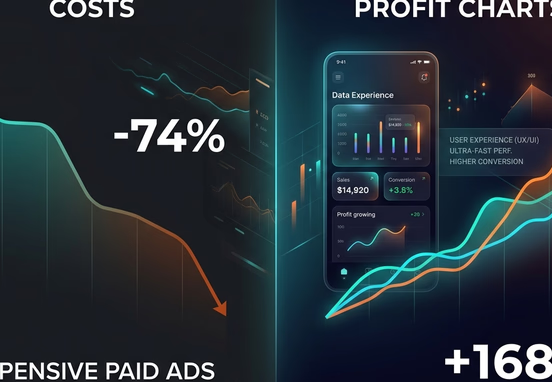
Customer Acquisition Cost (CAC) functions as a brutal indicator of a business's operational health. When digital media costs scale upward, companies instinctively pour more capital into acquisition platforms like Google Ads, Meta, or LinkedIn. This strategy creates a dangerous dependency on paid networks, masking the structural defects present on the destination web asset itself.
Investing in user experience (UX) engineering tackles the acquisition problem from the inside out. Instead of paying more to attract new traffic, a refined interface maximizes the commercial value of the traffic you already possess. When an interface operates with seamless efficiency, user hesitation drops, form completions rise, and the cost to acquire each individual client plummets.
The relationship between user retention and marketing efficiency is direct. Paid ad campaigns pull qualified prospects to a landing page, but the interface dictates whether that paid click turns into a recorded lead or bounces back to the search results. If the user interface introduces cognitive friction, complex navigation paths, or unpredictable layouts, your marketing capital is systematically wasted.
The Mathematical Relationship Between UX and Customer Acquisition Costs
To understand how user experience mathematically deflates CAC, you must analyze the core variables that determine marketing spend efficiency. Advertising networks charge businesses based on impressions or clicks, but your actual business growth is measured in acquired customers.
When your digital platform conversion rate is low, you must buy a higher volume of traffic to secure a single sale. Elevating your application's usability alters this entire operational equation by converting a higher percentage of incoming sessions.
Let's break down the basic financial relationship between traffic volume, conversion efficiency, and customer acquisition costs:
CAC = Total Marketing and Advertising Spend / Total Acquired Customers
When user experience lowers the barriers to action, the number of acquired customers increases while the total advertising spend remains static. This shifts the mathematical outcome heavily in your favor, unlocking capital that can be reinvested into product development or market expansion.
Consider a baseline scenario where an enterprise spends $10,000 on paid media to generate 5,000 clicks. If the landing page features an unoptimized interface that converts at a meager 1%, the campaign yields exactly 50 customers, resulting in a CAC of $200.
By re-engineering that same landing page interface to remove layout confusion and performance lag, the conversion efficiency can easily climb to 4%. That identical $10,000 marketing outlay now produces 200 customers, driving your individual acquisition cost down to $50.
Core Friction Points That Artificially Inflate Advertising Spend
Digital conversion funnels break down at highly predictable interfaces. When an organization ignores the underlying mechanics of user interaction, they inadvertently construct barriers that drive potential buyers straight to market alternatives.
Identifying and eliminating these design errors is the primary step in stabilizing an acquisition pipeline. These common interface failures actively drive up your customer acquisition costs:
- Asymmetrical Layout Hierarchies: Content layouts that fail to present a clear, immediate value proposition within the first three seconds of a session forcing users to search for basic context.
- Invasive Intrusive Elements: Pop-ups, aggressive cookie banners, and unexpected layout shifts that interrupt the reading flow and break user trust before a value exchange occurs.
- Convoluted Navigation Architectures: Forcing visitors to guess where critical information is located rather than using intuitive, self-explanatory pathways.
- Over-Engineered Data Collection Form Factors: Demanding excessive personal information upfront before establishing brand credibility or offering immediate value.
By shifting toward custom architectures and clear user pathing, organizations avoid these systemic structural traps. When evaluating how custom platforms stack up against algorithmic site builders, it becomes evident that automated templates cannot replicate the nuanced UX design required to convert high-intent traffic. Stripping away unnecessary interface options forces the user's attention onto your primary commercial calls to action.
Analyzing the Metrics: Poor vs. Optimized Digital Interfaces
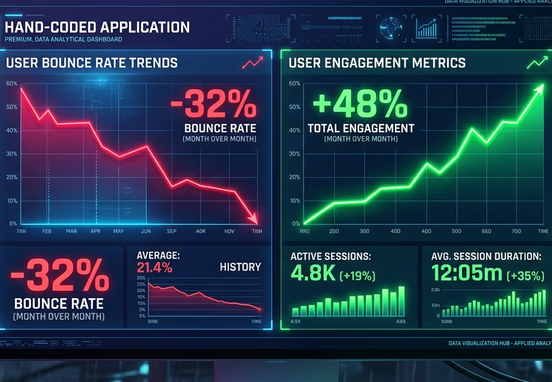
The financial impact of usability defects becomes undeniable when examining operational performance metrics across different framework ecosystems. Monolithic, unoptimized systems consistently introduce traffic leaks that force advertising platforms to charge premium rates for customer acquisition.
| Performance Indicator | Legacy / Page-Builder Infrastructure | High-Performance Engineered Interface | Direct Impact on Acquisition Cost |
|---|---|---|---|
| Initial Landing Page Bounce Rate | 55% - 75% | 20% - 35% | Lowers CPC by improving ad relevance scores |
| Average Session Duration | Sub 45 Seconds | 2.5 - 4.5 Minutes | Increases brand equity and information retention |
| Lead Form Completion Rate | 1.5% - 2.2% | 4.8% - 7.5% | Drops overall CAC by a factor of three |
| Mobile Cart Abandonment Metric | 78% - 88% | 42% - 55% | Reclaims lost revenue from mobile traffic |
| Page Infrastructure Load Time | 4.5+ Seconds | Under 1.5 Seconds | Prevents early-stage network session drops |
When an asset features a highly optimized interface, every single marketing dollar spent yields a higher return. The advertising network detects that users remain on your site longer, which directly improves your quality score and lowers your average cost-per-click.
Structural Mechanics That Lower Acquisition Barriers
Lowering acquisition costs requires custom execution across the technical stack. You cannot achieve world-class efficiency using generic, bloated software codebases that compromise user interactions for development speed.
Maximizing Load Velocity to Catch User Attention
A user's intent is at its absolute highest peak the moment they click a link. If your platform delays rendering its main contents, that intent degrades rapidly into frustration, leading to a bounce.
By systematically stabilizing core web vitals and page speed, you eliminate network latency and ensure elements display instantly. This immediately secures user focus before they can navigate away to a competitor.
Asynchronous Form Processing and Minimalist Form Fields
Form structures represent the ultimate conversion gateway for B2B and lead-generation companies. Standard forms require page reloads or run heavy scripts that freeze mobile viewports, stalling the customer journey.
Building custom, lightweight inputs that validate data instantly without forcing full-page refreshes removes psychological friction. The transition from interested reader to confirmed lead happens naturally.
When you spend time carefully mapping out the customer journey from discovery to purchase, you identify the exact moment a consumer is ready to share their data, allowing you to insert high-performing forms perfectly.
Streamlining Mobile Checkout Funnels
Desktop-first layouts scaled down to mobile viewports create tight text clusters and tiny tap targets. Users frequently mistap fields, causing input validation failures that lead to checkout abandonment.
Mobile UX design requires native thumb-zone optimization, sticky primary buttons, and auto-populating field data parameters. This level of precision transforms complex multi-step buying funnels into simple, fast interaction sequences.
The Downstream Effect: Brand Equity and Organic Customer Loops
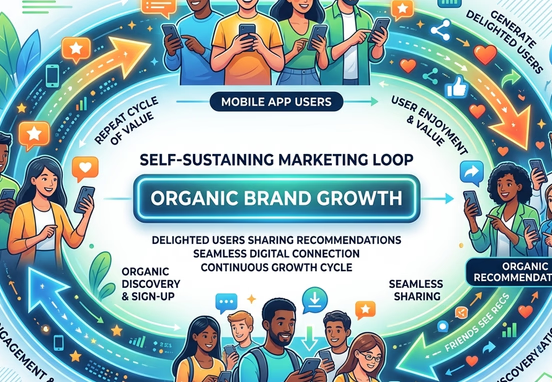
Great user experience does more than lower immediate ad costs; it changes how your customer base behaves over time. A frictionless interface turns a one-time buyer into an advocate, creating self-sustaining marketing loops.
When a platform feels rewarding to use, clients instinctively share it within their professional networks. This word-of-mouth visibility brings in organic, high-intent traffic that features a raw customer acquisition cost of zero.
+---------------------------------------+
| 1. The Frictionless Transaction       |◄----------+
+---------------------------------------+           |
                    |                               |
                    v                               |
+---------------------------------------+           |
| 2. The Positive Memory Loop           |           |
+---------------------------------------+           |
                    |                               |
                    v                               |
+---------------------------------------+           |
| 3. Organic Referral Action            |           |
+---------------------------------------+           |
                    |                               |
                    v                               |
+---------------------------------------+           |
| 4. Direct Organic Traffic Influx      |           |
+---------------------------------------+           |
                    |                               |
                    v                               |
+---------------------------------------+           |
| 5. CAC Capital Deflation              |-----------+
+---------------------------------------+
- The Frictionless Transaction: A user navigates your interface, experiences zero lag, and completes their task or purchase within minutes.
- The Positive Memory Loop: The user associates your brand name with structural competence, reliability, and ease of use.
- Organic Referral Action: When a peer asks for a recommendation, the customer points them directly to your platform due to the ease of the interface.
- Direct Organic Traffic Influx: The new prospect arrives via direct search or referral, bypassing expensive paid ad channels completely.
- CAC Capital Deflation: As the percentage of organic referral sales increases, your overall blended acquisition costs drop to historic lows.
This behavioral phenomenon shifts your public website from an unpredictable marketing expense into a high-yield corporate asset. Over time, this compounding efficiency is critical for maximizing website ROI and protecting your business margins from ad market inflation.
Psychological Trust and Its Direct Impact on Lead Conversion
Consumers protect their financial data with high scrutiny. If an interface looks outdated, handles data poorly, or features layout jumps, the user feels a sense of digital insecurity that stops them from buying.
Professional layout hierarchy, premium typography choices, and structured layouts act as silent trust signals. These design choices reassure the user that your company handles operations with extreme professionalism and care.
A clean interface directly answers consumer objections before they can form. This silent reassurance allows organizations to achieve maximum performance, matching or exceeding the standard rules for identifying a good conversion rate for a hand-coded website.
Operational Growth Directive: Do not optimize your marketing spend until you have optimized your interface infrastructure. Pouring premium paid traffic into an unoptimized, template-restricted platform is the exact financial equivalent of filling a leaking bucket. Fix the underlying interaction engineering first to secure a stable foundation for your ad scale.
Algorithmic Rewards of Superior Interaction Design
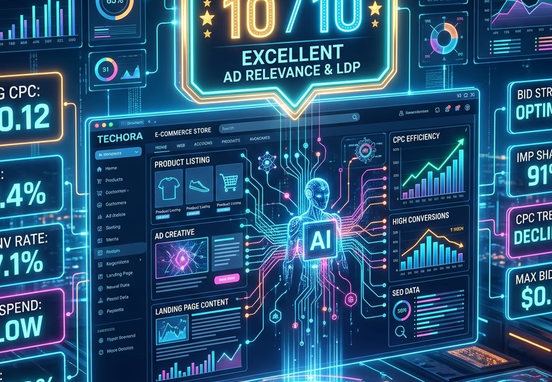
Modern digital advertising platforms rely on complex machine learning algorithms to distribute ad placements. Platforms like Google and Meta track post-click user behavior to determine whether your destination page provides a high-quality environment.
When users click your advertisement and immediately click the back button because of an unoptimized layout, the ad network penalizes your account. This penalty manifests as a lower Quality Score or lower Ad Relevance Diagnostic rating.
A low relevance score causes the advertising auction to artificially inflate your Cost Per Click (CPC). The network actively charges you more money to display your ads because your destination page harms their user retention metrics.
Conversely, a custom-coded interface that keeps users engaged drops your acquisition costs algorithmically. High time-on-site indicators signal to the platform that your business offers value, earning your campaigns cheaper ad inventory and placement priorities over unoptimized competitors.
Mitigating Hidden Churn Vectors Through Cognitive Simplicity
Failing to design an interface around human cognitive limits creates choice paralysis. When a consumer is presented with a chaotic wall of text, competing call-to-action colors, and disjointed menu options, their mental energy drains rapidly.
Psychological research confirms that high cognitive load causes immediate task abandonment. Users exit platforms not because they lack interest in the product, but because the effort required to decipher the layout outweighs their immediate motivation.
Engineered interfaces employ deliberate negative space and strict typographic sizing scales to guide the human eye effortlessly down the page. Reducing the volume of choices at any single step protects the user's executive processing capacity.
This minimalist presentation style removes the secondary confirmation steps that give buyers time to overthink or doubt their purchase intentions. By streamlining the interaction flow, you lock in consumer commitment before friction can disrupt the sales process.
Stabilizing Customer Acquisition Channels for Sustainable Scale
Relying exclusively on aggressive advertising campaigns to drive business growth is an unsustainable, low-margin approach to digital commerce. True competitive advantage belongs to the organizations that optimize their interfaces to transform basic user attention into predictable transactional actions.
By focusing heavily on functional layout design, speed-first development principles, and zero-friction customer pathways, you insulate your company from volatile ad platform pricing. A premium user experience converts standard market attention into clear business value, ensuring your marketing dollars yield the maximum possible revenue.
Deploy custom infrastructure tailored for your conversion goals using our professional speed-first design and development services.