

How to Document Exceptions When an Order Deviates From the Standard Web Workflow

Standard web commerce networks are engineered to support the frictionless transactional loop commonly known as the happy path. In this ideal sequence, a customer submits a valid payment token, the relational database modifies inventory balances instantly, and outbound APIs transmit fulfillment data to back-office ledgers within milliseconds. In high-volume enterprise architectures, however, real-world data payloads frequently drift from this optimal lane due to external API timeouts, sudden inventory drops, payment gate micro-failures, or complex, non-standard customer account overrides.
When a web order deviates from your standard processing sequence, handling the disruption through unrecorded manual patches or generic database updates introduces massive technical risk. Without an explicit, automated system to isolate and document anomalies, your enterprise platforms quickly experience data fragmentation. Accounting modules lose track of localized pricing adjustments, warehouse teams receive incomplete fulfillment instructions, and customer support representatives lack the unified interface visibility required to address client inquiries accurately.
Hardening your digital infrastructure against these vulnerabilities requires moving away from informal communication chains and building an automated exception documentation protocol. Every operational deviation must be intercepted, structured as an immutable data entity, and recorded inside a localized event ledger. By establishing dedicated exception-handling boundaries within your custom code base, you transform unpredictable runtime anomalies into transparent, auditable business logic milestones.
Classifying Runtime Anomalies and Business Logic Exceptions
To build a comprehensive exception management network, your engineering teams must first differentiate between infrastructure fault states and deliberate business logic deviations. Forcing a single generic error logger to handle both database cluster blackouts and specialized customer shipping overrides creates cluttered log vaults that slow down technical diagnostic operations and compromise administrative workflows.
System exceptions are generally categorized into two distinct operational classes:
- Systemic Infrastructure Failures: These occur when physical connection channels break, such as a third-party credit card gateway returning a raw HTTP 503 error, an on-premise inventory database timing out, or an internal server running out of volatile memory capacity.
- Operational Business Violations: These occur when the technical components are operating perfectly, but the payload variables break explicit business rules. Examples include a wholesale buyer exceeding their pre-approved credit ceiling, a regional distributor ordering an asset restricted by geographic import laws, or a support rep manually bypassing standard shipping calculations to satisfy a VIP client.
When a systemic infrastructure failure occurs, your data pipelines must deploy automated fallback routines and time-delayed retry matrices to restore connection states without dropping data. Conversely, when an operational business violation is triggered, the system must pause the workflow sequence, lock the record, and generate an independent exception incident file that documents the explicit logic boundaries breached before routing the asset to an administrative verification queue.
The Architectural Schema of an Exception Incident Record
Documenting a workflow deviation cleanly requires establishing a highly structured database schema specifically dedicated to exception tracing. Relying on unstructured text files or basic text-based error files prevents administrative automation modules from parsing the exception metrics downstream, forcing employees to execute slow manual code reviews to evaluate the status of a blocked order.
Every exception record generated by your custom web pipeline must function as a comprehensive diagnostic file, capturing the complete state configuration of the transaction at the exact millisecond the deviation was intercepted. The exception tracking table within your central database repository must enforce strict typing constraints and feature the following essential fields:
| Database Column Name | Data Typographical Definition | Architectural Role and Enforced Log Constraint |
|---|---|---|
incident_id | Global Unique Identifier (UUIDv4) | Generates a completely unique, non-sequential primary tracking key for the specific exception record. |
order_reference_id | Foreign Key Relation Key (UUID) | Establishes a rigid cascading connection to the core transaction record inside the primary orders table. |
exception_class_code | Strict String Enumeration | Categorizes the error vector using explicit system constants (e.g., PAYMENT_DISCREPANCY, SHIPPING_BYPASS). |
raw_state_payload | Binary Large Object JSON Data | Captures the complete, unparsed JSON data packet received by the ingestion gateway before mutation occurred. |
breached_rule_metadata | Relational JSON Ledger | Records the specific business parameters or metric thresholds that triggered the validation exception gate. |
assigned_operator_id | Nullable Foreign Key Identifier | Tracks the unique account ID of the internal back-office employee assigned to review or manually clear the asset. |
resolution_status | Enforced State Enumeration | Tracks the active lifecycle position of the incident using strict parameters: pending, under_review, resolved. |

The Sequential Exception Interception and Logging Flow
Building an airtight validation pipeline requires separating your web form ingestion layers from your primary database execution threads. When a customer executes an order, the ingestion endpoint validates the request signature, verifies structural data types, and writes the raw string payload directly into a secure message queue broker. This architecture guarantees that even if a transaction exhibits deep logical anomalies downstream, your front-end web interfaces remain completely responsive and immune to execution deadlocks.
The secondary asynchronous worker processes extract payloads from the queue and pass the data variables through your core business logic filters. If the worker identifies an operational deviation—such as a price mismatch between the checkout page and your internal master pricing database—the exception handling matrix isolates the execution thread instantly. The pipeline halts further down-stream writes, extracts the system state variables, updates the exception ledger table, and shifts the primary transaction status to a suspended hold block.
The comprehensive flowchart below illustrates the execution architecture of an automated exception management pipeline, showing how logical deviations are intercepted, documented as structured entities, and routed to isolated administrative queues without interrupting standard transactional pathways:
[Ingested Web Order Payload Extracted From Queue]
                        │
                        ▼
       [Query Master System Validation Engine]
                        │
                        ▼
    [Evaluate Order Metrics Against Business Rules]
                        │
         ┌──────────────┴──────────────┐
         ▼ (Data Aligns Perfectly)     ▼ (Deviation Intercepted: e.g., Price Mismatch)
   [Execute Standard Happy Path] [Halt Primary Execution Thread Instantly]
   [Update Production Ledgers]                 │
   [Dispatch Shipping Webhooks]                ▼
   [Close Active Worker Thread]  [Acquire Target Transaction Row Lock]
                                               │
                                               ▼
                                 [Generate Unique Incident UUIDv4]
                                               │
                                               ▼
                                 [Compile Snapshot of Raw JSON State]
                                               │
                                               ▼
                                 [Write Fields to Exception Tracking Table]
                                               │
                                               ▼
                                 [Update Core Order Status to "ON_HOLD"]
                                               │
                                               ▼
                                 [Route File to Back-Office Admin Queue]
                                               │
                                               ▼
[End: Release Row Lock & Log Diagnostic Alert]
Enforcing Row-Level Database Protective Barriers
When an active worker thread halts a transaction to log an operational deviation, it must instantly acquire an explicit database lock on that specific record row using isolation commands like SELECT FOR UPDATE. This directive forces adjacent automated microservices to pause if they attempt to modify the identical client account or asset balance concurrently. Once the exception ledger entry completes successfully and the core order status transitions to a suspended hold, the lock is released safely, preventing race conditions or double-processing errors.
The Operational Playbook for Manual Review and Resolution Transitions
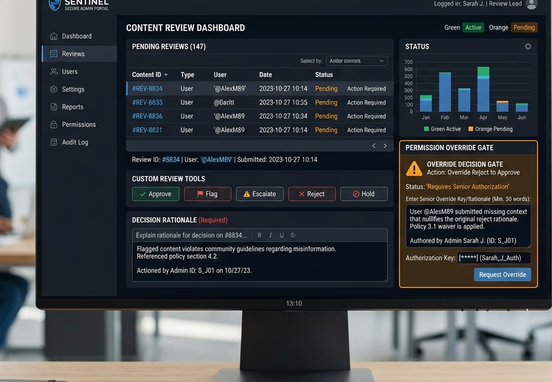
Once an order deviation is safely isolated within the exception tracking table, your back-office administration systems must govern its clearance using strict, permission-based workflows. Manual fixes executed straight inside production database consoles via direct SQL commands are highly dangerous, as they bypass your application's validation layers, create un-auditable data tracks, and easily introduce schema corruption. All manual clearances must execute through highly controlled administrative control portals.
To ensure long-term visibility and operational control, your engineering teams must implement a structured three-step verification playbook across all internal administrative modules:
- Mandatory Rationale Enforcement: The administrative interface must block an internal employee from clearing an exception hold until they populate a text input field detailing the explicit operational justification for the override.
- Dual-Authorization Controls: For adjustments that exceed defined fiscal thresholds, the custom application logic must require a secondary administrative manager token to authorize the state shift, preventing internal security exposures.
- Automated Re-Validation Testing: When an operator updates an asset and clicks the resolve button, the pipeline must pass the modified payload back through the primary automated validation engines to ensure the change has not introduced secondary data formatting faults.
Once the modified transaction successfully clears the re-validation checkpoint, the system updates the incident tracking row status to resolved, records the timestamp and operator ID, and automatically passes the payload to your core fulfillment engines to resume standard operational processing.
System Engineering Tip
Connect your exception handling matrix to automated, outbound internal alerts using secure communication integrations. Configuring your background workers to push a structured alert to a dedicated administrative notification endpoint the exact millisecond a deviation is logged ensures your operations crews can triage high-value exceptions instantly, minimizing fulfillment delays.
Core Integration Safeguards and Forensic Integrity Controls
Building a robust, evergreen exception logging architecture requires grounding your system pipelines in clean, decoupled software patterns. Developing your core system applications around native trigger-action logic provides your software engineering teams with the exact computational boundaries needed to track state transitions, enforce strict conditional logic rules, and manage complex multi-step data transformations safely.
Furthermore, because modern enterprise networks rely on high-velocity data pipelines to link external interfaces with internal ledgers, your ingestion endpoints must be protected by strict security boundaries. Deploying advanced validation frameworks and learning how to detect system errors and automate data validation ensures your data engines catch format drift, filter out malicious structural inputs, and protect your primary tables from long-term silent corruption.
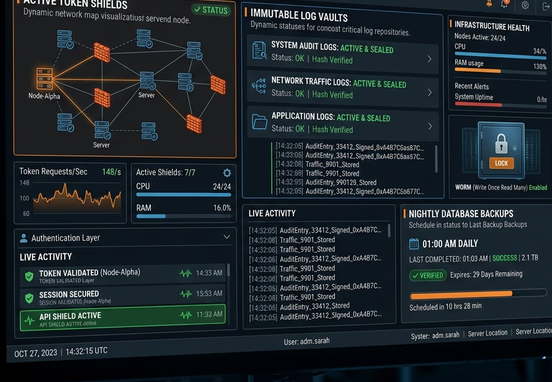
To isolate your authentication keys completely during these complex data transmission loops, your outbound API calls must be protected by dynamic abstraction layers. Implementing specialized security infrastructure driven by how token shields keep system authentication keys secure guarantees that your automated background processes can query external vendors and route synchronization micro-payloads without ever exposing master corporate credentials to persistent text-based logs or developer sandboxes.
Finally, your historical exception ledgers and system diagnostic files must be backed up dynamically to prevent permanent information loss during localized hardware drops. Integrating automated database maintenance routines configured to automatically back up business data and system logs every night ensures that even if a critical cloud storage cluster encounters an unrecoverable crash, your security teams can restore historical compliance records and forensic audit paths to a verified state instantly.
Hardening Systems Architecture for Total Operational Clarity
Transitioning your enterprise workflows away from fragile manual data overrides and deploying a custom, automated exception documentation pipeline completely removes operational uncertainty and protects corporate data integrity. By capturing system deviations as structured records, locking relational rows during mutations, and restricting overrides to permission-based admin portals, you eliminate data corruption risks and ensure your platforms operate with total transparency.
Designing, securing, and scaling these advanced exception tracking frameworks demands deep systems software engineering expertise, precise database coordinate mapping, and robust quality assurance testing. Partnering with professional platform architects ensures your backend data networks are engineered to isolate technical and operational anomalies with complete safety.
For organizations focused on taking complete ownership of their digital infrastructure and driving peak operational efficiency, utilizing professional custom workflow and systems automation services provides the technical expertise required to build secure, high-performance exception pipelines that eliminate middleman platforms, safeguard critical information assets, and protect long-term digital growth.