

How to Connect Multiple Global Office Databases Into One Secure Logic Network

Managing data assets across multi-regional enterprise environments introduces significant systemic friction when individual office hubs operate in isolation. Localized environments often spawn fragmented documentation protocols, divergent tech stacks, and siloed transaction records that disrupt executive oversight. To achieve true operational alignment, technical leaders must establish a singular, unified framework capable of consolidating disparate storage arrays without compromising localized processing speed or baseline data integrity.
The Core Impediments of Regional Data Hub Isolation
When regional branches process operations independently, the resulting data discrepancies degrade corporate agility and lower market valuation. Engineering teams frequently run into severe synchronization conflicts when overlapping records from London, Tokyo, and New York converge without pre-established operational rules. These architectural inconsistencies produce compliance oversights, transaction errors, and profound blind spots within operational analysis.
Data isolation also breeds operational inefficiencies that ripple across every department. When human resources, logistics, and sales teams use separate local instances, generating a single, reliable global report requires dozens of hours of manual compilation. This delay stalls critical decision-making, leaving leadership to rely on outdated metrics that fail to reflect the true state of the global enterprise.
Bridging these distributed systems demands moving past basic third-party connectors or volatile plugins that choke under enterprise-scale traffic. True operational harmony requires an optimized network that intercepts data at the regional edge, validates its schema, and securely commits it to a centralized ecosystem. Organizations can systematically optimize these distributed assets by deploying enterprise-grade workflow and systems automation services that structurally unify separate network infrastructures.
Engineering the Secure Logic Layer Architecture
Constructing a resilient cross-border infrastructure requires a decoupled logic layer positioned squarely between regional databases and the primary corporate application. This intermediary middleware functions as an automated customs house, evaluating incoming payloads, validating security certificates, and formatting schemas before execution. By separating data capture from raw storage operations, your engineering team protects core infrastructures from direct external exposure.
Implementing Decentralized API Gateways
Decentralized API gateways serve as the primary perimeter defense and routing mechanism for individual regional environments. Instead of allowing localized systems to communicate directly with foreign servers, each office pushes data directly to an isolated endpoint. This architectural boundary prevents localized vulnerabilities from expanding horizontally across the global network environment.
These gateways execute rapid authorization checks before passing payloads further down the pipeline. If a localized database node experiences a security breach, the gateway can instantly isolate that specific branch without taking the entire global logic network offline. This containment strategy is essential for protecting multi-million dollar digital infrastructure deployments.
Normalizing Dynamic Data Structures
Different regions naturally develop distinct data formatting preferences, such as contrasting time zones, currency valuations, and character sets. The central logic layer enforces a rigid schema validation matrix that translates regional inputs into a standardized global ledger. This automated normalization process guarantees that cross-border calculations remain clean, coherent, and immediately actionable for executive reporting engines.
Data normalization also eliminates the issue of duplicate record creation. When customer information or inventory adjustments arrive from multiple offices simultaneously, the logic layer cross-references existing keys to merge updates accurately. This architectural precaution ensures that internal systems maintain a singular version of truth for every operational event.
Here is the underlying network topology that handles global payload routing, transformation, and structural confirmation:
[ Regional Node: London ]     [ Regional Node: Tokyo ]     [ Regional Node: NY ]
           │                             │                            │
           ▼                             ▼                            ▼
   [ HTTPS Payload ]             [ HTTPS Payload ]            [ HTTPS Payload ]
           │                             │                            │
           └──────────────────────┬──────┴────────────────────────────┘
                                  │ (Encrypted TLS 1.3 Tunnel)
                                  ▼
                     [ Decentralized API Gateway ]
                                  │
                                  ▼
                     [ Central Logic Network Layer ]
                       ├── Token Shield Verification
                       ├── Schema Normalization Engine
                       └── Global Privacy Filter Matrix
                                  │
           ┌──────────────────────┼──────────────────────┐
           ▼                      ▼                      ▼
[ Validated Master DB ]   [ Real-Time Dashboard ]   [ Audit Trail Log ]
Strategic Synchronization Methodologies
Deciding how data flows between global endpoints requires balancing immediate consistency requirements against acceptable bandwidth limits. Engineering teams must evaluate whether specific processing functions demand instantaneous updates or if they can tolerate delayed batch processing. Selecting the incorrect methodology can overload transcontinental pipelines or lead to severe inventory and financial allocation errors.
| Synchronization Method | Operational Mechanics | Ideal Corporate Use Case | Primary Engineering Constraint |
|---|---|---|---|
| Real-Time Event Streams | Instantaneous ledger updates executed via secure webhook triggers. | Inventory reconciliation, financial settlement pipelines. | Requires constant high-bandwidth availability. |
| Hybrid Webhook Polling | Automated state checks executed at micro-intervals during business hours. | Regional client service dashboards, support queues. | Moderate processing overhead at the local endpoint. |
| Scheduled Batch Pipelines | High-volume structural updates grouped and executed during off-peak hours. | Non-critical human resource logs, internal archiving. | High transactional latency between synchronization intervals. |
Maintaining synchronization stability across cross-border databases requires careful attention to the mechanics of how two-way data sync keeps websites and back-office systems aligned over erratic wide-area networks. Choosing the appropriate architecture safeguards the network against data overwrites and processing loops.

Security Topography and Access Governance
A global logic network is only as dependable as the access protocols guarding its outer perimeters. Moving data across public internet backbones demands strict, end-to-end encryption protocols coupled with robust identity verification checks at every node. Organizations must assume that every regional access vector faces constant exposure risks.
Securing Inter-Database Communications
All data traffic traveling between regional office servers and the centralized logic network must be wrapped inside encrypted TLS tunnels. Employing strict IP access control lists ensures that the central logic engine exclusively accepts incoming payloads from verified corporate servers. Any unexpected connection attempt from an unlisted IP address is automatically dropped before it can interact with internal network logic.
Furthermore, cryptographic keys must be rotated automatically at scheduled intervals to prevent long-term credential compromise. By treating every connection as inherently untrusted until fully verified, the system eliminates traditional reliance on perimeter-only security frameworks. This approach keeps data completely shielded during transit across international infrastructure lines.
Enforcing Strict Identity Constraints
Mitigating horizontal security risks requires granular administrative parameters across all regional endpoints. Implementing strict role-based system permissions guarantees that regional operations personnel can interact solely with data pertinent to their specific geographic jurisdiction. This isolation prevents a security compromise in one local branch from exposing sensitive data assets worldwide.
Granular identity constraints also create comprehensive accountability across the entire organization. Every transaction, modification, and deletion is permanently tied to a verified system profile, providing a crystal-clear trail of operations. This level of transparency is vital for detecting internal operational anomalies before they scale into systemic problems.
Architectural Tip: Never embed raw database credentials directly within regional office software configurations. Always leverage centralized environment managers and short-lived token authentication methods to eliminate the risk of hard-coded credential exposure during external system audits.
Maintaining Cross-Border Regulatory Compliance
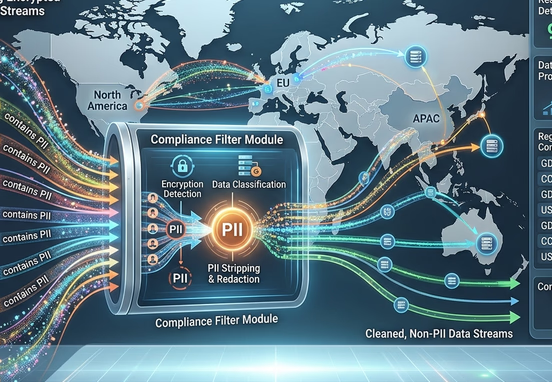
Global organizations operate within a highly fragmented web of data privacy laws that dictate how consumer information is managed. Transporting personally identifiable information across international borders without adequate filtering risks massive financial penalties and regulatory sanctions. The central logic network must serve as an automated compliance filter.
Corporate systems developers must construct data logic engines that evaluate payloads for localized privacy markers before they leave regional boundaries. Engineering teams mitigate structural liability by learning how to align custom web data pipelines with global privacy rules like GDPR, CCPA, and regional sovereignty acts. The centralized logic layer can instantly strip or redact sensitive fields based on the origin country of the record.
This selective data stripping allows organizations to maintain global operational metrics without violating localized sovereignty laws. For instance, the system can pass financial transaction totals to the corporate headquarters while leaving protected consumer identities securely locked inside the originating country’s local database. Building compliance directly into the logic tier eliminates reliance on manual staff oversight.
Error Isolation and Network Resiliency
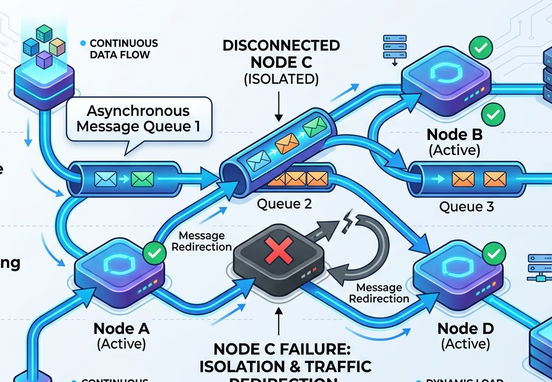
Transcontinental networks are inherently subject to unpredictable latency fluctuations, undersea fiber disruptions, and regional power failures. A primitive database network will often collapse or lock up when an active connection abruptly terminates during a high-volume sync event. Building true system resilience requires designing stateful error tracking mechanisms directly into the middleware code base.
Instead of allowing a dropped connection to corrupt active operations, systems must implement asynchronous message queues that temporarily store payloads when a target endpoint is unreachable. Developers ensure systemic continuity by designing the bulletproof web pipeline how custom error controls and smart fallbacks prevent system blackouts across the distributed environment. This design pattern ensures that when a regional office experiences a temporary blackout, its transactions are queued safely and executed automatically once connectivity is restored.
These resilient error channels must also include automated alert systems that notify engineering teams when a queue exceeds healthy capacity thresholds. By separating temporary network drops from fatal code exceptions, the system avoids generating false alarms for minor connectivity blips. This isolation allows developers to focus their energy entirely on genuine operational bottlenecks.
Step-by-Step Blueprint for Global Database Integration
Unifying distributed corporate storage systems requires a methodical deployment plan that minimizes system downtime and prevents data corruption. Engineering teams should follow this structured integration roadmap to transition legacy environments into an automated logic network.
- Conduct a Comprehensive Schema Audit: Document every active data table across all regional offices to pinpoint structural variations, redundant keys, and formatting anomalies.
- Deploy the Centralized API Gateway Layer: Establish the core cloud infrastructure that will accept, filter, and log all incoming cross-border network requests.
- Configure Regional VPN Tunnels: Provision dedicated, encrypted transport channels between each localized office server and the central logic hub.
- Implement Token Shielding Protocols: Replace static authentication methods with dynamic, short-lived tokens to protect the integration endpoints from unauthorized discovery.
- Establish Asynchronous Retry Queues: Code resilient fallback parameters that intercept failed payloads, store them safely, and schedule automatic retries without administrative intervention.
- Execute Controlled Sandbox Iterations: Run simulated operational loads through isolated environments to confirm that data transformation logic operates perfectly under maximum stress.
- Initiate Phased Production Migration: Systematically transition individual regional offices onto the live logic network one by one, verifying data integrity at every step.
Optimizing the Connected Enterprise Architecture
Once the structural pipelines are operating smoothly, the unified data network unlocks profound operational advantages for the enterprise. Executive teams gain access to real-time performance analytics that reflect the absolute state of global operations without manual reporting delays. This comprehensive visibility allows for faster operational pivots, more accurate forecasting, and a significantly smaller technical debt footprint.
Maintaining this state of operational clarity requires treating the unified logic network as an evolving piece of corporate infrastructure. Continuous monitoring, scheduled security evaluations, and regular payload validation audits ensure that the system scales smoothly alongside the company. By eliminating regional data isolation, growing enterprises build a durable digital foundation capable of supporting continuous international expansion.