

Role-Based System Permissions: Keeping Sensitive Data Safe at Scale

Organizations operating at scale face an inherent risk when access to corporate data layers is uniformly distributed. In the early stages of a business, giving every employee global administrator privileges appears convenient, bypassing internal friction and allowing rapid software updates. However, as team headcount scales and the volume of sensitive client records, financial statements, and technical infrastructure nodes expands, flat permission models become an hazard. A single compromised employee account or an accidental internal misconfiguration can instantly trigger catastrophic database leaks, data corruption, or compliance failures.
Securing an expanding enterprise requires decoupling individual employee identities from direct database permissions. Role-Based Access Control (RBAC) establishes a structured administrative layer where system access is tied strictly to defined organizational responsibilities rather than specific individuals. By implementing a granular system of roles, scopes, and actions, firms can systematically enforce the Principle of Least Privilege. This infrastructural architecture limits the blast radius of compromised credentials, keeps operational records protected, and ensures data visibility scales safely alongside team growth.
Architectural Foundations of Scoped Permissions
To implement a resilient RBAC framework, developers must construct a clean intermediary layer between user authentication and database query execution. When an employee attempts to view a webpage, request an API endpoint, or alter an inventory item, the application must not simply verify who the user is. The system must evaluate the specific role assigned to that identity and determine whether that role possesses the explicit clearance to execute the requested method.
This multi-tiered evaluation loop keeps internal data isolated from unauthorized viewing. The verification pipeline cross-references incoming session tokens against localized database permission schemas before allowing the data storage layer to return records. To maintain sub-second application speeds, these evaluation networks utilize optimized caching strategies that read role parameters instantly without creating performance logjams in primary operational code bases.
+-----------------------------------------------------------------+
|                    USER/API INBOUND REQUEST                     |
|  (Passes JSON Web Token containing Authentication Signature)   |
+--------------------------------+--------------------------------+
                                 |
                                 v
+-----------------------------------------------------------------+
|                   IDENTITY AUTHC VERIFICATION                   |
|  (Confirms Cryptographic Integrity and Expiration of Token)     |
+--------------------------------+--------------------------------+
                                 |
                                 v
+-----------------------------------------------------------------+
|                RBAC INTERMEDIARY AUTHORIZATION LAYER            |
|  (Evaluates Contextual Role Permissions, Scopes, and Actions)   |
+--------------------------------+--------------------------------+
                                 |
         +-----------------------+-----------------------+
         | (Authorized Context)                          | (Unauthorized Context)
         v                                               v
+--------------------------------+               +--------------------------------+
|    DATA STORAGE MATRIX QUERY   |               |   HTTP 403 ACCESS DENIED NODE  |
| - Executes Safe SQL Lookup     |               | - Terminate Pipeline Thread    |
| - Returns Masked Record Rows   |               | - Write Anomaly to Audit Trail |
+--------------------------------+               +--------------------------------+
The Architectural Matrix: Defining Roles, Scopes, and Actions
Evaluating structural security requires a clear mapping of user responsibilities to database operations. Without a formalized permissions blueprint, internal engineering departments frequently assign custom permissions on an ad-hoc basis, creating a messy permission structure that is impossible to audit during institutional reviews.
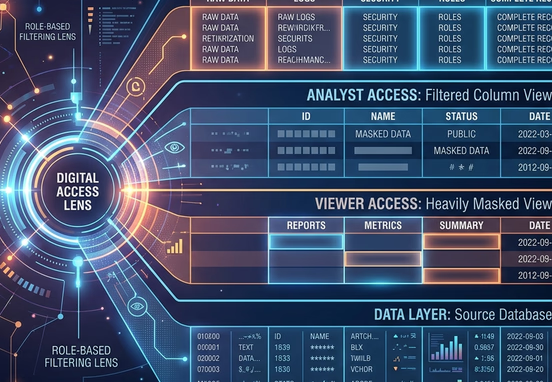
The matrix below contrasts the operational privileges across standard organizational roles, highlighting how data boundaries are maintained across different system layers:
| System Role | Read Access | Write Access | Deletion Privileges | Allowable Database Scope |
|---|---|---|---|---|
| System Administrator | Full System | Full System | Full System | Unrestricted Global Access |
| Operations Manager | Assigned Units | Assigned Units | Restricted Node | Departmental Records Only |
| Customer Support | Client Tiers | Masked Fields | Denied | Assigned Active Tickets |
| External Vendor | Portal Scope | Form Inputs | Denied | Isolated Vendor Identifier |
| Billing Specialist | Invoice Ledger | Ledger Entry | Denied | Financial Processing Tables |
Designing Granular Separation Models
Defining Action Constraints at the API Level
A resilient access control framework separates the type of data a user can view from the exact operations they can perform on that data. System interactions must be divided into distinct programmatic verbs: Create, Read, Update, and Delete. A customer support agent may require clear visibility into a client's historical shipping data to resolve a tracking dispute, but they lack any valid operational reason to execute deletion scripts on those records.
Enforcing these boundaries requires implementing explicit action controls directly at the application routing layer. When an API route is declared, it must be bound to a validation filter that matches the user's role against the required action. If a user assigned a lower-tier role attempts to pass a modification request to a high-security endpoint, the server intercepts the payload immediately, blocking the database from executing the unauthorized query.
Constructing Data Minimization Boundaries
Beyond restricting system operations, enterprise systems must limit the specific data columns returned to different users. If a finance manager and a shipping clerk both look at an order summary page, they should see entirely different sets of information based on their roles. The shipping clerk requires dimensions, weights, and addresses, while the finance manager requires tax codes, ledger processing hashes, and split-payment configurations.
Programmatic data minimization involves filtering database responses through translation layers before rendering them on user screens. The system strips out high-value columns like social security numbers, banking details, and unhashed authorization tokens based on the active session role. This targeted filtering limits the exposure of critical data, ensuring employees only see the exact information fields required to fulfill their specific day-to-day duties.
- Request Ingestion: The endpoint receives an inbound data packet along with the user's verified identity token.
- Role Extraction: The application decrypts the token payload to pull the specific roles and assigned department scopes.
- Policy Cross-Reference: The system checks the internal permission database to ensure the requested role can perform the action.
- Query Modification: The data abstraction layer updates the base query, appending specific filters to limit the returned columns and rows.
- Payload Masking: The system scrubs sensitive values from the final output object before sending the response back to the browser interface.
- Dynamic Attribute Checks: Check contextual parameters like time of day, network IP ranges, and device signatures before granting access.
- Inheritance Boundaries: Prevent higher roles from automatically inheriting risky sub-permissions without explicit architectural authorization.
- Separation of Duties: Ensure no single role can create, verify, and execute financial transactions independently.
- Temporary Escalation Paths: Set up structured, auto-expiring access windows for emergency maintenance tasks rather than granting permanent privileges.

Mitigating Governance Risks and Credential Hardening
Maintaining strict access control boundaries is also essential for corporate compliance and long-term business security. When companies let employees adopt unvetted software platforms without centralized oversight, sensitive data can easily leak out of the main corporate perimeter. This unmanaged growth of software tools complicates access control and leaves organizations highly vulnerable to hidden operational liabilities. Leadership can spot these operational risks and learn to consolidate their environments by reviewing how shadow IT costs enterprises millions in hidden software fees across different corporate departments.
Furthermore, keeping your permissions model secure requires having absolute trust in the system logs that track user behavior. If an account with high-level access privileges alters a database row, that action must be permanently recorded in an unchangeable archive. Connecting access control events directly to automated logging workflows ensures the business can successfully pass strict external reviews. Deploying structured automated audit trails keeps a growing business audit-ready by proving to external compliance inspectors that every administrative change is fully monitored, logged, and authorized.
Infrastructure Protection Tip: Always isolate your system authentication keys and API credentials from the primary application code layer. If an attacker gains access to your front-end repository, they must still be blocked from reading your backend database secrets. Using secure token shields keeps system authentication keys secure by locking down core access mechanisms away from exposed client environments.
Ultimately, these hardened access parameters provide the clean, reliable data needed to support high-level corporate planning and strategic shifts. When corporate records are protected by strong role boundaries, executive teams can trust that their performance charts reflect accurate operational realities. Funneling this reliable, well-governed data into a centralized web data hub supports executive decision-making by giving the leadership matrix a secure, single source of truth for long-term forecasting.

Deploying Bespoke Access Systems for Enterprise Scaling
Moving away from flat permission structures to a secure, role-based architecture requires a deliberate approach to backend systems engineering. Many businesses fall into the trap of using basic content management system plugins or cookie-cutter authentication packages to secure their systems. These off-the-shelf tools add unnecessary system overhead, lack the flexibility needed to handle complex workflows, and introduce unexpected security holes into your core platforms.
True system security is achieved by developing custom data infrastructure engineered specifically around your day-to-day workflows. Working directly with expert developers to build a bespoke workflow and systems automation platform allows you to construct highly optimized access control loops directly inside your core code engines. This custom foundation keeps your critical records safe from external breaches, automates repetitive compliance tracking, and gives your organization the resilient technical foundation needed to scale safely across global markets.