
How Centralized Web Data Hubs Support Executive Decision-Making

Modern enterprise execution suffers not from a lack of data, but from an overwhelming distribution of it across disconnected operational systems. When marketing metrics live exclusively inside analytics tools, sales numbers remain trapped in CRM platforms, and financial transactions occupy separate databases, leadership operates with a fractured worldview. Deciding the strategic trajectory of a growing firm on lagging reports creates reactive firefighting rather than proactive scaling.
A centralized web data hub acts as a single source of truth, establishing a unified backend layer that ingests, cleans, and consolidates data streams from every corporate touchpoint. Instead of forcing executives to log into multiple platforms to piece together a narrative, a consolidated hub presents a real-time snapshot of the business ecosystem. This infrastructural clarity eliminates guesswork, minimizes alignment errors across departments, and builds an undeniable competitive advantage for agile teams.
Architectural Foundations of a Centralized Data Hub
To appreciate the utility of a centralized system, one must understand how information moves from an isolated event to a strategic asset. Traditional web setups rely on scattered plugins that pass data through fragile pipelines. When one system updates, the connection breaks, leaving executives with incomplete data sets. A custom data hub operates via an enterprise-grade ingestion model designed to withstand high-volume traffic without experiencing data loss.
The architecture relies on direct integrations that establish a clean loop between front-end web actions and back-office financial ledgers. By implementing a robust two-way data sync architecture, companies ensure that modifications made on a management dashboard propagate perfectly down to customer-facing platforms, keeping all organizational gears aligned.
+--------------------+   +--------------------+   +--------------------+
| Web Traffic & Forms|   | CRM & Sales Systems|   | Billing & Checkout |
+---------+----------+   +---------+----------+   +---------+----------+
          |                        |                        |
          +------------------------+------------------------+
                                   |
                                   v
+----------------------------------------------------------------------+
|             Custom Ingestion Layer & API Data Pipelines              |
+----------------------------------+-----------------------------------+
                                   |
                                   v
+----------------------------------------------------------------------+
|           CENTRALIZED WEB DATA HUB (Single Source of Truth)          |
+----------------------------------+-----------------------------------+
                                   |
         +-------------------------+-------------------------+
         |                                                   |
         v                                                   v
+-----------------------+                           +-----------------------+
| Executive Dashboards  |                           | Automated Audit Trails|
| (Real-Time Insight)   |                           | (Governance & Safety) |
+-----------------------+                           +-----------------------+
The Executive Decision Matrix: Siloed vs. Centralized Systems
Evaluating the return on infrastructure investment requires analyzing the operational variance between fragmented software stacks and centralized data networks. Executives routinely waste high-value cognitive energy resolving contradictions between departmental reports rather than analyzing the market opportunities revealed by the data itself.
The following matrix contrasts the vulnerabilities of standard corporate data isolation with the strategic leverage provided by a centralized engineering approach:
| Operational Variable | Siloed Data Architecture | Centralized Web Data Hub |
|---|---|---|
| Data Latency | Weeks spent manually exporting and combining CSV spreadsheets. | Real-time sync across all dashboard views. |
| Information Accuracy | High human-error rate due to manual entry and overlapping tools. | Programmatic validation ensuring data matches targets. |
| Cross-Dept Alignment | Siloed teams tracking conflicting metrics and arguing over definitions. | Unified definitions creating a universal truth. |
| Security & Permissions | Scattered tokens and broad passwords exposed across platforms. | Granular control over specific data matrices. |
| Strategic Agility | Reactive maneuvers based on historical data that is out of date. | Proactive pivots guided by immediate behavioral changes. |
Accelerating Velocity to Insight for the C-Suite
Eradicating the Manual Report Generation Tax
In many mid-sized enterprises, an immense amount of labor capital is spent preparing for executive board meetings. Mid-level managers spend consecutive days extracting tables, cleaning formatting errors, and compiling slide decks. This manual collection process represents a substantial operational tax, consuming hours that should be spent optimizing core operations or assisting clients.
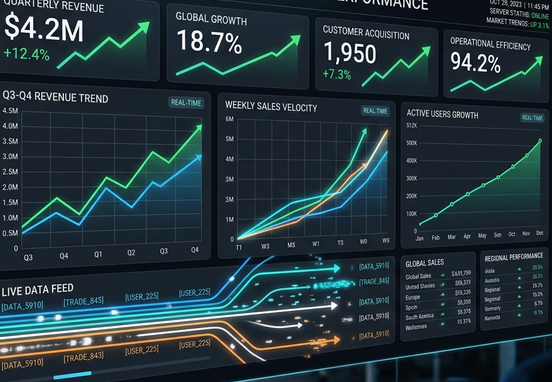
Centralization removes the friction of compilation entirely. By focusing technical energy on building live operational dashboards for real-time reporting, leadership can inspect financial performance, operational blockages, or customer acquisition trends on demand. Decisions shift from being events scheduled around reporting cadences to natural, continuous loops executed in real time.
Transforming Reactive Firefighting Into Predictive Scaling
Operating a business using lagging historical records is akin to driving a car while looking exclusively through the rearview mirror. You can see exactly what you hit, but you cannot navigate the road ahead. Executives relying on monthly financial reconciliations only discover drop-offs in customer retention or spikes in operational costs weeks after the damage has occurred.
A centralized hub surfaces macro-trends while they are nascent. The typical tactical sequence for modern scaling includes:
- Ingesting user cohort engagement numbers at the exact point of conversion.
- Routing unexpected drop-offs to automated tracking pipelines for triage.
- Presenting real-time behavioral shifts directly to the leadership matrix.
This structured flow gives leadership a tactical window to deploy corrections, alter pricing parameters, or reallocate budgets before a localized dip transforms into a quarterly deficit.

Corporate Governance, Integrity, and System Security
Data aggregation is not solely about operational speed; it is also a fundamental tool for risk management and regulatory compliance. As modern enterprises handle increasingly complex privacy mandates, leaving customer data scattered across dozens of random software plugins creates an unmanageable security footprint. A centralized repository consolidates your digital perimeter, making it easier to monitor, defend, and audit.
Executive Insight: Prioritize the integrity of your ingestion pipelines before designing complex data visualization elements. A stunning dashboard is completely useless if built on top of corrupted data streams. Investing in custom API pipelines that guarantee data ownership (and the critical features to look for) ensures your executive suite makes decisions based on immutable, proprietary assets rather than fragile third-party platform connections.
Furthermore, clear systems infrastructure supports long-term corporate valuation. When an enterprise prepares for a capital raise, an acquisition, or an external institutional audit, the due diligence process focuses heavily on data clarity. Having institutional knowledge locked inside individual spreadsheets creates massive friction. Conversely, deploying structured automated audit trails built directly into the data architecture proves to potential investors that your operations are reliable, compliant, and thoroughly organized.

Designing and Deploying Your Enterprise Data Engine
Transitioning away from a disjointed operational framework requires an intentional shift in engineering philosophy. Many businesses fall into the trap of purchasing expensive middleware subscriptions that claim to connect disparate software packages out of the box. These tools often serve as temporary patches that add unnecessary latency, introduce security holes, and fail to scale when transaction volume scales.
True operational leverage requires building clean, uncompromised infrastructure tailored to your exact workflows. By working directly with engineers to deploy a bespoke workflow and systems automation engine, your leadership team can construct custom processing loops that capture specific operational nuances. This custom-engineered foundation ensures that your data hub adapts directly to your existing operational systems, rather than forcing your teams to change how they operate to accommodate rigid software limitations.
When web data pipelines are optimized, the executive suite stops wrestling with technology and starts utilizing it as a multiplier. The path to scalable operations is paved with clear, structured information. By removing structural blind spots, automating manual data compilation, and protecting your records within a centralized hub, you provide your leadership team with the definitive clarity needed to outpace the market confidently.