

Why Corporate Enterprises Migrate to Headless CMS Platforms
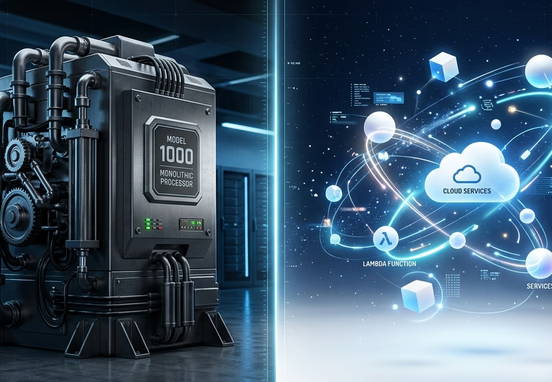
Legacy monolithic architectures powering corporate web ecosystems can no longer meet modern operational demands. In a traditional content management system, the creation dashboard, database, and presentation layer are permanently welded into a single codebase.
For organizations handling multi-brand portfolios and international sites, this coupling introduces inefficiencies. Enterprises are migrating toward headless CMS platforms to decouple content pipelines from front-end environments.
The Architectural Limits of Legacy Monolithic Stacks
Traditional web structures present significant hurdles for scaling engineering pipelines within complex corporate ecosystems. When content workflows, administrative logic, and visual front-end modules share an identical server environment, a performance issue or code bug in one element can degrade the entire domain.
Enterprise environments require agility, yet making a simple layout adjustment on a legacy platform frequently demands a full backend deployment cycle. This rigid structure slows down product rollouts, dampens engineering velocity, and ties content marketing teams to the availability of core backend developers.
| Architectural Dimension | Traditional Monolithic CMS | Modern Decoupled Headless CMS |
|---|---|---|
| Front-End Frameworks | Restricted to engine-specific templates (PHP, .NET). | Complete freedom (Next.js, Nuxt, custom frameworks). |
| Content Distribution | Exclusively bound to a single web browser layout. | Omni-channel delivery via REST or GraphQL APIs. |
| Security Risk Footprint | Broad attack surface across coupled database links. | Complete backend isolation from public endpoints. |
| Systemic Deployment | Synchronous builds; entire stack restarts required. | Asynchronous deployment via edge-rendered APIs. |
Moving away from these restrictive frameworks allows large-scale operations to optimize their deployment patterns. Transitioning to custom solutions provides corporations with the capability to manage vast, distributed content ecosystems across globally independent networks while escaping the operational constraints of proprietary enterprise SaaS platforms.
Securing the Corporate Footprint Through Perimeter Isolation
Monolithic systems expose database instances directly to public-facing traffic routes, forcing web security teams to constantly manage injection patches. If an attacker identifies a vulnerability inside a theme module, they gain a direct path to internal application servers.
A headless configuration eliminates this vector entirely by severing the pipeline between public presentation layers and underlying content engines. The database sits securely behind automated authentication firewalls, completely invisible to public browsers, transmitting static data strictly via secure web endpoints.
Maintaining total perimeter integrity across global sites requires moving beyond generic setups. Advanced isolation strategies protect proprietary operations, mirroring the foundational protocols established in our guide to enterprise web security and data privacy frameworks to ensure absolute infrastructure resilience.

Omni-Channel Scalability and API-First Content Pipelines
Consumers interact with corporate brands across digital surfaces far beyond desktop sites. Organizations must broadcast uniform information to mobile apps, wearable devices, IoT hardware, and storefronts.
Traditional structures force teams to duplicate data records inside separate silos for every channel. Headless architecture treats content strictly as decoupled data assets, accessible instantly via secure application programming interfaces.
- Centralized Information Repositories: Content teams author a promotional record or documentation asset exactly once within a master cloud dashboard.
- Unified Semantic API Delivery: Front-end architectures query the specific text fields through lightweight GraphQL or REST endpoints, retrieving raw JSON strings.
- Decoupled Execution Environments: Separate development squads build independent consumer experiences tailored exactly to the target hardware device layout.
- Instant Dynamic Content Synchronicity: When a product detail or regulatory terms update changes in the master dashboard, every active channel updates globally.
Pro Tip: When executing a headless migration strategy, prioritize platforms that offer robust, typed GraphQL APIs. GraphQL allows front-end developer teams to request the precise data fields required for an individual view component, completely eliminating network payload bloat.
Eradicating Legacy Software Debt and Infrastructure Friction
Large scale platforms operating on traditional frameworks over multiple decades inevitably accumulate severe structural overhead. Third-party plug-in dependencies, custom patch layers, and outdated code bases build up, degrading the core capabilities of the engineering organization.
As system performance drops, the effort required to implement modern user features scales exponentially. This unmitigated drag compromises server performance while simultaneously preventing product engineering teams from keeping up with agile market alternatives.
Resolving these systematic blockages requires auditing the core delivery mechanism. Examining how legacy technical debt and bad web infrastructure halt corporate growth shows that decoupling frontend environments is necessary to free internal teams from restrictive backend requirements.

Enhancing Core Web Vitals and Front-End Optimization
Page load speeds and UI responsiveness directly govern organic search exposure and visitor retention curves in highly competitive industries. Legacy content engines require heavy server execution routines to compile HTML templates on every page view, introducing systemic latency.
Headless systems completely alter this delivery dynamic by moving to static generation or edge-cached rendering frameworks. Pages are fully compiled into lightweight, static code sheets before a user ever requests the link, allowing global content delivery networks to serve files in milliseconds.
Here is an example of an enterprise edge routing and header initialization module configured for a secure headless pipeline:
+--------------------------------------------------------+
|                        USER BROWSER                    |
+--------------------------------------------------------+
                            │
                            │ 1. Inbound Request
                            ▼
+--------------------------------------------------------+
|                 ENTERPRISE EDGE ROUTER                 |
|  - Intercepts request at edge network layer            |
+--------------------------------------------------------+
                            │
                            │ 2. fetch(request)
                            ▼
+--------------------------------------------------------+
|                  HEADLESS API GATEWAY                  |
|  - Fetches dynamic content assets/JSON from DB         |
+--------------------------------------------------------+
                            │
                            │ 3. Returns Raw Response
                            ▼
+--------------------------------------------------------+
|              HEADER INITIALIZATION MODULE              |
|  - Set: X-Content-Source = "Headless-API-Gateway"     |
|  - Set: Cache-Control = "public, max-age=31536000"     |
+--------------------------------------------------------+
                            │
                            │ 4. Edge-Cached Optimized Response
                            ▼
+--------------------------------------------------------+
|               LIGHTNING-FAST END USER UI               |
+--------------------------------------------------------+
Engineering highly performant, accessible digital frontends requires removing the rigid bloat built into basic page builder systems. Our specialized, enterprise-grade speed-first design services craft isolated, custom-coded web architectures that tie seamlessly into cloud-based headless environments, achieving lightning-fast loading speeds.

Streamlining Global Regulatory Compliance and Brand Consistency
Operating cross-border corporate platforms introduces extreme compliance friction regarding localization rules, assistive data protocols, and accessibility rules. Managing accessibility inside a monolithic framework across distinct regions frequently causes layout regressions.
A headless structure ensures that accessibility rules are written directly into independent, reuseable layout components. Front-end engineering squads validate these components exactly once, ensuring they persist identically across every localized destination site.
Enforcing strict visual and interactive compliance prevents costly class-action lawsuits and regulatory fines. Reviewing the core concepts within our guide on enterprise accessibility audits and compliance risks for large digital storefronts enables management teams to build compliant front-end layers.
Technical SEO Domination Over Abstracted Page Builders
Traditional platforms generate massive amounts of redundant nested layout markup and inline script payloads. This structural bloat confuses search engine crawlers, driving up crawl budgets and slowing indexation across massive web directories.
Headless platforms provide complete dominion over the rendered source code layer. Engineers construct hyper-efficient HTML patterns that highlight microdata layouts without unnecessary computational elements.
Unlocking maximum search discovery performance requires moving away from heavy consumer templates entirely. Analyzing why clean hand-coded web architecture beats page builders for technical SEO shows that removing processing layers maximizes indexing health across extensive enterprise directories.
Executive Content Deployment Governance and Workflow Controls
The scale of corporate operations demands meticulous validation checkpoints before any digital record goes live. Headless engines give administrators complete control over user roles, content states, and localized editing boundaries.
Corporate managers can configure localized editing permissions, allowing domestic field offices to adjust specific text parameters without gaining access to core global landing page schemas. This structured isolation protects global brand integrity across every deployment.
By implementing decoupled infrastructure patterns, eliminating systemic plugin reliance, and distributing raw copy data via secure API endpoints, you transform your web footprint from a rigid operational liability into a secure, hyper-scalable brand asset.