

Enterprise Accessibility Audits: Compliance Risks for Large Digital Storefronts
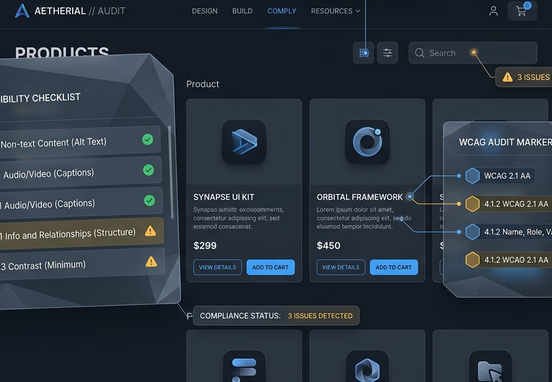
Enterprise digital storefronts handle millions of user interactions monthly across complex layouts, product grids, and checkout flows. For large corporate entities, web accessibility is a strict legal and operational mandate.
Failing to engineer an inclusive digital ecosystem exposes corporations to civil litigation and regulatory penalties. Because enterprise-scale storefronts contain thousands of programmatic variables, maintaining compliance requires an audited technical framework.
The Legal and Regulatory Reality of Digital Accessibility
Many corporations mistakenly view web accessibility as a minor checklist item managed exclusively by front-end design teams. In reality, international regulations treat non-compliant digital platforms as a direct violation of civil rights, carrying substantial financial and brand exposure.
In the United States, Title III of the ADA dictates that commercial websites constitute places of public accommodation. Similarly, the European Accessibility Act (EAA) enforces strict criteria across corporate entities selling to the EU market.
| Regulatory Framework | Target Jurisdiction | Compliance Standard | Primary Legal Consequences |
|---|---|---|---|
| ADA Title III | United States | WCAG 2.1 / 2.2 AA | Civil litigation, federal consent decrees, statutory damages. |
| European Accessibility Act | European Union / Global | EN 301 549 / WCAG | Direct market fines, blocking of commercial digital operations. |
| AODA | Ontario, Canada | WCAG 2.0 Level AA | Corporate fines reaching up to $100,000 per day of non-compliance. |
| Section 508 | US Federal Agencies / Vendors | WCAG 2.0 Level AA | Loss of massive public sector enterprise procurement contracts. |
Teams must coordinate to embed accessibility parameters directly into their development lifecycles. Leaving software unmonitored invites expensive corporate vulnerabilities.
Protecting your enterprise from combined legal and privacy liabilities requires proactive engineering oversight. Mitigating these systemic vulnerabilities is highly comparable to deploying robust data structures, which we analyze in depth regarding enterprise web security and data privacy frameworks to ensure complete platform integrity.
Systemic Technical Failures in Complex Storefronts
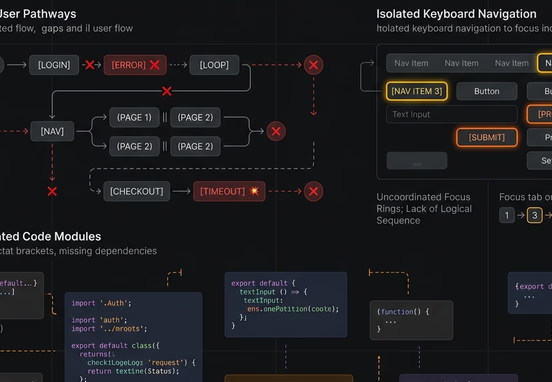
Large digital storefronts routinely suffer from critical accessibility barriers due to their heavy reliance on dynamic, JavaScript-driven modules. When content changes on a page without reallocating user focus, assistive technologies become completely disoriented.
The lack of architectural planning often results in massive accessibility failures across automated carousels, dynamic search filters, interactive mini-carts, and custom form elements. These system flaws completely block individuals utilizing screen readers or keyboard navigation from completing purchases.
Consider these four persistent structural failures found during enterprise engineering audits:
- Flawed Keyboard Navigation and Focus Traps: Users navigating via the tab key become trapped inside interactive modals or drop-down menus, unable to escape or continue down the page layout.
- Missing or Cryptic ARIA Attributes: Custom interactive elements lack Accessible Rich Internet Applications (ARIA) labels, rendering complex application state changes entirely invisible to screen readers.
- Improper Heading Hierarchies: Engineering teams routinely use heading tags (H1 through H6) for visual styling choices rather than logical document structuring, destroying the semantic map of the page.
- Dynamic Content and Toast Notifications: Real-time updates, like adding an item to a cart or displaying an error banner, fail to utilize ARIA live regions, leaving disabled users completely unaware of the event.
Pro Tip: Never rely on automated "accessibility overlays" or third-party JavaScript widgets that promise instant compliance. These tools do not modify the underlying source code, frequently fail to resolve complex transactional flow barriers, and are increasingly cited in class-action lawsuits as proof of superficial compliance efforts.
Technical Execution of Semantic Code Architecture
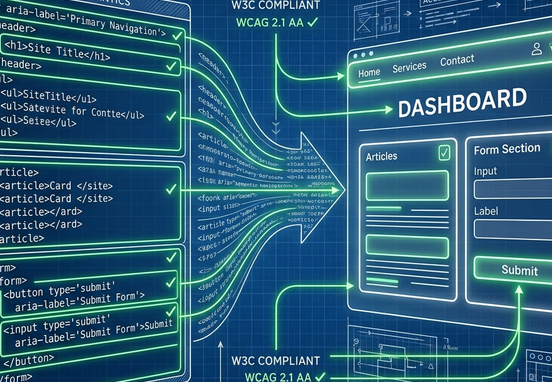
Resolving enterprise accessibility challenges requires moving completely away from brittle page-builder templates and abstracted software stacks. True compliance is achieved at the foundational layer of clean, unbloated, machine-readable HTML markup.
When web structures are hand-coded with absolute semantic precision, assistive devices naturally interpret the interactive components without needing hundreds of lines of fragile patching script. This technical clarity directly protects the platform from algorithmic crawl confusion and legal risks alike.
Here is an example of an accessible, semantic modal trigger code block executing correct focus handling and ARIA control states:
+----------------------------+
|      [Button Trigger]      |
|    aria-expanded="false"   |
+----------------------------+
              |
              | Click / Activation
              v
+----------------------------+
|     [Open Cart Modal]      |
|       role="dialog"        |
|     aria-modal="true"      |
+----------------------------+
              |
              | Focus Shifted
              v
+----------------------------+
|       [Close Button]       |
|  aria-label="Close Cart"   |
+----------------------------+
              |
              | Close / Escape
              v
+----------------------------+
|       [Focus Restored]     |
|    aria-expanded="false"   |
+----------------------------+
Deploying accessible, high-performance web architecture requires deep programmatic discipline that eliminates structural flaws before code hits a production server. For corporate entities looking to modernize their front-end performance while cementing absolute WCAG alignment, selecting a deeply experienced technology partner is vital.
Our enterprise-grade speed-first design services deliver custom-engineered, hand-coded architectures built precisely on valid semantic markup, eliminating the core compliance risks and rendering failures associated with heavy, template-driven platforms.

The Economic Impact of Inclusive Web Engineering
Enterprise decision-makers frequently treat accessibility updates purely as a compliance defense expense. This narrow perspective overlooks the massive economic returns generated by optimizing a digital platform for inclusive interaction.
When you strip out code blockages that prevent disabled populations from browsing, you immediately expand your total addressable market. Furthermore, engineering a site to meet strict accessibility guidelines naturally optimizes the core navigation loops for all users.
Simplifying the user path significantly boosts conversion rates while dropping support tickets. Understanding how great user experience lowers customer acquisition costs shows that clean, highly usable digital pathways eliminate friction points, creating highly scalable customer retention loops.
Eradicating the Financial Burdens of Technical Debt
Large digital storefronts often accumulate layers of outdated front-end frameworks through continuous feature additions and hasty third-party marketing tool integrations. This unmonitored accretion of code creates severe obstacles for modern screen readers and assistive devices.
When multiple development teams deploy code to separate sections of a massive e-commerce environment without strict oversight, the semantic unity of the domain breaks down entirely. This unmitigated clutter introduces both critical security exposures and accessibility regressions.
Remediating these fragmented systems requires addressing your core software infrastructure directly. Analyzing how legacy technical debt and bad web infrastructure halt corporate growth reveals that unpatched, archaic frontend layouts drag down overall performance, increase compliance risks, and slow down your development pipeline.
The Enterprise Accessibility Audit Workflow
To achieve and systematically maintain absolute digital compliance across a sprawling multi-location storefront architecture, corporate organizations must implement a multi-layered, rigorous testing framework. Relying on simple automated scans captures fewer than forty percent of total WCAG violations.
An elite enterprise audit strategy combines automated scanning engines, expert manual inspection, and user testing. Teams should establish an evaluation program following this execution blueprint:
- Continuous Automated Edge Scanning: Integrate automated accessibility checkers directly into your continuous integration and continuous deployment (CI/CD) development pipelines to prevent broken markup from reaching production.
- Comprehensive Manual Keyboard Audits: Systematically verify that every single interactive element, form input field, checkout gateway, and navigation dropdown menu can be fully operated using only a standard keyboard interface.
- Screen Reader Verification Testing: Test critical transaction pathways using industry-standard screen reading software across diverse operating systems and browsers to validate conversational and layout clarity.
- Mandatory Documentation Preservation: Maintain detailed, cryptographically timestamped records of all accessibility evaluations, remediations, and Voluntary Product Accessibility Templates (VPAT) to serve as verified evidence against legal challenges.
By integrating rigorous semantic coding rules, resolving underlying engineering debt, and mandating comprehensive human audits into your corporate design system, you transform digital accessibility from an ongoing legal liability into a powerful engine for market expansion and brand loyalty.