

Enterprise Web Security and Data Privacy: Why Corporations Require Dedicated Frameworks

Corporate enterprises handle immense volumes of sensitive consumer data, proprietary intelligence, and financial transactions daily. Unlike small businesses that can rely on standard off-the-shelf security modules, large corporations are prime targets for sophisticated cyber threats, requiring robust, isolated infrastructure layers.
A single data breach at the enterprise level results in catastrophic financial penalties, legal liabilities, and irreversible damage to market reputation. Legacy systems and monolithic web architectures frequently lack the defense-in-depth mechanisms necessary to isolate malicious traffic, making customized security frameworks an absolute business mandate.
Structural Deficiencies of Standard Web Deployments
Many organizations mistakenly deploy enterprise-scale web properties using platforms originally built for personal blogging or small business e-commerce. These template-driven content management systems create a monolithic environment where the front-end user interface is tightly coupled with the backend database. Evaluating the strategic divide between a bespoke engineered infrastructure and corporate SaaS suites highlights how easily organizations fall into restrictive software ecosystems.
If a vulnerability is discovered within a third-party plugin or the core presentation layer, an attacker can gain unrestricted access to the underlying application server and database. This single point of failure is unacceptable for corporate entities bound by strict global compliance regulations and corporate governance standards.
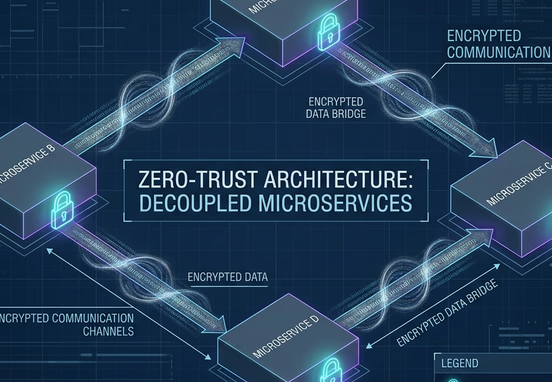
To mitigate these vulnerabilities, large-scale organizations isolate their architecture into decoupled components. Transitioning away from insecure, rigid frameworks allows teams to separate public-facing presentation layers from internal databases containing proprietary information.
When examining the foundational reasons why corporate enterprises migrate to headless cms platforms, architectural isolation emerges as a dominant factor. By removing the direct link between user inputs and database queries, enterprises eliminate entire classes of web application vulnerabilities like SQL injection and remote code execution.
Global Compliance Mandates and Regulatory Risks
Operating a corporate web platform means adhering to an intricate web of international, federal, and state data privacy laws. These regulatory bodies impose massive fines for failing to safeguard consumer data or failing to provide transparent data processing visibility.
| Compliance Framework | Primary Jurisdiction | Main Focus Area | Maximum Financial Penalty Risk |
|---|---|---|---|
| GDPR | European Union / Global | Consumer privacy, consent, and user portability rights. | Up to 4% of global annual turnover or €20 million. |
| CCPA / CPRA | California, United States | Consumer data control, opt-out visibility, and profiling limits. | Up to $7,500 per intentional violation. |
| HIPAA | United States | Protection of protected health information (PHI) and clinical data. | Up to $1.5 million annually per violation category. |
| PCI-DSS | International Markets | Secure credit card processing and end-to-end tokenization. | Up to $100,000 per month of non-compliance. |
Failing to build your digital presence on a foundation of strict privacy compliance introduces extreme legal risk. Beyond data minimization practices, every corporate site must display explicit consumer-facing terms that accurately reflect internal storage operations.
Integrating proper legal disclosures across all digital storefronts is essential for mitigating litigation. Reviewing the core 4 legal documents every business website must display ensures your engineering team coordinates directly with legal compliance officers to implement accurate privacy policies, cookie disclaimers, and data processing terms.

Advanced Threat Vectors Targeting Enterprise Infrastructure
Enterprise web applications face a continuous barrage of automated and targeted exploitation attempts that easily bypass standard commercial firewalls. Security engineering teams must design infrastructure around threat models that assume perimeter defenses will eventually fail.
Understanding these advanced threat vectors allows enterprise architects to build resilient microservice layers that limit lateral movement across internal networks:
- Distributed Denial of Service (DDoS) Attacks: Malicious actors coordinate massive botnets to flood corporate origin servers with junk traffic, exhausting memory resources and forcing prolonged operational downtime.
- Broken Object Level Authorization (BOLA): Attackers manipulate API parameters within user requests to access unauthorized records, bypassing standard login portals due to flawed code architecture.
- Supply Chain Exploitation: Cybercriminals compromise open-source packages or third-party web widgets used across a corporate domain, executing malicious code directly inside user browser sessions.
- Server-Side Request Forgery (SSRF): Exploiting flaws in backend image parsers or file upload tools allows attackers to force the internal corporate server to make malicious requests to isolated backend databases.
Pro Tip: Implement a strict Content Security Policy (CSP) header across your entire HTTP response layer. A meticulously configured CSP restricts the execution of unauthorized scripts, neutralizes cross-site scripting (XSS) vectors, and prevents third-party data tracking tools from scraping sensitive user keystrokes.
Architectural Frameworks for Enterprise Web Security
Securing a sprawling digital footprint requires shifting away from reactionary patch-management workflows toward an inherently secure system architecture. Enterprise security frameworks rely heavily on the principle of least privilege, ensuring no single service or user has total network visibility.
This philosophy manifests through Zero Trust Network Architecture (ZTNA), where every API request, internal microservice call, and administrative user session must be continuously authenticated, authorized, and encrypted.
Here is an example of an enterprise-grade security configuration for a modern web server, enforcing secure transport controls and preventing cross-domain frame-jacking:
+-----------------------------------------------------+
|                User / Client Request                |
+-----------------------------------------------------+
                           |
                           v
+-----------------------------------------------------+
|              Edge CDN & Enterprise WAF               |
|        (Filters DDoS & Malicious Traffic)           |
+-----------------------------------------------------+
                           |
                           v
+-----------------------------------------------------+
|            Decoupled Front-End Layer                |
|     (Static Presentation / Zero DB Access)          |
+-----------------------------------------------------+
                           |
                           v
+-----------------------------------------------------+
|             Secure API Gateway (ZTNA)               |
|     (Continuous Auth & Token Verification)          |
+-----------------------------------------------------+
                           |
                           v
+-----------------------------------------------------+
|          Isolated Backend Microservices             |
|            & Encrypted Core Database                |
+-----------------------------------------------------+
Deploying clean, secure web assets requires deeply specialized engineering capabilities that prioritize defense-in-depth over visual design speed. If you are preparing to rebuild your digital ecosystem, choosing partner agencies with deep infrastructure experience is paramount.
Our specialized speed-first design services provide corporations with custom-engineered, hand-coded web architecture designed from the ground up to support enterprise data isolation, eliminating the systemic vulnerabilities introduced by consumer-tier web platforms.

Mitigating the Financial Burden of Technical Debt
Many enterprise security failures do not stem from a lack of budget, but rather from the accumulation of unpatched historical software modules. Legacy codebases and outdated web servers create a massive attack surface that grows more dangerous with each passing month.
As corporate footprints expand, tracking insecure subdomains becomes impossible without automated discovery tools. Maintaining these aging web properties drains valuable engineering resources away from proactive feature creation.
Unresolved infrastructural weaknesses expose the entire organization to devastating security compromises. Evaluating how legacy technical debt and bad web infrastructure halt corporate growth reveals that neglecting code updates compromises system stability, limits API interoperability, and leaves digital storefronts wide open to exploitation.
Comprehensive Data Privacy Audits and Accessibility Risks
Modern data privacy is inextricably linked with how cleanly a web property handles machine-readable information. When web applications are built with bloated code, unstructured DOM nodes, or insecure script tags, they fail to provide assistive technologies with clear boundaries, exposing the site to both privacy and legal vulnerabilities.
Regulatory agencies monitor corporate storefronts not only for transactional data leaks but also for digital discrimination. An enterprise platform that cannot be navigated securely by users utilizing assistive tools frequently violates civil rights regulations.
Conducting routine engineering reviews helps mitigate these cross-departmental compliance vulnerabilities. Reviewing the financial and operational insights within enterprise accessibility audits and compliance risks for large digital storefronts allows your product management teams to address UX barriers before they spark public class-action litigation or regulatory investigations.
Incident Response Frameworks
An elite enterprise web security strategy assumes that security incidents are inevitable. The true metric of corporate operational resilience is not the absolute avoidance of attacks, but rather the speed of detection, containment, and systemic eradication.
Corporations must maintain an immutable audit trail by integrating security information and event management (SIEM) systems that aggregate logs across firewalls, web servers, and microservices.
By implementing strict decoupling, addressing underlying software debt, and embedding real-time automated logging into your operational workflow, you transform your public web ecosystem from a vulnerable operational vector into an impenetrable enterprise asset.