

High Quality Stock Images vs Custom Photos for Your Company Website
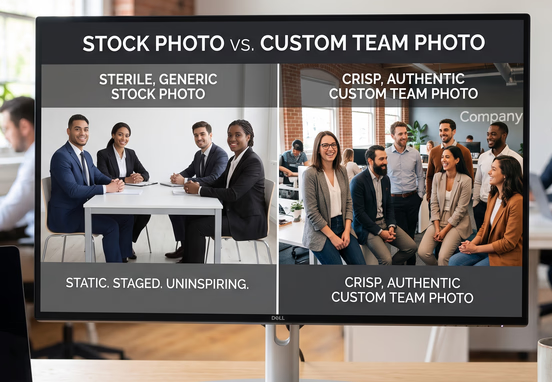
Visual communication acts as an immediate trust proxy long before a website visitor reads a single sentence of your corporate copy. Many organizations treat web photography as an afterthought, populating their service pages with generic, unoptimized stock images purchased from massive online repositories. This shortcut introduced a hidden conversion tax, sending an unprompted signal to high-value buyers that your company relies on generic, standard templates rather than bespoke, premium solutions.
The human brain processes visual elements significantly faster than textual data. When a user lands on a B2B platform and encounters an over-stylized, highly staged photo of generic models shaking hands in a sterile boardroom, their internal skepticism matrix activates. They instantly recognize that the imagery is artificial, which subconsciously erodes the credibility of the neighboring value propositions.
Conversely, deploying authentic, custom corporate photography establishes an immediate baseline of operational validity. It shows your actual engineering team, your true logistical infrastructure, and your real office environment. This transparent presentation satisfies the strict risk-assessment requirements of high-ticket buyers, giving your business a distinct competitive edge over competitors hiding behind stock assets.
The Cognitive Friction of Overused Stock Photography
Stock imagery repositories offer undeniable convenience, but they suffer from a severe lack of market exclusivity. When you purchase a generic stock asset, you are buying a non-exclusive license that has likely been deployed across hundreds of other digital platforms globally, including those of direct competitors in your exact vertical.
This saturation creates a phenomenon known as banner blindness, where users subconsciously tune out generic visual components. When an asset looks like a marketing asset, users glaze right over it, which lowers session duration and drives up bounce rates across your critical entry-level landing pages.
| Visual Performance Metric | Commodity Stock Imagery | Bespoke Custom Corporate Photography |
|---|---|---|
| Exclusivity Matrix | Zero exclusivity; identical assets can be deployed by market competitors. | 100% unique intellectual property proprietary to your organization. |
| Trust Validation | Creates psychological distance through staged, unnatural interactions. | Establishes immediate authority by showcasing true operations and personnel. |
| Brand Consistency | Inconsistent lighting, color casting, and clothing styles across pages. | Unified color grading, spatial framing, and art direction matching your identity. |
| Technical Optimization | Massive, unoptimized source files with chaotic resolution matrices. | Engineered directly around specific responsive UI layout coordinates. |
| Conversion Efficiency | Serves as generic filler material that fails to guide user action. | Functions as an active visual guide directing focus to primary CTA targets. |
The underlying problem with commodity stock assets is that they are built to please everyone generally, which means they speak to no one specifically. A true enterprise platform requires a cohesive visual narrative where every image functions as a deliberate piece of evidence validating your company’s market specialization.
Technical Liabilities: Code Bloat, Layout Shift, and Image Formats
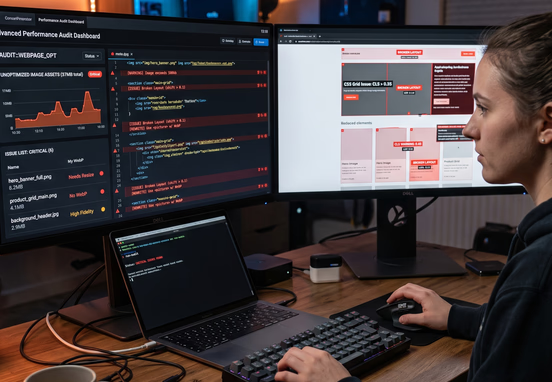
From a pure systems engineering perspective, both stock and poorly processed custom images introduce massive technical risk to your web architecture. Raw images exported directly from digital cameras or stock portals are typically saved in unoptimized formats with bloated metadata channels, dragging down page speed.
When front-end developers embed these heavy assets directly into a website header without adjusting rendering rules, they trigger severe Cumulative Layout Shift (CLS) errors. This architectural failure causes neighboring text elements to jump around while the image slowly processes, destroying your Core Web Vitals and lowering your search rankings.
To keep your infrastructure running smoothly, you must process assets through modern, responsive frameworks. For businesses looking to scale their digital infrastructure, pairing custom photography assets with an optimized speed-first web design service ensures your visual elements render instantly across mobile and desktop devices without compromising page speed.
Furthermore, managing your visual assets requires setting up automated compression pipelines to deliver assets in next-generation file formats. Utilizing a modern image configuration ensures that your images are delivered efficiently across all viewports:
       [ Raw Image Asset ]
                |
                v
     [ Compression Pipeline ]
                |
        +-------+-------+
        |               |
        v               v
   (>=1024px)       (>=768px)       (Fallback)
        |               |               |
        v               v               v
   Large WebP      Medium WebP     Fallback JPG
By serving properly scaled WebP or AVIF images using the native markup example shown above, you drastically reduce server bandwidth consumption. This programmatic configuration keeps your code footprint lightweight, allowing your platform to pass rigorous technical speed checks while presenting crisp, clear visual evidence to your prospective customers.

Strategic Integration: Aligning Imagery with Brand Architecture
Bespoke photography performs at its highest level when it is planned directly alongside your digital interface layout. A professional photographer does not simply walk into an office and take random shots; they compose images that align perfectly with specific CSS layout parameters and structural components.
This means calculating precise negative space zones within the image frame to accommodate overlay headings, marketing value copy, and interactive buttons. If an image lacks proper negative space, text overlays become unreadable, creating accessibility violations that drive users away.
- Ensure the camera angle directs the user's focus naturally toward your primary contact form or call-to-action button.
- Maintain identical color temperature metrics across every photo to ensure your visual assets match your core corporate brand guidelines.
- Capture your actual, day-to-day work processes to validate your brand claims and separate your agency from lower-tier competitors.
A unified visual style ensures that your website elements complement one another perfectly. Taking the time to execute a unified style is just as critical as building a bespoke brand identity system instead of a cheap icon, as your visual presence must present a polished, authoritative image across every single page.

Humanizing Your Enterprise and Driving Conversions
High-value enterprise clients are ultimately investing in the people who run the organization, not just the technology behind it. When a prospect browses your team structure, they are looking for evidence of depth, continuity, and internal stability. Populating your corporate directory with stock photos of models destroys that evaluation process entirely.
Bespoke corporate photography humanizes your enterprise, transforming your business from a sterile entity into an approachable, authoritative market leader. Showing your real team collaborating in real workspaces builds immediate subconscious trust, helping lower customer acquisition costs.
Streamlining the Visual Journey Across Landing Pages
To ensure your visual assets actively guide users through your marketing funnels, structure your photography deployment around high-intent areas:
- The Primary Hero Area: Showcase a high-fidelity widescreen image of your real infrastructure or elite leadership team to anchor your primary value propositions.
- The Case Study Matrix: Feature authentic, unedited documentary-style photos of your projects or services in action, providing clear proof of real-world results.
- The Team Interface: Deploy clean, professionally lit portraits of your actual staff with matching backdrops to deliver a polished, cohesive presentation.
This visual transparency reinforces the strength of your website copy. When a visitor reads your customer-centric value propositions and immediately sees authentic visual evidence to support those claims, they encounter zero psychological friction, keeping them engaged with your content and moving smoothly toward your conversion targets.
Crafting these cohesive visual elements is essential for maximizing your platform's long-term conversion efficiency. Reviewing how to write high-converting website copy for trust building ensures your text and custom photography work as a unified conversion engine, transforming passive browsers into qualified business opportunities.
Production Design Tip: When hiring a commercial photography team to shoot assets for your web interface, provide them with a copy of your technical wireframes and layout guidelines before production begins. Instruct the team to capture both horizontal and vertical variations of key setups, with generous background breathing room on either side of the subject. This preparation gives your development team the spatial flexibility required to crop assets perfectly for responsive mobile screens without losing crucial details.
The Financial Realities of Visual Performance Asset Depreciation
While custom corporate photography requires a higher upfront financial investment than purchasing a handful of cheap stock downloads, it is an investment that yields measurable returns over time. Custom brand assets do not depreciate in value; they become core intellectual property assets that can be utilized across your entire marketing ecosystem for years.
Relying on generic stock downloads creates ongoing creative limitations, as you continually pay subscription fees for generic, uninspiring files that do not build true brand equity. This pattern mirrors the exact hidden costs of relying on cheap DIY web templates, where initial shortcuts inevitably lead to technical failures, brand dilution, and expensive redesigns down the line.
By investing in bespoke corporate photography and pairing it with a high-performance web architecture, you insulate your company from lookalike competitor styling, optimize your technical Core Web Vitals, and build an ironclad visual presence that commands respect from high-value enterprise accounts.