
The Hidden Costs of DIY: Why Free Templates, Squarespace Themes, and WordPress Limit Growing Businesses

Selecting an entry-level DIY path when establishing a commercial website appears logical to bootstrapped operations or early-stage startups. Platforms like Squarespace, standard WordPress templates, and free page builders promise low initial cash outlays and lightning-fast deployment timelines. Non-technical founders are lured by the premise that visual, drag-and-drop mechanics can completely replicate the engineering standards of an elite, custom-built corporate application.
This perceived affordability represents a profound operational misunderstanding. When examining the long-term financial liabilities of budget website platforms, the structural compromises made to accommodate an amateur-accessible platform introduce a cascade of compounding liabilities as your transactional volume and user acquisition scale. The limitations inherent to pre-packaged layouts directly cripple your long-term search engine performance, user experience consistency, and internal data infrastructure.
For an expanding company, a website cannot survive as a passive, digital brochure built on brittle consumer-tier architecture. It must function as an optimized, hyper-secure customer acquisition pipeline. Relying on mass-market web solutions forces your growing enterprise to conform its entire operational model to the rigid technical boundaries of an inflexible third-party framework.
The Architectural Constraints of Closed SaaS Frameworks
Proprietary website tools maintain strict infrastructure control by placing your digital storefront inside a highly restricted runtime environment. While this design prevents users from breaking critical system scripts, it simultaneously creates a hard technical ceiling that actively stifles custom application development, advanced data integration, and granular server-side architecture optimization.
When an enterprise requires bespoke configurations—such as specialized customer data pipelines, complex B2B portal integrations, or customized inventory automation—these closed systems fail completely. You are permanently bound to their native plugin marketplaces and basic API capabilities. This structure forces operations to build costly, fragile external workarounds to achieve standard business capabilities.
The True Stakes of Infrastructure Subjugation
Relying on a third-party content platform means your core lead generation asset is entirely vulnerable to platform-wide outages, algorithmic modifications, and unexpected shifts in corporate pricing structures. If a SaaS provider chooses to modify its core engine, adjust its service terms, or retire a specific framework version, your operational infrastructure must adjust, regardless of the cost or disruption.
True commercial resilience requires absolute control over your digital infrastructure, rendering platform dependencies completely obsolete. Entrusting your core client portal to a rigid, proprietary subscription ecosystem introduces severe business risks. Businesses must recognize that the freedom of data ownership and why proprietary SaaS is a trap is an essential operational consideration when choosing long-term software architecture.
The WordPress Dependency Spiral: The Illusion of Open-Source Flexibility
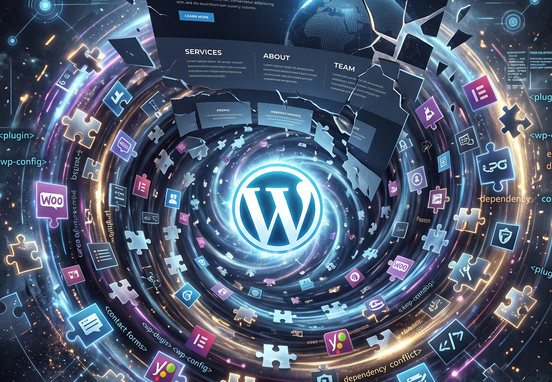
WordPress templates are often marketed as the ultimate middle ground between restrictive SaaS builders and custom application development. However, configuring a pre-made theme to fulfill professional business criteria inevitably triggers an unsustainable reliance on third-party plugin extensions. Because pre-made layouts lack native features for specialized business workflows, administrators must download separate software packages for basic utilities like contact forms, security protocols, search optimization, image caching, and schema distribution.
This excessive accumulation of plugins creates a highly fragile ecosystem where multiple uncoordinated developer frameworks are forced to run simultaneously on a single server instance. Each added utility expands your site's vulnerability profile, worsens backend resource strain, and creates highly unpredictable script collisions.
The Administrative Burden of Continuous Software Updates
Maintaining an enterprise-grade WordPress presence requires constant vigilance over automated patch cycles. If a single developer stops supporting a critical plugin, your site becomes vulnerable to malicious injections or crashes completely during core software updates.
- The Core Deployment: A pre-made theme is launched with fifteen distinct plugins handling standard operations like form submissions, asset compression, and visual editing layouts.
- The Security Vulnerability: An independent developer fails to patch a critical remote code execution flaw within a secondary database plugin.
- The Script Collision: The platform administrator applies a generic security patch, which immediately conflicts with the theme's core visual builder engine.
- The Operational Disruption: The main conversion pipeline breaks on mobile browsers, corrupting the user database and blocking all inbound contact requests for several business days.
Quantitative Comparison of Operational Performance
The true cost of a web application goes far beyond the initial setup invoice. Expanding companies must evaluate the multi-year fiscal and technical impacts of choosing pre-made templates over scalable infrastructure.
| Technical Evaluation Metric | Mass-Market DIY / Monolithic Templates | Elite Professional Custom Engineering |
|---|---|---|
| Initial Financial Capital Outlay | Extremely low upfront software or subscription fees | Higher strategic investment during structural discovery |
| Three-Year Maintenance Cost | Accumulating plugin fees, emergency developer fixes, security patches | Minimum overhead backed by clean, stable codebases |
| Page Speed Performance Lifecycle | Degrades over time as database bloat and plugins accumulate | Consistently fast via clean, lightweight execution |
| Search Engine Optimization Potential | Trapped by rigid template structures and inline code bloat | Completely unrestricted layout flexibility and semantic HTML |
| Data Architecture Ownership | Tied to rigid databases or third-party cloud hosting environments | Total physical data sovereignty and custom pipeline control |

Performance Penalties and the Collapse of Conversion Architecture
Modern search engines place immense value on technical page diagnostics, specifically targeting how efficiently a page parses assets and renders content onto mobile screens. Pre-packaged themes are built to fit as many industry verticals as possible, meaning they load thousands of lines of unused layout scripts, redundant fonts, and styling files on every page view.
This excessive code weight causes severe latency during the initial layout rendering phase. If your target demographic experiences even minor visual stuttering or layout shifts while attempting to interact with your site, they will immediately abandon the session and return to the search engine results to select a competitor.
Code Bloat and Mobile Layout Failure
To illustrate how pre-packaged platforms degrade rendering speed, look at how a visual page builder handles a standard call-to-action button versus how a professional custom application renders it. This structural friction is a primary reason why bloated legacy layout engines compromise mobile speed. A typical template file wraps a single link in multiple deep layers of non-semantic container elements to accommodate visual settings:
                        [Browser Engine]
                               │
                               ▼
[div.wp-block-button.aligncenter.custom-btn-wrap-912]
                               │
                               ▼
           [div.builder-inner-container-box-alpha]
                               │
                               ▼
                [div.elementor-button-wrapper]
                               │
                               ▼
          [a.elementor-button-link.elementor-size-sm]
                               │
                               ▼
            [span.elementor-button-content-wrapper]
                               │
                               ▼
                  [span.elementor-button-text]
                               │
                               ▼
                    "Schedule Consultation"
In stark contrast, professional, custom-coded layouts achieve the identical visual output using a single line of hyper-efficient HTML markup:
          [Browser Engine]
                 │
                 ▼
        [a.btn.btn-primary]
                 │
                 ▼
      "Schedule Consultation"
When a website contains hundreds of consumer-grade block elements, this excessive layout layering strains mobile processors, tanks core performance metrics, and actively lowers search rankings. Failing to address these underlying architectural flaws means risking severe penalties under modern platform metrics. Reviewing the explicit link between Core Web Vitals and page speed vulnerabilities reveals how platform performance issues directly cause lower search visibility and lost conversions.
Strategic Flaws in Template Customization
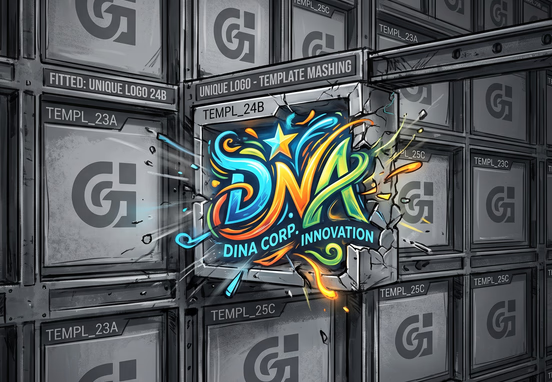
Pre-made templates limit your ability to position your brand uniquely in competitive markets. Because these themes rely on rigid, pre-defined grids, your company's value proposition must be warped to fit within the constraints of the template's existing layout boxes.
This approach creates a severe lack of visual distinction. When an enterprise relies on the same trending theme elements as hundreds of other businesses in its vertical, it loses its distinct corporate identity. A company cannot establish true market differentiation when its primary digital interface looks identical to an amateur startup.
Moving Beyond Amateur Development Traps
Accepting structural limitations because of an initially low price point is a major operational oversight. Many growing companies encounter these identical roadblocks when they attempt to use amateur resources to build out commercial assets.
- Layout Constraints: The marketing team cannot rearrange conversion elements because the theme's core grid system breaks on mobile viewports.
- Functional Deficiencies: The sales division cannot link incoming leads directly to their CRM because the platform restricts custom JavaScript endpoints.
- Brand Dilution: The entire user journey feels generic, failing to reflect the premium pricing model of your actual physical operations.
Choosing to launch an enterprise asset on amateur-tier foundations introduces long-term liabilities that hinder growth. These issues share close structural similarities with the operational bottlenecks outlined when evaluating the hidden dangers of letting a relative build your business site. Stepping up to professional, custom-engineered systems is essential to protect your company's digital equity.
The Long-Term Economics of Custom Digital Assets
Escaping the DIY template loop requires a complete shift in how your company views its web infrastructure. A corporate website should not be treated as an ongoing tech expense or an administrative chore; it is a primary digital asset built to maximize your customer lifetime value.
Transitioning to high-performance custom applications allows organizations to eliminate ongoing plugin subscription costs, eliminate platform dependency risks, and dramatically lower client acquisition costs through superior user experiences. Relying on an enterprise-grade clean, hand-coded web architecture ensures your application loads instantly, scales flawlessly, and remains completely secure against emerging digital threats.
Operational Scaling Standard: When a business scales past its initial validation phase, its digital infrastructure must shift from a consumer-tier template model to an enterprise-tier custom application framework. This structural transition prevents technical debt from stalling future marketing campaigns, security audits, or data integrations.
Securing expert engineering ensures your site remains adaptable, performant, and perfectly tailored to your internal sales pipelines. By deploying high-performance web design and development services, your company builds a resilient, highly optimized digital asset that drives sustainable revenue growth for years to come.