

How to Write High-Converting Website Copy: Headlines, Value Propositions, and About Us Pages That Build Trust
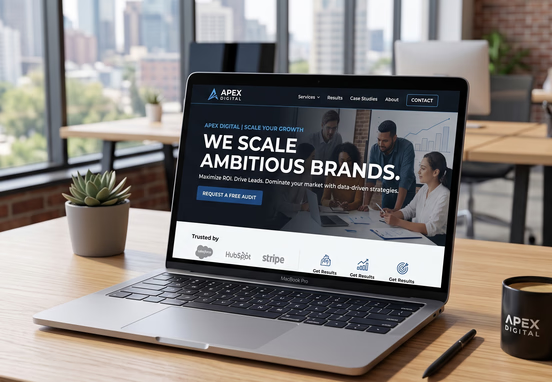
Website copy is not an artistic showcase of corporate vocabulary; it is a structural conversion engine designed to transition users from passive browsing to qualified inquiries. Most corporate platforms fail to convert traffic because their messaging is self-centered, abstract, or completely detached from the user's primary pain points. When an enterprise populates its landing pages with vague buzzwords, it introduces cognitive friction that drives potential clients straight to the competition.
Every headline, sub-headline, and body paragraph must function as a mechanical lever that systematically dismantling buyer skepticism. To achieve institutional-grade conversion metrics, your copywriting framework must be anchored in empirical user behavior data. If your text does not immediately communicate what your business does, who it serves, and how it eliminates operational liabilities, your platform is a sunk cost.
To construct a high-converting digital platform, an organization must abandon speculative writing patterns. While algorithmic shortcuts might seem tempting, analyzing the strategic gap between custom-built digital platforms and automated site generators reveals why generic software cannot replicate authentic human persuasion. High-performance copy requires a disciplined architecture that balances user psychology with technical clarity, ensuring that every sentence guides the reader seamlessly toward your primary call to action.
The Cognitive Blueprint of Above-the-Fold Headlines
The primary H1 headline on a corporate website is the single most expensive piece of digital real estate your company owns. A user forms an definitive opinion on your brand’s relevance within three seconds of landing on your page. If your headline relies on poetic metaphors or insider jargon, the visitor will bounce before processing your secondary value markers.
An effective headline must answer two fundamental questions immediately: what is the explicit utility of your product, and what is the tangible economic or operational return for the buyer? Bypassing this immediate clarity triggers cognitive fatigue, causing the user to lose interest in your content.
- The Direct Outcome Formula: [Action Verb] + [Measurable Solution] + [Without the Primary Industry Pain Point]. This structure works because it states the benefit immediately while neutralizing the user's hidden objections.
- The Authority Positioning Statement: The definitive [Product Category] built exclusively for [Specific Target Audience] to achieve [Core KPI Optimization]. This model relies on deep vertical specialization to command instant industry respect.
- The Counter-Intuitive Truth Anchor: Challenge an entrenched, inefficient industry norm directly in the header, then position your framework as the modern operational alternative.
To optimize these formulas effectively, the copy cannot be written for a generic, undefined crowd. True messaging precision requires building a data-backed buyer persona before drafting a single sentence, allowing you to harvest the exact vocabulary, structural fears, and daily operational metrics that resonate with your highest-value prospects.
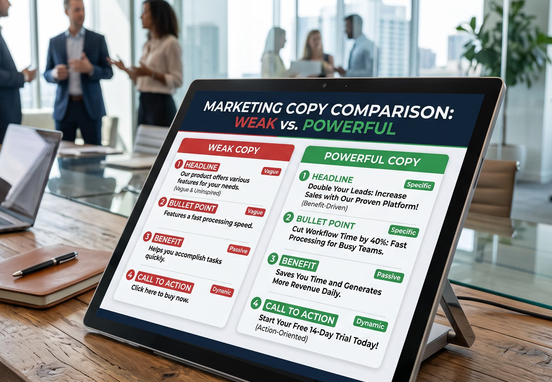
The Structural Framework of a Bulletproof Value Proposition
A value proposition is not a generic mission statement; it is a clear declaration of economic and operational superiority over existing market alternatives. It is typically positioned directly below the primary headline as a secondary paragraph or a highly structured text block that expands on the overarching brand promise.
A conversion-grade value proposition must isolate your primary differentiator and frame it as an indispensable competitive asset for the client. If your value proposition claims that your business is simply "the best," "more reliable," or "customer-centric," you are using empty modifiers that possess zero persuasive weight in complex enterprise procurement loops.
| Messaging Element | Ineffective Commodity Copy | High-Converting Structural Copy |
|---|---|---|
| Operational Framing | We offer innovative cloud software solutions for modern businesses looking to scale. | We automate corporate data pipelines to reduce infrastructure overhead expenses by 40%. |
| Authority Validation | Our experienced team provides industry-leading consulting services globally. | Backed by verified compliance audits to clear enterprise procurement blocks in 14 days. |
| Risk Mitigation | We are dedicated to customer satisfaction and offer support whenever you need it. | Guaranteed 99.99% system uptime backed by legally binding service-level agreements. |
| Onboarding Velocity | Our intuitive platform is simple to set up and easy for your staff to use. | Zero-code API migration framework that deploys natively into your stack in under one hour. |
Your value proposition should serve as the absolute thematic anchor for your entire site. When structured properly, it gives your sales team a clear linguistic baseline to reference during discovery calls, ensuring that your public-facing digital assets and your private sales pitches operate in total messaging alignment.

Converting Skeptics Through the About Us Page
The About Us page is routinely the most misunderstood and mismanaged asset on a corporate website. Most organizations treat this page as a self-indulgent archive of corporate history, timeline charts, and generic team portraits. In reality, a high-converting About Us page is not about your company at all; it is about validating your capability to solve the client's problem.
When a high-value prospect navigates to your story, they are searching for proof of structural alignment and risk reduction. They do not care when your company was founded; they care whether your operational principles and technical methodologies are resilient enough to handle their complex corporate liabilities.
Deconstructing the Conversion-Focused Narrative
To transform your brand story from a passive biography into an active customer acquisition tool, structure the narrative around a disciplined, client-centric sequence:
- The Shared Enemy Alignment: Open by outlining a systemic, painful inefficiency that plagues your target industry, demonstrating an intimate, ground-level understanding of the client's daily frustrations.
- The Catalytic Disruption: Explain the exact moment your organization realized that legacy industry solutions were fundamentally broken, framing your corporate genesis as a technical necessity rather than a commercial venture.
- The Proprietary Framework: Introduce the custom methodology, code standards, or operational protocols your team engineered to solve that systemic friction point permanently.
- The Quantifiable Validation: Back up the narrative with hard historical metrics, verified case studies, and third-party compliance proofs that demonstrate your system's real-world efficacy.
This structural shift alters how a prospect evaluates your organization's capability. By moving away from empty vanity metrics and positioning your background as a targeted answer to market deficits, you elevate your brand above commodity service providers and justify premium corporate pricing.
Integrating Strategic Content Architecture
An authoritative messaging framework can only perform at its peak when integrated into a properly organized digital container. Before deploying your text to a live server, taking the time to outline your layout guarantees that your arguments flow in a sequence that maximizes user retention.
Learning the core principles of planning your website’s information architecture ensures your headlines, case studies, and corporate profiles are positioned exactly where users expect to find them, eliminating cognitive navigation errors across your entire digital ecosystem.

Technical Harmony: Where Copy Meets Performance Architecture
The most compelling, data-validated copy in the world will fail to convert a single user if the underlying technical framework of the website is fundamentally flawed. If a busy corporate decision-maker clicks your search result and is forced to wait seconds for your primary value proposition to render on their screen, they will abandon the tab before reading a single word.
Copywriting and front-end engineering are deeply interdependent disciplines. High-converting copy requires an infrastructure that delivers text elements instantly, ensuring a seamless visual transition as the reader scrolls through your conversion funnels.
+-------------------------------------------------------+
|               USER LANDS ON PLATFORM                  |
+-------------------------------------------------------+
                          |
                          v (Within First 3 Seconds)
+-------------------------------------------------------+
|            ABOVE-THE-FOLD HEADLINE (H1)               |
|  - Communicate explicit utility & operational return  |
|  - Eliminate industry pain & neutralize objections    |
+-------------------------------------------------------+
                          |
                          v (Reduce Cognitive Friction)
+-------------------------------------------------------+
|            BULLETPROOF VALUE PROPOSITION              |
|  - Isolate primary technical differentiator           |
|  - Define operational superiority & risk mitigation   |
+-------------------------------------------------------+
                          |
                          v (Validate Capability)
+-------------------------------------------------------+
|            CONVERSION-FOCUSED ABOUT US PAGE           |
|  1. Shared Enemy  --> 2. Catalytic Disruption         |
|  3. Proprietary Framework --> 4. Quantifiable Proof   |
+-------------------------------------------------------+
                          |
                          v (Performance Architecture Layer)
+-------------------------------------------------------+
|             TECHNICAL HARMONY & RENDERING             |
|  - Instant element delivery & optimized font loading  |
|  - Cross-device legibility & mobile UX execution      |
+-------------------------------------------------------+
                          |
                          v
+-------------------------------------------------------+
|         CONTINUOUS OPTIMIZATION & REFINEMENT          |
|  - Readability audits (7th-9th grade comprehension)   |
|  - Live behavior tracking, heatmaps, & split-testing  |
+-------------------------------------------------------+
                          |
                          v
+-------------------------------------------------------+
|           MAXIMIZED CONVERSION METRICS                |
+-------------------------------------------------------+
To safeguard your conversions from being sabotaged by slow infrastructure, pairing your messaging strategy with a premium speed-first web design service is mandatory. This operational alignment guarantees that your conversion frameworks render instantly across all global networks, keeping your bounce rates low and maximizing your search engine visibility.
Furthermore, your messaging must be fine-tuned to function flawlessly across varying viewport sizes and user environments. Neglecting how your text responds on a smartphone interface introduces structural issues that alienate mobile decision-makers.
Studying high-converting landing pages and UX principles allows you to balance your copy blocks with clean spatial layouts, preventing banner blindness and ensuring your text remains completely legible on every device size.
Copywriting Performance Tip: Always execute a rigorous readability index audit on your primary value assets before locking down production code. Keep your core body copy written between a seventh and ninth-grade comprehension level. Simplifying your sentence structures does not degrade your corporate authority; it dramatically accelerates user processing speed, allowing busy executives to digest your core value propositions with zero cognitive resistance.
Continuous Optimization and Data-Driven Refinement
Writing high-converting website copy is not a static, one-time project with a fixed endpoint. True optimization requires a continuous performance pipeline where live user behavior patterns, heatmaps, and conversion metrics dictate ongoing structural copy updates.
Once your foundational messaging is live, you must monitor how real-world users interact with your arguments. Observing your metrics over time allows you to confirm whether your headlines are successfully capturing attention or if your structural elements require further adjustments.
Understanding the direct correlation between your text layout and your bottom-line economic output is critical for evaluating your platform's performance. Reviewing the data surrounding achieving a competitive conversion rate on a hand-coded website provides the clear baseline metrics needed to audit your messaging systems, run precise split-testing frameworks, and maximize customer acquisition efficiency over the long term.