

4 Legal Documents Every Business Website Must Display

Deploying a public web property requires navigating complex international legal mandates. Many companies approach website construction as a marketing exercise, overlooking strict regulatory requirements governing consumer data.
Operating an online footprint without verified, legally binding agreements exposes your enterprise to regulatory fines and class-action lawsuits. Maintaining explicit documentation layers protects your brand assets while signaling security to discerning buyers.
1. The Privacy Policy: A Non-Negotiable Global Mandate
A Privacy Policy is a required document detailing how your digital infrastructure collects, processes, stores, and distributes data. Under modern regulations, any website capturing tracking metrics or contact rows must display a policy.
Failing to outline these operations violates strict global frameworks like the GDPR in Europe and the CCPA in the United States. These governing bodies impose severe statutory fines regardless of your corporate location.
| Regulatory Framework | Primary Data Enforcement Focus | Core Compliance Document Obligation | Maximum Financial Risk Factor |
|---|---|---|---|
| GDPR | Global consumers interacting with EU frameworks. | Mandatory data maps, transparent vendor disclosures. | €20M or 4% of total worldwide annual revenue. |
| CCPA / CPRA | Explicit data protection for California residents. | Clear opt-out mechanisms, structural access portals. | $7,500 per deliberate statutory violation. |
| COPPA | Children under thirteen years of age globally. | Verified parental authorization mechanics. | $50,120 per single individual violation row. |
| PIPEDA | Commercial data processing across Canada. | Express consumer consent pathways, breach notifications. | Over $100,000 for systemic structural non-compliance. |
To satisfy these strict transparency frameworks, your document must explicitly declare every touchpoint where user telemetry is captured. This includes standard lead capture forms, newsletter registrations, automated payment gateways, and background tracking scripts.
If your frontend components drop insecure script elements without declaring them, your entire corporate data perimeter becomes highly vulnerable. Aligning your internal data maps with strict processing compliance requires a secure architectural approach, which is analyzed extensively in our guide to enterprise web security and data privacy frameworks to ensure absolute infrastructure isolation.

2. Terms and Conditions: Establishing Your Operational Rules
The Terms and Conditions document functions as a binding contract between your enterprise and site visitors. It dictates rules governing the use of your digital asset, protecting intellectual property and limiting corporate legal exposure.
Without a distinct terms framework, users can exploit system flaws, misuse digital tools, or hold your company liable for operational interruptions. This statement forms the core legal defense layer for any platform processing commerce or offering software utilities.
An evergreen Terms and Conditions agreement must cover four critical protection pillars:
- Intellectual Property Protection: Declaring absolute corporate ownership over all visible copy assets, brand design elements, technical code libraries, and database structures.
- Acceptable Use Enforcements: Prohibiting malicious scraping scripts, automated security probing loops, structural reverse-engineering, and user profile distribution.
- Limitation of Liability Corridors: Disclaiming financial responsibility for sudden system downtime, third-party network failures, or user data entering external channels.
- Governing Law Selection: Explicitly declaring the specific state or federal court jurisdiction that will handle any contractual or systemic legal disputes.
Pro Tip: Ensure your terms framework includes a distinct clause addressing automated scraping tools and artificial intelligence data engines. Explicitly prohibiting AI scrapers from harvesting your proprietary data blocks allows you to pursue legal remedies if third-party models scrape your original content library without direct business authorization.

3. The Cookie Policy and Consent Notice Framework
A Cookie Policy details the specific tracking pixels and analytics markers deployed across your layout. While some companies group this under their privacy policy, global rules mandate a cookie breakdown with an interactive consent tool.
Cookies are divided into operational categories based on their purpose. Your architecture must prevent tracking scripts from executing before a user interacts with your consent framework.
Here is an example of an enterprise-grade header layout configuration block designed to securely manage tracking scripts and enforce cross-site cookie privacy limits programmatically:
   [ User Requests Page ]
             │
             ▼
┌──────────────────────────────────┐
│ Apply Enterprise Security Headers│
│ (Secure, HttpOnly, SameSite, CSP)│
└──────────────────────────────────┘
             │
             ▼
[ Has User Interacted & Consented? ]
     │                      │
     ├─► NO                 ├─► YES
     │                      │
     ▼                      ▼
┌──────────────────┐   ┌──────────────────┐
│ Block Analytics  │   │ Execute Tracking │
│ & Tracking Code  │   │ & Analytics API  │
└──────────────────┘   └──────────────────┘
Deploying compliant, fast tracking code requires deep technical capabilities that avoid standard bloated software plugins. If you are preparing to deploy multi-location storefront pipelines, choosing an engineering partner with extensive infrastructure capabilities remains paramount.
Our specialized speed-first design services deliver custom-engineered, hand-coded web architectures that support clean tracking integrations, completely eliminating the bloated visual layouts and compliance risks introduced by consumer-grade platforms.
Relying on automated platforms can quietly compromise compliance by inserting hidden scripts. Evaluating 3 things AI website generators miss that kill human conversions demonstrates that visual builders prioritize appearance over legal precision and code integrity.
4. The Accessibility Statement and Disclaimers
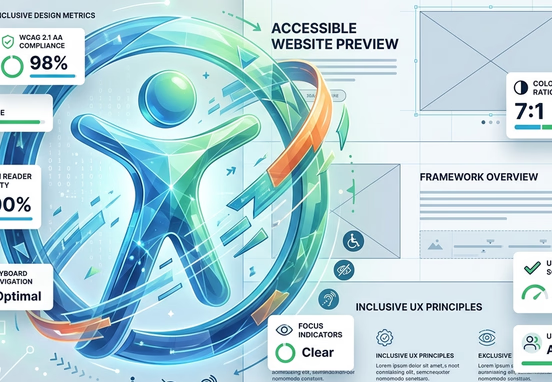
An Accessibility Statement explicitly documents your platform's active efforts to align with international Web Content Accessibility Guidelines (WCAG). This text declares your targeted compliance level, active testing routines, and direct channels for reporting interaction blocks.
Displaying a transparent accessibility framework is essential for protecting your organization against aggressive class-action lawsuits targeting digital discrimination. Corporate entities must demonstrate proactive engineering practices to defend against claims of digital exclusion.
Failing to continuously audit your front-end rendering engines for assistive navigation support creates immense regulatory vulnerability. Reviewing the legal structures inside enterprise accessibility audits and compliance risks for large digital storefronts enables your compliance team to eliminate technical UX obstacles before they spark expensive federal litigation.
In addition to accessibility logs, websites operating within specialized sectors require dedicated consumer disclosures to mitigate corporate liability:
- Professional Services Disclaimers: Explicitly stating that your content does not constitute formal legal, financial, or medical advice, protecting your team from malpractice allegations.
- Affiliate and Revenue Disclosures: Disclosing external financial relationships or promotional compensation arrangements to satisfy transparency directives.
- Earnings and Outcome Disclaimers: Clarifying that historical business case studies do not guarantee equivalent future financial outcomes for new clients.
Systemic Integration and Ongoing Code Maintenance
Many corporations treat legal documentation as a static project item, copy-pasting standard text blocks onto hidden pages during the initial development cycle and ignoring them for multiple years. This operational neglect builds up severe corporate liabilities.
As web architectures expand through continuous marketing feature iterations, code updates, and database expansions, tracking unmonitored script behaviors becomes functionally impossible without dedicated automated code reviews. Maintaining these outdated software footprints creates severe system vulnerabilities.
Neglecting core compliance frameworks can completely halt your company's expansion pipelines. Analyzing how legacy technical debt and bad web infrastructure halt corporate growth reveals that ignoring deep structural logic and code optimization dependencies slows down your engineering speed while leaving digital assets exposed to systemic legal liabilities.
Enterprise engineering directors must establish continuous, automated monitoring loops to ensure that all public-facing disclosures remain in perfect lockstep with internal database changes. Data paths, cookie consent mechanics, and layout parameters must be regularly tested under real-world compliance criteria.
By deploying isolated database models, prioritizing hand-coded semantic source files over unmonitored visual plugins, and displaying explicit, legally binding documentation across your root subdirectories, you transform your public web presence from a major legal vulnerability into a protected corporate asset built to support sustainable, multi-market enterprise growth for decades.