

Custom Web Vendor Portals: Syncing Sales, Shipping, Project Milestones, and Work Logs
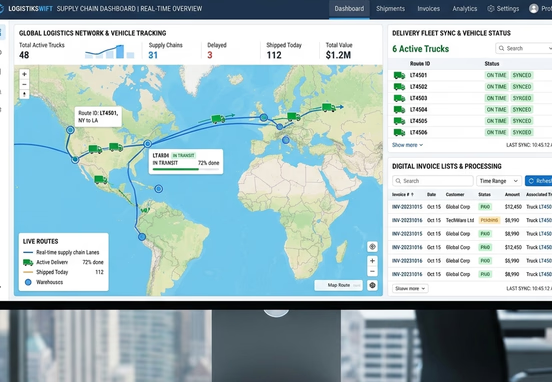
Managing third-party suppliers, manufacturing partners, and external contractors through fragmented communication channels introduces massive operational friction. When purchase orders exist purely inside email chains, shipping statuses live in isolated carrier portals, and project deadlines sit on manual spreadsheets, supply chain transparency completely collapses. This distribution of essential operational details forces internal teams to spend high-value labor capital on continuous data entry, resulting in delayed production schedules, invoicing errors, and systemic blind spots.
A custom web vendor portal resolves these operational inefficiencies by establishing an access-controlled digital platform where external vendors interact directly with your core database. Rather than operating as a superficial front-end skin, a robust vendor portal acts as a bi-directional pipeline that syncs sales data, shipping logistics, project milestones, and work logs in real time. Building this custom layer eliminates communication gaps, keeps cross-company operations thoroughly aligned, and scales processing capacity without increasing internal administrative head count.
The Architecture of an Interconnected Vendor Loop
To engineer a resilient web portal, the development architecture must support fluid data exchanges across completely different systems. Traditional web solutions use basic automation scripts to push data one way, which regularly leads to mismatched system states when an error occurs during transmission. An enterprise-grade portal relies on structured database integrations that keep the vendor-facing dashboard fully aligned with internal enterprise resource planning (ERP) systems, financial ledgers, and inventory engines.
By ensuring that external updates flow instantly into internal workflows, businesses can eliminate human error and data latency. Implementing this level of infrastructure requires clean API webhooks and database optimization designed to handle concurrent operations. When a vendor modifies a data field within their private interface, the modification immediately propagates through your entire technical ecosystem. This fluid movement of information relies explicitly on how well a company designs its system hooks, ensuring that two-way data sync keeps websites and back-office systems aligned across every single touchpoint.
+-----------------------------------------------------------------+
|                      VENDOR PORTAL INTERFACE                    |
|  [Sales Orders]   [Shipping Logs]   [Milestones]   [Work Logs]  |
+--------------------------------+--------------------------------+
                                 |
         +-----------------------+-----------------------+
         | (Real-Time Form Actions / Webhook Triggers)   | (Secure API Rest Payload)
         v                                               v
+-----------------------------------------------------------------+
|             CORE ENGINE & API DATA PROCESSING LAYER             |
|   - Token Validation   - Data Cleaning   - Payload Routing      |
+--------------------------------+--------------------------------+
                                 |
         +-----------------------+-----------------------+
         | (SQL Transaction)                             | (Direct System Webhook)
         v                                               v
+--------------------------------+               +--------------------------------+
|    INTERNAL CENTRAL DATABASE   |               |   THIRD-PARTY CARRIER / ERP    |
| - Inventory / SKU Balances     |               | - Automated Billing Systems    |
| - Active Operational Maps      |               | - Live Freight Tracking APIs   |
+--------------------------------+               +--------------------------------+

Evaluating Infrastructure Frameworks: Custom Portals vs. Plugins
Many growing organizations attempt to construct vendor environments by combining standard content management system plugins and basic membership modules. While these off-the-shelf tools feature lower initial deployment barriers, they introduce strict functional limitations, heavy recurring subscription fees, and profound security vulnerabilities.
The following matrix highlights why mid-market firms must move past generic plugins and deploy custom-built web application architecture for vendor coordination:
| System Parameter | Off-the-Shelf Plugin Bundles | Bespoke Custom Web Portal Architecture |
|---|---|---|
| Data Sync Frequency | Intermittent batch processing or manual page updates. | Instant, event-driven webhooks. |
| API Extensibility | Limited to pre-built, rigid third-party connectors. | Limitless integration with any legacy or modern API. |
| Access Control Security | Generic role definitions susceptible to privilege escalation. | Granular, database-level role permissions. |
| Database Scalability | Prone to slow queries when processing thousands of line items. | Indexed relational databases built for scale. |
| Transaction Processing | Requires high-fee middleman tools for automated checkout. | Direct integration with custom web checkout pipelines. |
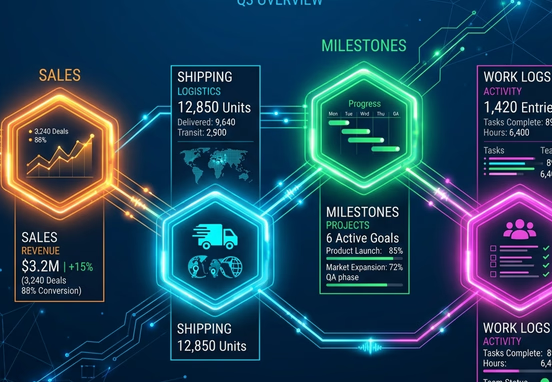
The Four Core Syncing Modules of an Enterprise Portal
1. Automated Sales and Purchase Order Management
The sales engine within a custom portal automates the transition from a verified customer order to an active vendor fulfillment task. When a customer executes a purchase on your primary digital storefront, the system reads the product SKUs, identifies the assigned supplier, and generates a structured digital purchase order inside that specific vendor’s dashboard view.
This execution loop completely removes the manual step of emailing documents back and forth. The vendor receives an automated notification, reviews the specifications, and changes the status to accepted. The system immediately captures this input, updating the central inventory master log and adjusting internal financial allocations without requiring manual intervention from your administrative staff.
2. Real-Time Shipping and Inventory Coordination
A major vulnerability in supply chain logistics is the lack of real-time visibility into freight status and product movement. A custom portal resolves this by integrating directly with carrier APIs (such as FedEx, UPS, DHL, or regional freight networks), allowing suppliers to generate shipping labels and manifest documentation directly from their browser window.
When a vendor marks an order as packed, the system forces the inclusion of a valid tracking hash and automatically updates the client-facing tracking notifications. The portal uses automated tracking loops to check carrier servers every hour, providing the precise location of inventory before it reaches your fulfillment center.
- Automated Weight Calculations: The portal reads product metadata to calculate bulk freight weights automatically.
- Dynamic Customs Generation: For international suppliers, the system populates customs declarations using stored tariff codes.
- SKU Ledger Deductions: Warehouse inventory tallies adjust automatically the moment a vendor logs a dispatched shipment.
- Automated Barcode Printing: The portal generates scannable compliance barcodes that match your internal warehouse routing logic.
3. Transparent Project Milestones and Phase Approvals
For businesses managing complex manufacturing operations or long-term service contracts, project progress tracking cannot afford to be vague. A custom portal transforms milestones into structured validation steps, requiring vendors to submit definitive proof of completion before a phase is officially cleared.
Instead of relying on unscheduled phone calls, vendors log into their portal dashboard to view a linear, visual timeline of their active assignments. This transparent structure acts as an ironclad operational log. By leveraging the same engineering methodologies used when you eliminate status meetings by automating progress logs, companies establish a clean record of project execution that holds all external entities perfectly accountable.
- Phase Assignment: The internal operations team defines a phase requirement along with its associated quality metrics.
- Vendor Documentation: The vendor uploads completed assets, technical specifications, or quality control logs directly to the phase entry.
- Programmatic Verification: System rules run automated checks on the uploaded files to ensure they match size, format, and naming conventions.
- Managerial Authorization: Internal staff approve the phase with one click, triggering the next step on the operational map and updating financial records.
4. Consolidated Work Logs and Financial Reconciliation
When vendors bill by hours worked or units produced, auditing manual invoices against actual output is an administrative nightmare. A custom portal fixes this issue by including integrated time-tracking mechanisms and production counters directly inside the operational interface.
Contractors use built-in timers or validated submission grids to record exactly what they accomplished during a shift. Because this data is collected directly within the system where the project milestones exist, internal accounting teams can immediately match a contractor's billing statements with verifiable project progress. This tight alignment prevents over-billing, cuts down on invoice disputes, and speeds up payment cycles for your top-performing partners.

System Resilience and Security Standards
Technical Safeguard Tip: When engineering bi-directional web portals, always implement defensive data-validation filters at the server layer rather than relying on browser-based validation rules. If an external system encounters an error or attempts to push an unvalidated data payload, your system must execute defensive fallbacks. Building the bulletproof web pipeline with custom error controls keeps your central operating database perfectly isolated from third-party application crashes and corrupted data entries.
Beyond error control, securing access parameters within the portal is paramount. Since vendors are external entities, they must never have access to your database's root architecture. A custom application implements role-based access tokens that tightly restrict a user's visibility. A vendor can only view data rows that feature their specific organization identifier, protecting your company's proprietary data, client lists, and broader financial records from unauthorized exposure.
Deploying Custom Portal Workflows for Long-Term Scaling
Shifting your vendor ecosystem from disjointed manual communication to an automated digital portal requires a deliberate, engineered approach to operational logic. Off-the-shelf software options will always force your business to alter its internal workflows to match the rigid constraints of their pre-built code bases. This dynamic limits your unique competitive advantages and causes friction among your suppliers.
True operational efficiency is achieved by partnering with specialized web engineers to develop a bespoke workflow and systems automation hub designed specifically around your unique business rules. When your portal is custom-built, it wraps perfectly around your established relationships, automates repetitive administrative burdens, and creates a highly scalable foundation for growth. Optimized web portals transform vendor management from a chaotic logistics bottleneck into a smooth, predictable, and highly profitable operational engine.