

Multi-Location SEO: How Franchises Architect Landing Pages Using Custom Frameworks

Managing organic visibility for a franchise with hundreds of locations introduces complex engineering challenges. Template-driven structures fail to scale under multi-location demands, causing crawl budget exhaustion, indexing errors, and internal keyword competition.
To capture localized search traffic, franchises must move away from generic configurations. Success requires custom technical frameworks engineered to handle distributed landing pages, automated schema, and programmatic content deployment without sacrificing core performance.
The Architectural Choice: Subdirectories vs. Subdomains
The first step in executing a scalable multi-location digital strategy is establishing how localized pages sit within your domain architecture. The incorrect structure bottlenecks your organic search authority across all locations.
Many organizations isolate locations onto independent subdomains. This fragmented approach forces teams to build up search engine trust from zero for every location page, diluting global brand authority.
| Architectural Dimension | Subdirectory Strategy (/location/city) | Subdomain Strategy (city.domain.com) |
|---|---|---|
| Domain Authority Sharing | Inherits 100% of the root domain's primary authority metrics. | Treated as a distinct entity; requires isolated link acquisition. |
| Technical Overhead | Simple centralized updates across a single master directory. | High complexity; requires managing independent SSL and DNS rows. |
| Crawl Budget Efficiency | Highly efficient; search spiders crawl the domain cohesively. | Segmented; spiders index each subdomain on independent cycles. |
| Design Consistency | Guaranteed; shares the global CSS and component framework. | Variable; prone to design drifts across location networks. |
Deploying a clean subdirectory model provides regional locations with the immediate ranking benefits of your established domain history. Maintaining this unified technical approach protects the corporate platform from architectural fragmentation and unmanaged indexing errors.
When corporate infrastructure becomes disorganized across multiple subdomains, the entire organization suffers from structural operational friction. Analyzing how legacy technical debt and bad web infrastructure halt corporate growth demonstrates that clean, unified directory architectures are necessary to preserve development agility and search visibility.
Programmatic Content Customization vs. Duplicate Content Penalties
Search engine algorithms prioritize unique, contextually relevant local data over generic page sets. Franchises frequently commit the critical error of cloning an identical landing page template across five hundred cities, merely swapping out the city name in the primary heading.
This lazy strategy triggers duplicate content filters, causing search engines to omit the vast majority of your location pages from the organic search results entirely. To secure prominent regional rankings, each landing page must feature genuine, localized information tailored directly to that specific market segment.
Custom frameworks resolve this issue by combining database fields with dynamic text rendering engines, assembling unique pages programmatically:
- Dynamic Hyper-Local Copy: Automatically inject specific regional identifiers, community histories, and localized service offerings unique to the individual operating unit.
- Real-Time Regional Reviews: Programmatically pull localized customer reviews and testimonials via secure API hooks directly associated with that specific location's database row.
- Live Operational Datapoints: Display exact local operating hours, localized inventory updates, regional pricing models, and direct employee rosters.
- Geographic Proximity Assets: Embed interactive maps, clear step-by-step regional driving directions, and localized transit access points.

Automating Multi-Location Structured Data Architecture
Search engine crawlers rely heavily on advanced schema markup to accurately process the relationships between a global parent corporation and its regional franchise locations. Manual implementation of this code across hundreds of landing pages is prone to structural errors and deployment delays.
Custom engineering allows corporations to generate nested JSON-LD structured data programmatically. The system extracts variables directly from your master location database and renders the schema code dynamically inside the HTML head container.
Here is a clean, standard example of an enterprise-grade nested LocalBusiness and Franchise structured data module:
+------------------------------------+
|      Master Location Database      |
+------------------------------------+
                  |
                  | (Extracts Variables)
                  v
+------------------------------------+
|   Dynamic Text Rendering Engine    |
+------------------------------------+
                  |
                  | (Generates Nested Schema)
                  v
+------------------------------------+
|   Nested JSON-LD Structured Data   |
|    (Franchise & LocalBusiness)     |
+------------------------------------+
                  |
                  | (Injects Code Dynamically)
                  v
+------------------------------------+
|        HTML Head Container         |
+------------------------------------+
                  |
                  | (Processed By)
                  v
+------------------------------------+
|       Search Engine Crawlers       |
+------------------------------------+
Deploying this structured code across your digital map ensures search engine crawlers understand your exact geographic coverage coordinates. Combining custom schema modules with accurate directory structures allows your brand to claim extensive real estate within competitive local maps.
To achieve dominance across local markets, your technical code layer must integrate with map listings. Exploring the complete local SEO playbook and map optimization strategies allows your team to align web architecture with Google Business Profile properties perfectly.

Eliminating CMS Bloat and Front-End Performance Bottlenecks
Multi-location platforms built on top of template-driven content management systems or heavy page builders quickly accumulate crippling layout bloat. When hundreds of localized pages pull scripts from multiple uncoordinated plugins, loading speeds deteriorate drastically.
Slow page loads destroy your mobile conversions and drop your organic search rankings. Franchise landing pages must load near-instantaneously on mobile devices, as a vast majority of local searches occur on smartphones while users are actively on the move.
Building hyper-scalable, lightning-fast digital storefronts requires stripping away abstract page builders. Our dedicated speed-first design services provide franchises with hand-coded, decoupled web architecture engineered to load in milliseconds, ensuring maximum mobile search exposure.
Adhering to hand-coded source disciplines provides benefits far beyond pure loading metrics. Analyzing why clean hand-coded web architecture beats page builders for technical SEO shows that semantic HTML ensures superior indexing health, security boundaries, and server cost efficiency across extensive franchise directories.
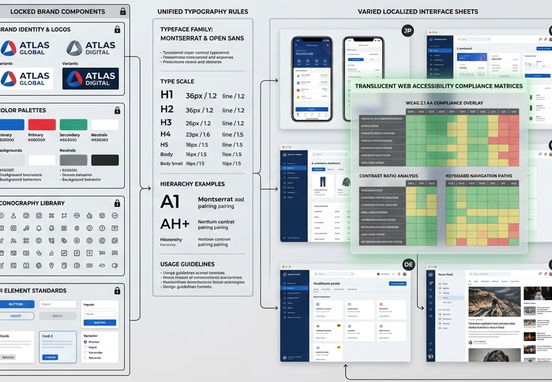
Maintaining Global Brand Consistency and Accessibility Compliance
Operating a distributed landing page system across multiple regions introduces significant risks regarding brand fragmentation and legal compliance errors. Giving individual franchise owners full editing privileges over their landing page layouts frequently leads to broken designs and accessibility regressions.
To mitigate these operational liabilities, enterprise technology frameworks utilize isolated design systems. The core interactive modules, color values, and typographic elements are locked inside a central codebase, allowing local managers to edit specific text rows without breaking the underlying presentation layer.
Ensuring layouts remain universally accessible is crucial for avoiding expensive discrimination lawsuits. Reviewing the insights within enterprise accessibility audits and compliance risks for large digital storefronts enables teams to preserve WCAG standards across thousands of locations.
The Scalable Franchise Deployment Workflow
Successfully scaling a multi-location landing page ecosystem demands a rigorous programmatic deployment pipeline rather than manual content creation workflows.
Teams must coordinate around an automated deployment sequence to ensure structural consistency:
- Central Location Database Setup: Establish a single, immutable source of truth for location data, housing verified operating hours, addresses, URLs, and local identifiers.
- API-Driven UI Component Architecture: Construct lightweight, custom front-end components that dynamically ingest data points via secure API gateways.
- Automated Validation and Testing Suite: Run continuous checks on every location page to scan for broken internal links, schema parsing errors, and mobile rendering anomalies before deployment.
- Edge Content Delivery Optimization: Deploy the localized page directory across global edge networks to ensure static files render instantly for regional searchers.
By decoupling your multi-location data pipelines, utilizing hand-coded semantic web architecture, and enforcing strict centralized design controls, you transform your franchise footprint into a high-performance local acquisition engine built for long-term growth.