

The Complete Guide to Selecting a Professional Business Phone Line

Operating a growing business using a personal cell phone number or an unmanaged residential line is a systemic risk to your operational scaling, brand authority, and client retention. When prospective customers call an established enterprise, they expect a seamless communication matrix. If they encounter a generic mobile voicemail greeting, a busy signal, or a disorganized call routing sequence, they immediately lose trust in your operational capabilities. Your communication infrastructure must project the exact same level of performance, security, and precision as a modern, high-speed digital application interface.
Establishing a professional business phone line extends far beyond simply getting an additional number to answer calls. It involves deploying a cloud-managed communication framework that integrates with your digital assets, automates data routing, protects team privacy, and guarantees high-availability connectivity. By engineering a structured telecommunications pipeline, you ensure that every inbound lead is routed to the correct operational department with zero friction, maximizing your team's efficiency and capturing valuable commercial opportunities.
Every element of your corporate communication strategy must be built to support long-term, scalable growth. From evaluating technical telephony architectures and choosing specific number classifications to configuring automated Interactive Voice Response menus and minimizing latency, executing a clean deployment prevents operational bottlenecks. It allows you to transform standard voice calls into structured data points that fuel your broader business intelligence systems.
Architectural Distinctions in Modern Telephony Systems
To select the correct telecommunications asset for your enterprise, you must look past basic software interfaces and examine the underlying networking architecture. Modern business communication options generally fall into three distinct structural categories: legacy analog lines, cellular dual-SIM frameworks, and Cloud-managed Voice over Internet Protocol systems.
Traditional analog lines rely on dedicated copper wire networks managed by regional utility carriers. While this legacy hardware offers high historical reliability, it lacks the technical flexibility, programmatic routing capabilities, and software integrations required by modern corporate teams. Furthermore, scaling an analog network requires physical on-site wiring adjustments, creating significant technical debt and unnecessary capital expenditures.
Cellular-based setups, using modern eSIM profiles to split a single mobile device between a personal and business line, work well for solo operators in the initial validation phase. However, this method scales poorly when you begin hiring administrative personnel. You cannot easily route incoming calls across a distributed team, implement centralized compliance recording, or integrate call metrics with corporate databases from a single user's smartphone.
Evaluating the Cloud VoIP Ecosystem
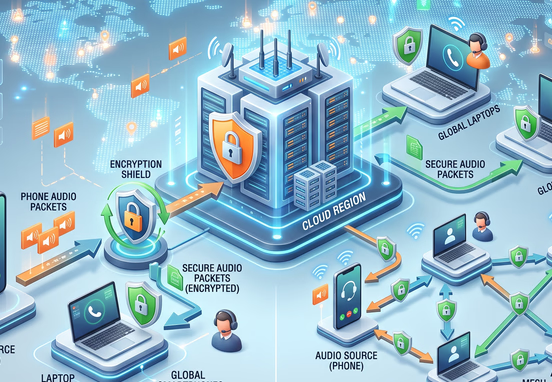
Cloud-managed Voice over Internet Protocol systems convert analog audio signals into digital data packets, routing them across standard fiber-optic internet networks. This architecture detaches your phone lines from physical locations or single hardware units, allowing your global team to manage client communications securely from laptops, desk phones, or mobile apps.
When deploying a VoIP framework, your network infrastructure must be optimized to handle real-time UDP packet delivery. If your local business network experiences high jitter or packet loss, your voice calls will drop frames, causing audio degradation and fragmented communication. Selecting a VoIP provider that operates a globally distributed Anycast network ensures your voice traffic is routed through the closest data center, lowering latency milestones and guaranteeing clear, crisp audio.
When mapping your organizational communication layout, refer to your data on how to build a buyer persona to identify your perfect target client. Understanding whether your core audience prefers direct SMS updates, high-touch consultative phone calls, or multi-channel communications allows you to configure your phone system's backend to match their specific behavioral habits.
Infrastructure Mapping and Communication Features
Selecting a provider requires evaluating the technical capabilities embedded within their server management platforms. The table below outlines the core differences and operational boundaries between these primary telephony options:
| Infrastructure Metrics | Legacy Analog Systems | Mobile eSIM Frameworks | Cloud VoIP Platforms |
|---|---|---|---|
| Simultaneous Call Capacity | Single Call Per Physical Line | Single Call Active At Once | Virtually Unlimited Concurrent Paths |
| Data Integration Capabilities | Zero Digital Integration | Basic Contact List Sync | Full API and CRM Webhook Connectivity |
| Geographic Mobility | Tied to a Physical Building | Limited to Single Cell Device | Global Availability via Web App Profiles |
| Routing Flexibility | Manual Physical Switches | Basic Call Forwarding Options | Dynamic IVR Cascades and Time-Based Rules |
| Security Layer Options | Easily Tapped Physical Wires | Standard Carrier Security | Encrypted TLS and SRTP Data Pipelines |
Understanding how great user experience lowers customer acquisition costs applies directly to your telecommunication channels. A confusing phone menu that drops calls or forces buyers to repeat information repeatedly increases friction, driving up acquisition costs through lost operational efficiency.
Selecting the Optimal Number Class for Brand Authority
The specific number structure you display across your web assets directly influences consumer trust and geographical search engine optimization. You must analyze the behavioral tendencies of your target market to choose the proper number classification for your business.
Local area code numbers establish an immediate regional presence, which is vital for service providers targeting specific geographic markets. Utilizing a local number aligns perfectly with your comprehensive local seo playbook for google business profile optimization. When local search bots scrape your digital assets, finding an accurate local number that matches your geographical schema tags strengthens your local ranking signals.
Toll-free numbers provide a national presence, signaling to enterprise buyers that your organization has the scale and capital to service nationwide accounts. These configurations allow users to contact your team without incurring long-distance charges, removing financial friction for out-of-market accounts. Vanity numbers utilize customized alphanumeric strings to build memorable brand association, maximizing offline ad recall and boosting inbound conversion loops.
Telephony Branding Tip: Never use your business phone number as a shared fallback verification channel across unsecured personal accounts. Always insulate your corporate communication lines by managing them inside dedicated enterprise security containers, protecting your brand from unauthorized SIM-swapping attempts.
Just as why a gmail address instantly destroys business credibility centers on consumer trust and technical professionalism, using a random cell number on a corporate contact page signals a temporary operation. Moving your business communication channels to a dedicated enterprise telephone network shows buyers that your business is stable, highly secure, and built to last.
Technical Step-by-Step: Provisioning and Routing Configuration
Deploying a Cloud VoIP phone system requires systematic configuration within your carrier's cloud management engine. Follow this clear sequence to ensure a flawless setup across your entire team.
Step 1: Execute Legal Porting Actions or Initial Number Provisioning
If you have an existing phone number tied to a legacy carrier, initiate a formal Local Number Portability request within your new provider's portal. Upload a recent Letter of Authorization alongside your tax documentation. This prevents your old carrier from rejecting the transfer, allowing you to migrate your primary communication assets without experiencing service blackouts.
Step 2: Establish the Interactive Voice Response Routing Logic
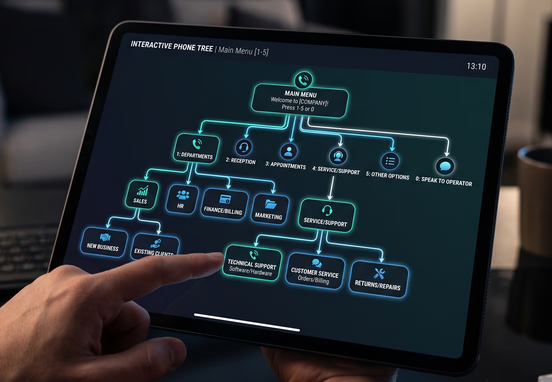
Log into your administrative control panel to build your primary Interactive Voice Response menu. Avoid creating multi-layered, confusing routing trees that exhaust a caller's patience. Design a clean, flat directory tree that moves users to their destination within two steps, keeping your internal communications organized and efficient.
                       [ Primary Trunk Line ]
                                 |
                                 v
+---------------------------------------------------------------------------+
|                          IVR Main Greeting Node                           |
+---------------------------------------------------------------------------+
       |                  |                  |                  |
   (Press 1)          (Press 2)          (Press 3)          (Timeout)
       |                  |                  |                  |
       v                  v                  v                  v
+--------------+   +--------------+   +--------------+   +--------------+
|    Sales     |   |   Support    |   |   Billing    |   |  Automated   |
|  Hunt Group  |   |  Escalation  |   |  Department  |   |   Operator   |
|              |   |    Queue     |   |              |   |   Fallback   |
+--------------+   +--------------+   +--------------+   +--------------+
       |                  |                  |                  |
       v                  v                  v                  v
  Simultaneous       Round-Robin       Voicemail to       Fallback
  Ring to AEs       Distribution      Email Gateway         Route
                                       if Offline
Step 3: Define Time-Based Business Hour Routing Vectors
Configure automated routing schedules that dynamically modify how inbound calls are processed based on the time of day and your team's office hours. During standard working windows, calls should route directly to live desk environments. Outside of these hours, configure the system to send calls to a specialized on-call emergency team or an automated voicemail-to-text processing server.
Step 4: Provision Secure Hardware and Mobile App Profiles
Deploy secure client softphone profiles to your team's workstations and mobile devices using encrypted configuration links. If you are using physical desktop VoIP hardware, utilize Secure Zero-Touch Provisioning protocols to feed encryption keys and account data directly into the hardware over HTTPS, blocking unauthorized interception risks.
Step 5: Test Connection Integrity via Codec Diagnostics
Before publicizing your new communication line, verify that your network firewalls are configured to allow clean VoIP traffic. Ensure that Session Initiation Protocol (SIP) traffic on port 5060 and Real-time Transport Protocol (RTP) data paths are completely unrestricted, preventing common one-way audio errors and call drop bugs.
Aligning Telephony Systems with Digital Conversion Strategy
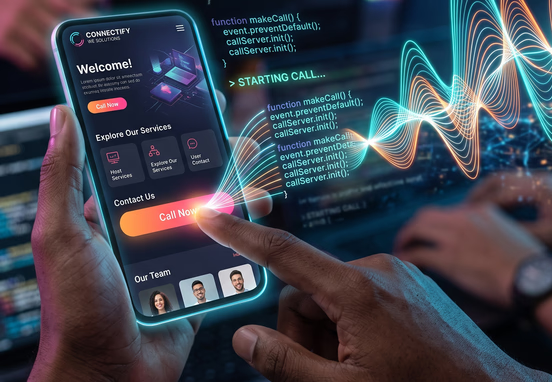
Your professional phone line should not exist as an isolated silo; it must operate as an integrated component of your web presence. When high-intent buyers navigate your website, they should be able to transition from reading code-optimized copy to speaking with a live representative in seconds.
To make this transition seamless, your digital assets must be developed with modern, clean code frameworks that native web browsers parse instantly. Investing in an optimized web design and development service ensures your phone links utilize correct semantic HTML hyperlink schemes, such as the tel: protocol. This allows mobile users to launch your communication funnel with a single tap, eliminating copy-paste friction and driving up conversion efficiency.
Furthermore, integrating advanced phone tracking software with your web infrastructure lets you trace a client's journey from their initial search engine query down to the exact phone call duration. By deploying dynamic number insertion scripts into clean, hand-coded layouts, you gather highly accurate ROI data without degrading page load speeds or breaking your site's visual composition.
Validating System Resiliency and Operational Security
Maintaining a reliable business phone system requires regular infrastructure health checks. Review your administrative dashboards monthly to clear out old employee access profiles, update your out-of-office automated responses, and audit call quality logs to address network latency bottlenecks before they impact client relationships.
By removing your company from the limitations of consumer cell plans and deploying an enterprise-grade cloud VoIP system, you eliminate significant communication friction. This infrastructure choices gives your brand a highly responsive setup that adapts to your workflow, keeping your customer acquisition pipelines open, secure, and ready to convert high-value accounts at scale.