

How to Build a Custom Subscription Engine Without Third-Party Platform Fees

Relying on out-of-the-box SaaS subscription management platforms seems convenient at launch, but the recurring platform fees quickly eat into profit margins as a business scales. Many growing enterprises realize that paying a percentage of top-line subscription revenue plus fixed per-transaction fees to a middleman engine becomes an expensive operational bottleneck. Building an internal, custom subscription architecture allows an enterprise to retain complete financial control, eliminate arbitrary revenue taxes, and significantly improve long-term profitability.
By building your own engine, you are not bypassing the core payment processor itself; instead, you are taking ownership of the scheduling, billing logic, and customer lifecycle management. This means you still utilize secure tokenization methods from processors like Stripe, Authorize.net, or Adyen, but you avoid their expensive premium billing tiers. The primary objective is to move from a system where a third party dictates your pricing structures to a system where your internal code controls your revenue.
Developing a proprietary billing framework requires strict attention to database design, scheduling security, error handling, and transactional validation. When executed correctly, this engineering choice serves as a permanent competitive advantage that maximizes the lifetime value of every customer contract. Businesses that shift to proprietary pipelines successfully lower your cost per transaction while establishing complete control over their transactional ledger.
Architectural Separation of Tokenization and Scheduling
To build an independent engine safely, your system must strictly decouple payment tokenization from billing schedule logic. Tokenization ensures that sensitive card data never touches your application servers, which keeps your infrastructure securely within the boundaries of low-level PCI-DSS compliance frameworks. The core payment gateway processes the initial transaction and returns a permanent payment method token that your system saves for future charges.
Your application layer assumes full responsibility for tracking when, how much, and how often that token is sent to the gateway for clearance. Instead of relying on a third-party platform's internal clock to trigger a renewal, your system uses structured native databases and precise cron schedules to execute charges. This separation means you can change your subscription tiers, offer custom contract terms, or adjust pricing instantly without modifying configurations across external software dashboards.
Bypassing the Middleman API Layers
Traditional setups pass customer data through intermediary API platforms that charge a premium for basic math and date tracking. Bypassing these layers involves sending raw payload requests directly from your application backend to the core payment gateway's tokenized vault endpoints. By engineering direct communication paths, you eliminate latency, minimize points of failure, and remove the threat of vendor lock-in that occurs when customer billing profiles are trapped inside a single platform's proprietary subscription ecosystem.
Database Schema Architecture for Subscription Tracking
A robust relational database schema is the backbone of any fee-free subscription engine. The database must track the relationship between users, tokenized payment profiles, subscription statuses, billing intervals, and historical invoices with total mathematical precision. Because financial records require absolute consistency, using a database engine with strong ACID compliance is mandatory for preventing race conditions during high-volume recurring runs.
The architecture requires distinct tables that separate the customer profile from their active contracts and billing history. This layout allows a single customer to hold multiple different subscriptions, use fallback payment methods, and maintain a pristine audit trail of every transaction.
| Table Name | Critical Fields | Purpose & Business Logic |
|---|---|---|
payment_methods | id, user_id, gateway_token, brand, last_four, exp_month, exp_year, is_default | Stores secure gateway reference tokens without holding raw card numbers. |
subscriptions | id, user_id, payment_method_id, status, price_cents, interval_days, current_period_start, current_period_end, next_billing_date | Tracks the active contract terms, lifecycle states, and precise scheduling dates. |
invoices | id, subscription_id, user_id, amount_cents, tax_cents, status, attempt_count, processed_at | Serves as the immutable ledger for every attempted, cleared, or failed renewal charge. |
billing_events | id, invoice_id, event_type, raw_payload, created_at | Provides a complete historical log for auditing dunning sequences and state changes. |
Every field within these tables must use explicit, unambiguous data types to avoid calculation drift over time. For example, currency amounts should always be stored as integers representing the smallest currency unit, such as cents, to completely prevent floating-point rounding errors during multi-item calculations.
Timestamps must be standardized to Coordinated Universal Time (UTC) across all tables to avoid synchronization mismatches when executing regional billing cycles. The next_billing_date field on the subscription table must be indexed heavily, as your scheduling engine will query this specific column constantly to determine daily processing queues.
The Core Billing Engine Processing Pipeline
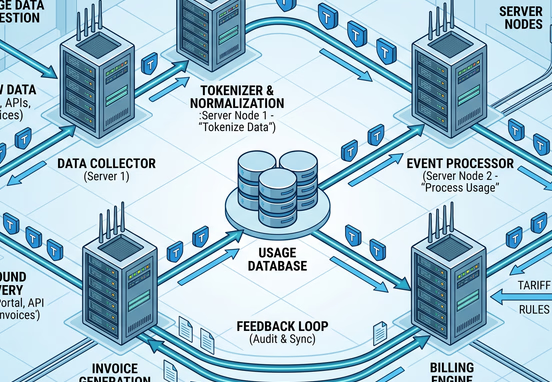
The engine operates on a deterministic, automated processing loop that evaluates subscription states at regular intervals. This pipeline typically executes via a secure daily cron job, a distributed background worker system, or a dedicated cloud event scheduler that triggers a series of transactional check scripts. The processing script isolates subscriptions that have reached or passed their renewal date, verifies the customer's default payment token, and issues a server-side charge request to the payment gateway.
To ensure system reliability, the engine must utilize strict database locking mechanisms when processing the queue. This prevents a subscription from being evaluated twice simultaneously if a worker process stalls or restarts mid-cycle, removing the risk of accidentally double-charging a client.
Below is the operational flow of how a custom billing pipeline executes a daily renewal loop, validates gateway responses, and updates internal ledgers safely:
[Start: Daily Billing Loop Triggered]
       │
       ▼
[Query subscriptions WHERE next_billing_date <= NOW AND status = 'active']
       │
       ▼
[Loop Through Target Subscription Records]
       │
       ├──► [Acquire Row-Level Database Lock]
       │          │
       │          ▼
       ├──► [Generate Immutable Draft Invoice Record]
       │          │
       │          ▼
       ├──► [Dispatch Tokenized Charge to Core Gateway API]
       │          │
       │          ├─► (Gateway Response: SUCCESS)
       │          │     │
       │          │     ▼
       │          │   [Update Invoice status = 'paid']
       │          │   [Advance next_billing_date by interval_days]
       │          │   [Release Row Lock & Dispatch Receipt Email]
       │          │
       │          └─► (Gateway Response: FAILED/DECLINED)
       │                │
       │                ▼
       │              [Update Invoice status = 'failed']
       │              [Route to Automated Dunning Retry Matrix]
       │              [Release Row Lock & Flag Account Status]
       │
       ▼
[End: Terminate Daily Billing Cycle and Log Metrics]
Optimizing High-Volume Batch Requests
When processing thousands of subscription renewals simultaneously, executing sequential synchronous API calls to an external gateway will exhaust server memory and hit platform timeouts. High-performance engines resolve this by segmenting the daily billing queue into smaller, manageable batches and routing them to parallel asynchronous workers. This distributed processing model ensures that if a single network request experiences latency or drops completely, the remaining concurrent workers continue executing charges without interrupting the wider system.
- Database Cursor Pagination: Avoid using heavy offsets that slow down SQL execution as records scale into the tens of thousands.
- Idempotency Key Verification: Generate unique keys for every transaction request to guarantee the payment processor never charges a token twice for the same billing event.
- Graceful Timeout Fallbacks: Set explicit network connection timeouts so that a hung gateway connection doesn't block processing threads indefinitely.
Mitigating Transaction Risks, Failed Payments, and Dunning Logic
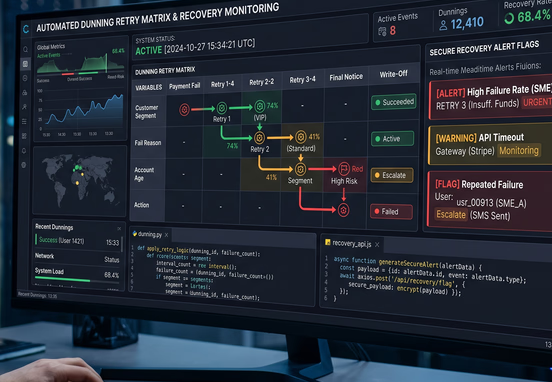
Building a custom billing architecture requires engineering an independent, resilient framework to manage failed transactions and customer churn. Unlike third-party SaaS tools that charge extra for basic automated retries, a custom engine allows you to implement granular, highly tailored dunning logic that perfectly matches your customer base's behavior. When a payment token fails due to temporary issues like insufficient funds, a network timeout, or a soft gateway decline, your application must respond with automated, staggered recovery actions.
The system must distinguish between hard declines, such as a reported stolen card or an invalid token, and soft declines, which are eligible for automated retries. Hard declines should immediately halt the subscription loop and trigger an account notification, preventing your servers from wasting API resources on unrecoverable profiles. Implementing this level of intelligence within your system ensures you protect cash flow, maintain user access continuity, and eliminate involuntary subscriber churn.
Engineering Tip
Always log the specific gateway decline code (e.g.,
insufficient_funds,expired_card,processing_error) directly into yourbilling_eventstable before launching a retry sequence. This structured historical data allows you to optimize your retry intervals based on real performance metrics, rather than relying on generalized industry assumptions.
Implementing a Multi-Tiered Retry Matrix
A standard, high-recovery custom dunning strategy should be structured across an automated, time-delayed timeline rather than retrying the card immediately. Retrying a soft decline multiple times within the same hour will flag your merchant account for potential fraud and decrease overall clearance rates.
- Day 1 (Initial Failure): Mark the invoice as failed, leave the subscription active, and schedule the second attempt exactly forty-eight hours later while sending a silent system notification.
- Day 3 (Second Failure): Trigger an automated email to the user containing a secure link to update their billing credentials, and schedule the final retry for day seven.
- Day 7 (Third Failure): Execute the final charge attempt; if the transaction fails again, automatically downgrade the subscription status to past_due or suspended, revoke application access, and flag the token.
By tailoring this progression through internal code, you bypass the standardized, rigid schedules imposed by external platforms. This ensures your business rules dictate exactly how long a customer remains in a grace period before their account access is restricted. Integrating tailored automated structures across your technical infrastructure allows you to maintain tight control over client lifecycles while utilizing custom billing logic to handle edge cases gracefully.
Continuous Synchronization and Financial Ledger Compliance
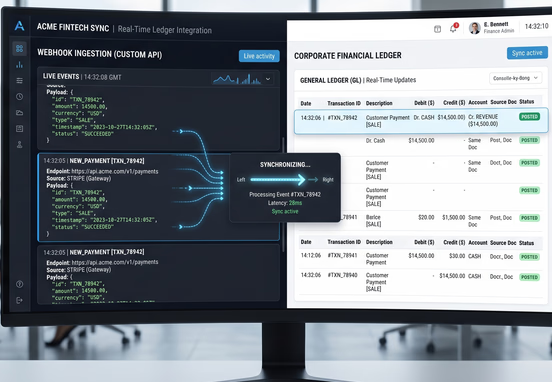
An independent subscription engine cannot operate as an isolated silo; it must continuously synchronize its internal transactional states with your broader financial accounting ecosystem. Every time an invoice state transitions from drafted to paid or failed, your system must record those adjustments in an absolute ledger format. This practice prevents discrepancies between your application's database, your core payment gateway reports, and your company's general ledger software.
Instead of relying on heavy manual updates or platform exports, custom integrations leverage optimized automated data pipelines to feed real-time financial data into business dashboards. This architectural alignment guarantees that your executive team has immediate visibility into critical metrics like monthly recurring revenue, lifetime value, and active churn rates without relying on third-party analytical add-ons.
Real-Time Tax Processing and Ledger Alignment
To maintain complete regulatory compliance across multiple jurisdictions without platform fees, your engine must integrate clean lookup utilities into its checkout pipelines. Before generating an invoice record, the system passes the buyer's geographical metadata to a dedicated tax calculation microservice or a localized database table containing current rate structures. The calculated variable tax amount is recorded on its own line within the immutable invoice schema, ensuring that automated financial workflows remain perfectly accurate during end-of-year tax reconciliations.
Building these specialized financial connections requires a deep understanding of data ownership and security protocols. Designing systems that leverage why custom api pipelines guarantee data ownership (and the critical features to look for) helps protect sensitive financial records from platform vulnerabilities while streamlining core operations. Furthermore, routing these records through custom web checkout pipelines ensures that multi-party distributions, ledger entries, and variable transaction logic sync flawlessly without manual interference.
To power this ongoing alignment efficiently across external enterprise tools, your architecture should leverage direct data-driven events. Implementing custom webhooks provides your system with low-latency, secure event distribution that outperforms traditional API polling models, keeping internal databases and accounting modules synchronized instantly.
Securing and Scaling Your Custom Billing Infrastructure
As your transaction volume grows, the custom subscription engine requires strict security hardening and performance tuning to remain highly available and completely secure. Because this engine handles the financial lifeblood of your enterprise, its underlying code paths must be treated with the highest degree of engineering rigor. This involves setting up isolated staging sandboxes for testing edge-case billing intervals, enforcing strict field-level encryption for user identifiers, and implementing robust rate-limiting systems on all checkout endpoints.
Automating the continuous maintenance, performance optimization, and log auditing of a proprietary infrastructure ensures your technical team can focus on feature development rather than manual troubleshooting. Transitioning to a fully managed, independent engine removes the constant operational tax of third-party platforms while ensuring your core architecture scales alongside your business demands.
For enterprises looking to build, optimize, or scale a highly reliable billing framework without third-party fees, partnering with specialized developers is essential. Utilizing expert custom workflow and systems automation services allows you to deploy secure, high-performance subscription infrastructure that maximizes profit margins, ensures data compliance, and gives your business complete control over its digital revenue pipelines.