

How Developers Safely Test Automated Web Networks in Sandbox Environments

Deploying live web automations without testing them inside fully isolated virtual networks introduces catastrophic operational vulnerabilities. When multiple enterprise systems are connected via complex event-driven networks, a single unhandled script mutation or a minor logical drift can trigger an uncontrollable execution loop. If these systems are tested in a production or live environment, the automated loop will rapidly consume API limits, corrupt live databases, and accidentally dispatch thousands of transactional emails or real credit card charges to active users.
To prevent these systemic breakdowns, engineering teams must establish airtight testing boundaries known as sandbox environments. A true sandbox is not merely a secondary database table or a test mode toggle within an external software dashboard. It is a completely mirrored, isolated replica of your organization’s entire web network, configured specifically to simulate live data exchanges without any risk of data escaping into the public internet. By verifying systemic code inside these protected zones, companies ensure that complex workflows operate with absolute predictability under real-world stress conditions.
When mapping out these isolated validation spaces, developers must ensure that every single step inside the automation workflow is bound by deterministic parameters. Establishing these testing rules around highly structured trigger-action logic provides your development teams with an exact computational framework. This precise configuration ensures that every simulated event produces a predictable, verifiable consequence, allowing you to catch edge-case exceptions long before your code interacts with live customer channels.
Core Architectural Components of an Enterprise Sandbox
A high-performance sandbox network relies on structural isolation to ensure that test data never mixes with live production infrastructure. Rather than relying on simple configuration files that can be accidentally mispointed during deployment, developers create standalone, containerized virtual environments. These environments run decoupled copies of front-end website engines, database clusters, and message queue brokers on an isolated local loopback address or a secure private staging server.
To maintain perfect fidelity with live systems, the testing sandbox must intercept all external outbound communication channels. If your web application attempts to send a tracking webhook or query a credit card processor during a test checkout, the sandbox network must route that request to a localized mock server instead of the public web. This local server is engineered to mimic the exact API responses, network latency, and HTTP status codes of the external platform, providing a realistic testing environment without breaking external vendor boundaries.
| Architectural Layer | Production Network Configuration | Sandbox Testing Environment Setup | Operational Security Boundary |
|---|---|---|---|
| Network Routing | Public DNS mapping; open internet communication via secure encrypted TLS endpoints. | Localized virtual bridge network; outbound traffic restricted via explicit DNS proxy tables. | Prevents test data payloads from escaping to public software vendors. |
| API Integration | Live authenticated connection tokens linking straight to production software engines. | Swapped local environment variables pointing directly to high-fidelity mock servers. | Insulates active operational accounts from automated testing noise. |
| Database State | Production clusters holding active client profiles and sensitive financial records. | Isolated containers running sanitized, synthetic mock database seed files. | Neutralizes the risk of data exposure or accidental historical overwrites. |
| Execution Logging | High-velocity logs streamed to centralized monitoring clouds and accounting tools. | Localized event vaults writing raw payload strings directly to isolated text files. | Provides complete, unmediated digital forensics for local developer auditing. |
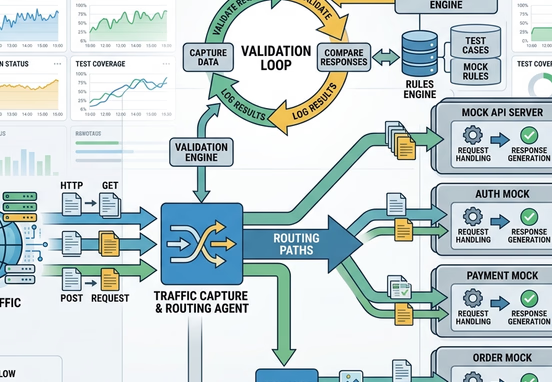
The Automated Sandbox Network Validation Loop
The mechanics of an automated testing sandbox revolve around a continuous, event-driven interception pipeline. When a developer initiates a testing sequence, the application backend executes its standard business logic, unaware that it is operating inside an isolated container. The local staging framework captures the generated web requests, runs programmatic validation checks against the payload structure, and evaluates how the network manages concurrent tasks.
To ensure absolute system safety, the integration network must deploy localized proxy guards that actively monitor every single outbound socket connection. If a script attempts to bypass local environment variables and reach a public external endpoint, the proxy guard intercepts the communication, halts the execution thread immediately, and writes a critical safety exception to the local developer console, preventing accidental live data leaks.
The technical workflow diagram below illustrates how an isolated sandbox pipeline processes a test transaction, validates payload structures, and utilizes localized mock servers to verify system alignment safely:
[Developer Triggers Test Automation Script]
                    │
                    ▼
      [Application Backend Processes Event]
                    │
                    ▼  (Generates Simulated JSON Payload)
      [Outbound Proxy Guard Interception Layer]
                    │
       ┌────────────┴────────────┐
       ▼ (Target = Public Web)   ▼ (Target = Local Sandbox Loop)
 [Terminate Execution Instantly] [Route to Localized Mock Server Container]
 [Log Critical Safety Alert]     │
                                 ▼
                     [Mock Server Evaluates Request]
                                 │
                       ┌─────────┴─────────┐
                       ▼ (Payload Valid)   ▼ (Payload Invalid)
             [Return Custom HTTP 200] [Return Simulated HTTP 400]
             [Inject Synthetic Latency] [Append Target Error Code]
                       │                           │
                       ▼                           ▼
             [Advance Dev Workflow]    [Route to Diagnostic Vault]
Managing Concurrent State Validations
When simulating thousands of concurrent automated steps within a local network container, developers must continuously monitor how the local database handles row locks and race conditions. A high-fidelity sandbox allows engineers to deliberately trigger overlapping event requests, revealing whether the application's transactional processing loops will stall or double-process records when pushed to extreme limits during high-velocity enterprise campaigns.
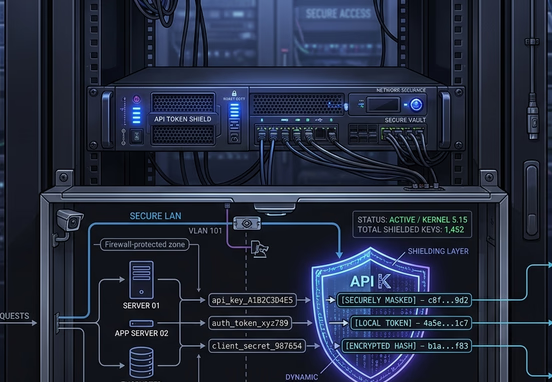
Hardening Secrets and Guarding Authentication Pathways
One of the most frequent vectors for accidental data corruption occurs when live system keys are mistakenly left within local environment configurations. If a testing script executes using a live production token, it will mutate real-world business data regardless of whether the software is running on a local machine or a cloud cluster. Securing your sandboxes requires implementing absolute credential isolation layers that strip out all production identifiers from development repositories.
Developers resolve this security threat by setting up strict runtime injection protocols that load test-specific tokens exclusively from encrypted local environment files. To maximize security across decentralized engineering teams, enterprise platforms deploy advanced credential protection frameworks. Ensuring your configuration files are secured by how token shields keep system authentication keys secure provides your teams with the automated infrastructure needed to mask authentication tokens, restrict key permissions, and prevent live access credentials from ever leaking into local staging zones.
Sandbox Security Architecture Tip
Always configure your local mock servers to expect a highly specific, low-privilege test signature header (such as
X-Sandbox-Execution-Token) on every incoming request. Force your local listener scripts to immediately drop the transaction payload if this specific verification identifier is missing, serving as an automated backstop against misconfigured live environment calls.
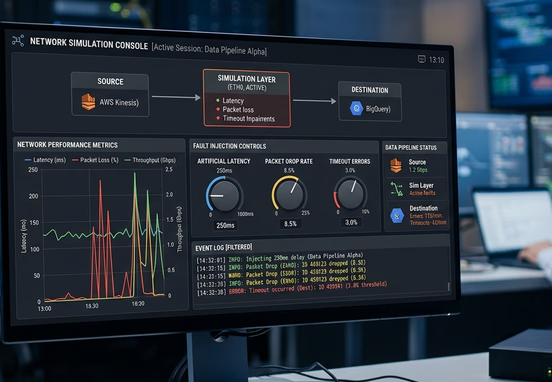
Simulating Unstable Networks, Time Delays, and Exceptions
A sandbox environment that only tests successful operations provides a false sense of security. Real web networks are fundamentally unstable: external APIs go offline, local office internet connections drop, and servers encounter unexpected hardware latency. To build a truly resilient system, developers must use their sandbox infrastructure to test how the web application responds when things break.
Modern sandbox containers allow developers to inject artificial network degradation directly into the automated workflows. By configuring local mock servers to deliberately drop packets, return sudden server errors, or introduce variable time delays, engineers can thoroughly evaluate their system's self-healing capabilities. This testing is essential for verifying that automated email notifications, client billing paths, and data sync tools recover gracefully from network dropouts.
Testing these complex asynchronous behaviors requires writing explicit, time-delayed logic paths that can handle out-of-order execution loops safely. Learning how to add time delays to automated workflows without breaking code provides your engineers with the structural patterns needed to manage prolonged grace periods, pause background processing threads, and prevent memory exhaustion during extended network drops.
Furthermore, these simulated network drops allow your teams to refine their automated recovery systems before deploying updates to production. Verifying your application's error boundaries inside a sandbox ensures that your software can isolate script exceptions and run automated dunning routines smoothly. Implementing robust custom error controls and smart fallbacks provides the technical framework needed to securely store failed payloads in persistent dead-letter queues, execute intelligent retry loops, and maintain platform uptime during major external system blackouts.
Transitioning Sandbox Architectures into Automated Environments
As engineering teams scale, manually configuring individual sandbox containers on every developer's local workstation becomes an expensive operational burden that introduces environment drift. To maintain absolute consistency across the organization, the setup, network bridging, and database seeding of these isolated testing zones must be converted into versioned, executable code.
Transitioning your testing workflows into automated pipelines allows your engineering organization to eliminate environment discrepancies entirely. Building a centralized platform that leverages how to build a self-service dev environment with automated system documentation enables any developer to spin up a fully isolated, pre-configured sandbox network with a single command line routine, ensuring that all local tests run against identical system schemas and real-time documentation logs.
Hardening System Infrastructure for Total Operational Safety
Constructing a highly resilient, fully isolated sandbox environment is an absolute operational requirement for any scaling enterprise that relies on complex web automations. By isolating data payloads, deploying intelligent proxy guards, and simulating real-world network instability, you protect your active production accounts from accidental data damage, ensure absolute compliance stability, and maximize software delivery speeds.
Designing, securing, and scaling these advanced, containerized testing networks requires specialized backend systems engineering, precise network orchestration, and deep architectural mapping. Partnering with professional software architects ensures your validation frameworks are engineered to handle complex web integrations with absolute safety.
For enterprises focused on taking complete ownership of their digital infrastructure and achieving flawless software deployments, utilizing professional custom workflow and systems automation services provides the technical expertise needed to build secure, high-performance sandbox networks that eliminate deployment risks, protect sensitive corporate intelligence, and support long-term digital growth.