

Why You Must Map Automated Emails Before Custom Coding Begins
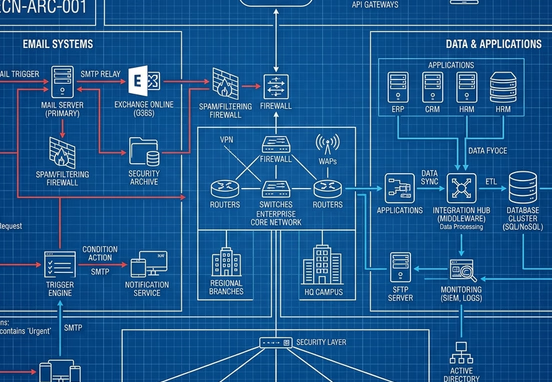
Deploying custom-coded transactional email systems without mapping the underlying database events beforehand introduces severe race conditions into an enterprise network. When engineering teams jump directly into writing script files for welcome sequences, invoice dispatches, or account recovery notifications, they operate under the unverified assumption that application states change linearly. In high-volume systems, however, network latency and database execution loops do not align perfectly, causing automated notifications to break down.
Software engineers often treat automated communication scripts as minor add-ons that can be handled within standard backend controllers. This architectural blind spot leads directly to split-state paradoxes where an application triggers a success notification before the underlying transactional database commits the record. If the database write encounters an exception after the email is dispatched, your customer receives a confirmation message for an operation that actually failed inside your internal infrastructure.
Preventing these communication failures requires moving away from code-first development strategies and implementing strict, visual system mapping. Mapping your notification paths maps out exactly how your front-end web layers, messaging queues, and database engines coordinate actions. This process ensures that every automated message functions as an atomic, deterministic result of a verified transaction, preventing technical debt and protecting system reliability.
The Architecture of a Transactional Email Pipeline
A sustainable notification ecosystem cannot be engineered as a collection of isolated helper functions scattered across a repository. It must function as a multi-tiered data network consisting of an ingestion layer, a template compilation layer, and an asynchronous transmission layer. If any of these tiers are tightly coupled to your primary database connection loops, your application will encounter severe performance bottlenecks during utilization spikes.
The Ingestion Layer and Event Triggers
The entry point of your pipeline must function exclusively as a low-latency receiver that captures point-in-time state changes within your database environment. This layer must remain completely agnostic about template layout, font styling, or destination email server configurations. Its sole responsibility is validating the trigger event metadata and writing the structured data array straight to a localized message broker.
By anchoring your ingestion points in strict, deterministic rules, you prevent system scripts from overloading your servers. Building your notification bridges around native trigger-action logic provides your engineering teams with the exact structural blueprints required to isolate event triggers from execution actions, ensuring your primary digital assets remain completely dormant until an authentic database mutation is verified.
The Template and Variable Orchestration Matrix
The secondary layer sits inside isolated worker nodes, responsible for parsing incoming JSON arrays and merging those variables with version-controlled HTML layouts. Hardcoding communication text directly inside your backend application controllers is an unmaintainable design pattern that slows development velocity and introduces formatting errors. Templates must be decoupled entirely from your application logic, allowing your operations teams to refactor styling components without requiring full backend database migrations.
Why Code-First Approaches Create Severe Technical Debt
When developers begin coding an integration loop before mapping the data paths visually, they almost always default to synchronous processing models. In a synchronous model, when a user completes an action, the server halts all subsequent tasks while it compiles the email layout, initiates a handshake with an external SMTP relay, and waits for a delivery response. This design causes massive delays, as a single outbound network drop can stall your customer's browser session for up to thirty seconds.
| Pipeline Element | Brittle Code-First Approach | Sustainable Mapped Infrastructure |
|---|---|---|
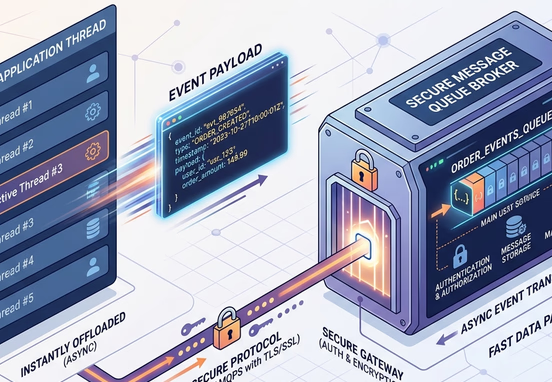
| Execution Path | Synchronous; inline function calls block primary database connection threads. | Asynchronous; event micro-payloads are instantly offloaded to a message broker. |
| Template Handling | Hardcoded text strings mixed directly inside server-side code blocks. | Decoupled HTML layout repositories managed via structured template registries. |
| Variable Mapping | Loose, unvalidated parameters passed directly to external mail server endpoints. | Strict schema enforcement; values are tokenized and validated before compilation. |
| Error Containment | Fatal script drops bubble up to crash active user checkout checkouts. | Isolated error boundaries route broken assets to local dead-letter vaults. |
| System Visibility | Zero historical transmission tracing; logs are mixed into general server files. | Dedicated tracking ledgers recording the exact lifecycle stage of every payload. |
Moving away from unmapped, multi-hop visual tools and intermediate middleware setups allows your business to optimize these computational parameters directly. Transitioning to direct, proprietary server-side architectures ensures that you can safely bypass the Zapier tax to achieve complete platform independence, maximize data processing velocities, and eliminate recurring usage fees completely.
Engineering the Asynchronous Email Queuing Flow
A bulletproof automated notification engine requires a complete separation of concerns between your web application controllers and your outbound mail delivery systems. When an event fires, the application backend writes the transaction payload to your message queue broker and returns a success status code to the user's browser within milliseconds, protecting the user experience from downstream system delays.
The secondary worker processes pull messages from the queue asynchronously, executing layout compilations and managing external API boundaries independently. If a downstream provider experiences a service blackout, the queue preserves the payload safely, executing automated retry loops until delivery is confirmed.
The technical workflow diagram below illustrates the exact execution path of a mapped, asynchronous notification network from initial database state change to final delivery tracking:
[Database State Shift Captured]
               │
               ▼
 [Generate Unique Request ID]
               │
               ▼
[Push Micro-Payload to Message Queue] ────┐
                                          │
                 (Frees Web App Thread)   ▼
                          [Asynchronous Worker Process]
                                          │
                                          ▼
                         [Query Idempotency Registry Table]
                                          │
                   ┌──────────────────────┴──────────────────────┐
                   ▼ (ID Exists: Stale/Duplicate)                 ▼ (ID Unique: New Task)
     [Halt Execution & Purge Queue]             [Lock Target Ledger Row Safely]
                                                                 │
                                                                 ▼
                                                  [Compile HTML Template Engine]
                                                                 │
                                                                 ▼
                                                  [Transmit to Outbound SMTP Relay]
                                                                 │
                                          ┌──────────────────────┴──────────────────────┐
                                          ▼ (Relay Drops/Times Out)                     ▼ (Relay Returns HTTP 200 OK)
                            [Initiate Exponential Backoff]                [Mark Idempotency Status as Delivered]
                            [Route Failures to Dead-Letter Vault]         [Update Core Order Tracking Logs]
Preventing Schema Drift and Mismatched Keys
Mapping your system schemas before coding allows your developers to configure automated validation rules that catch missing attributes before they hit your rendering engine. If a template expects a custom customer name variable, but the event payload transmits an empty field, unmapped code engines will render ugly blanks or throw unhandled compilation errors mid-flight. Pre-mapping forces developers to write explicit type-casting layers that secure data consistency across every automated communication channel.

Enforcing State Boundaries and Preventing Duplicate Delivery
A common vulnerability within poorly mapped custom architectures is the duplicate delivery problem. If a network glitch causes an external API provider to delay its response confirmation, an unmapped code engine may assume the transmission failed and mistakenly re-run the entire pipeline. This loop results in a terrible user experience, hammering your clients' inboxes with identical, repetitive messages.
Resolving this looping hazard requires building a dedicated idempotency matrix directly within your backend code layer. Every transaction payload generated by your system must feature a unique, deterministic request token. When an asynchronous worker picks up a task, it must query a localized database log to verify whether that specific token has already been processed, terminating the execution thread immediately if a duplicate match is flagged.
- Enforce Unique Request Identifiers: Utilize high-entropy cryptographic hashes compiled from the unique timestamp and user ID to act as an immutable primary key for every notification event.
- Deploy Row-Level Transaction Locks: Configure your background worker daemons to isolate target tracking rows during validation sweeps, preventing parallel processes from double-reading active payloads.
- Log Precise Delivery Status States: Track every message lifecycle phase explicitly using standardized database string flags like
queued,rendering,transmitted, orfailed. - Establish Automated Expiration Timelines: Configure your tracking ledgers to automatically purge stale transaction hashes after thirty days, keeping your active indexes light and lightning-fast.
Systems Architecture Tip
Always append your unique idempotency token as a custom tracking header within the metadata of your outbound email payloads. This optimization ensures that even if a message is intercepted, delayed, or resent by an intermediate relay network, the destination mail server can recognize and drop duplicate delivery packets before they reach the user's interface.
To protect your production database from performance degradation during these high-frequency idempotency checks, your validation layers must be optimized for maximum speed. Implementing specialized error controls and automated safeguards based on the bulletproof web pipeline: how custom error controls and smart fallbacks prevent system blackouts provides your engineering teams with the technical blueprints needed to securely handle timeouts, manage connection boundaries, and isolate script exceptions safely during high-volume processing runs.
Designing for Failure: SMTP Backlogs and Automated Retries
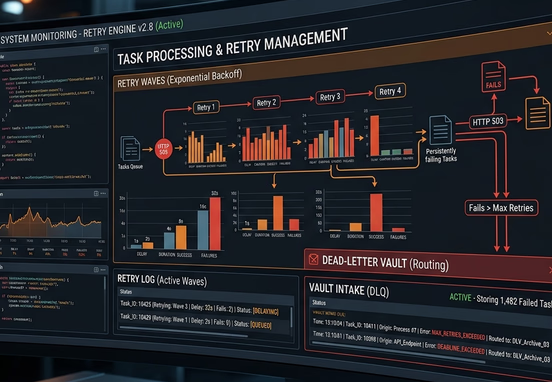
Outbound transactional email relays represent some of the most volatile external endpoints in modern web architecture. Corporate spam filters change rules dynamically, email service providers encounter hardware overloads, and network connections drop regularly. A resilient data infrastructure must be designed to assume that every outbound transmission path will eventually fail.
When an external endpoint returns an error code or fails to respond within a precise timeout window, your custom pipeline must isolate that failure immediately. If your system lacks explicit error boundaries, a single stalled SMTP connection can block your entire asynchronous worker array, backing up your message queues and delaying critical operations across your wider application network.
- Deploy Asynchronous Exponential Backoff Retries: Never allow your background workers to hammer a failing endpoint with immediate, aggressive retry requests. Configure your scripts to delay subsequent attempts using mathematical backoff calculations multiplied by randomized jitter.
- Redirect Broken Payloads to Dead-Letter Vaults: If a notification payload fails to clear its transmission checkpoint after five structured attempts, the system must permanently stop processing that specific thread and isolate the broken asset inside a dead-letter queue.
- Inject Automated Circuit-Breaker Guardrails: Monitor the global failure metrics of your outbound communication paths in real time. If your delivery endpoints encounter a continuous stream of connection drops, the system must trip an internal circuit breaker that routes all subsequent messages to a local storage backup until the destination server stabilizes.
- Isolate Analytics Ingestion Tracks: Ensure that your email click-tracking, link-forwarding, and bounce-monitoring engines run on separate server instances completely decoupled from your primary database ingestion pipelines, keeping tracking noise from slowing down your core business operations.
Hardening your automation loops against these external network drops ensures your corporate records remain completely accurate. Implementing an aggressive, multi-layered validation architecture based on the multi-million dollar leak: how to detect system errors and automate data validation provides your engineering teams with the technical frameworks needed to catch schema mutations, automate data auditing, and protect your internal databases from long-term silent corruption.
Securing Data Sovereignty Across All Communication Streams
Routing your sensitive corporate notifications through third-party visual aggregators introduces massive data privacy exposures and compliance liabilities into your enterprise. When you allow external middleware tools to handle your communication logic, your proprietary customer parameters, order structures, and internal identifiers are parsed and logged within external cloud databases that your security officers cannot control, audit, or safely harden.
True platform longevity requires moving past intermediate data brokers and engineering custom, direct-to-destination system pipelines. Designing direct integrations based on why custom api pipelines guarantee data ownership (and the critical features to look for) enables your development teams to maintain complete data minimization compliance, enforce field-level encryption, and ensure your communication logs remain strictly within your corporate security perimeter.
Hardening Enterprise Infrastructure for Flawless System Delivery
Mapping your automated communication pathways before custom coding begins is an absolute operational requirement for any scaling enterprise focused on protecting its platform stability and data integrity. By removing synchronous execution bottlenecks, decoupling HTML layouts from application logic, enforcing strict idempotency boundaries, and implementing intelligent retry matrices, you insulate your critical business platforms from software vulnerabilities and secure complete control over your digital networks.
Designing, securing, and maintaining these advanced, asynchronous system networks demands specialized backend engineering, deep relational database mapping, and rigorous quality assurance testing. Partnering with professional software architects ensures your system pipelines are engineered to navigate complex modern integrations with maximum velocity and complete data safety.
For organizations focused on taking absolute ownership of their digital infrastructure and achieving peak operational efficiency, utilizing professional custom workflow and systems automation services provides the technical expertise required to deploy secure, high-performance direct API pipelines that eliminate middleman platforms, safeguard critical information assets, and protect long-term digital growth.