
How Documented Direct Web Integrations Increase Firm Valuation

When institutional buyers, private equity firms, or strategic acquirers conduct due diligence on a growing enterprise, their valuation models extend far beneath the surface of the balance sheet. Top-line revenue and net margins tell only part of the story. Investors are fundamentally purchasing the predictability and scalability of future cash flows. A business that relies on manual human workarounds or fragile software setups presents an unacceptably high operational risk profile, which directly slashes the firm’s valuation multiple.
Conversely, a firm built upon a foundation of proprietary, direct web integrations behaves like a highly efficient machine. When a company's customer acquisition channels, inventory systems, financial ledgers, and delivery pipelines are programmatically woven together, operational leverage skyrockets. Buyers view this level of architectural maturity as a highly defensible enterprise asset. The underlying technology ceases to be an expense and transforms into a standalone value driver that justifies a premium acquisition multiple.
The Valuation Premium of Technical Maturity
In modern enterprise acquisitions, the sophistication of a company's web architecture directly influences its capital efficiency scoring. M&A advisory firms scrutinize how data moves across an organization. If your business depends on employees manually downloading spreadsheets, copying customer records, or reconciling accounts across separate platforms, your company will be penalized for operational drag during due diligence.
A business utilizing direct, custom API pipelines that guarantee data ownership positions itself as a modern, self-sustaining enterprise. Investors actively avoid companies trapped in data silos because they know that expanding operations under those conditions requires an expensive, linear increase in administrative headcount. Programmatic infrastructure proves that the company can scale its transaction volume exponentially without a corresponding explosion in overhead costs.
Replacing Vulnerable Middleware with Direct Architecture
Many scaling businesses attempt to connect their software platforms using generic, third-party no-code automation systems. While these tools allow for rapid prototyping, they introduce systemic platform risks that sophisticated buyers view as structural liabilities. Relying entirely on a third-party intermediary to handle mission-critical financial transactions or customer data movement creates an unmanaged dependency that can break unexpectedly during an acquisition transition.
Direct web integrations bypass these fragile third-party translation layers entirely. By establishing custom, point-to-point connections between your primary web engine, customer relationship management software, and enterprise resource planning systems, your firm retains absolute control over its data pipelines. Acquirers are willing to pay a substantial premium for this structural autonomy because it eliminates ongoing software licensing taxes and guarantees long-term platform stability.
Quantifying the Value of Systems Documentation
An integration is only as valuable as its documentation. In the high-stakes environment of an corporate acquisition, undocumented code or black-box systems are treated as zero-value assets, or worse, active liabilities. If the logic governing how your modern web frontend communicates with legacy desktop systems or back-office databases exists only in the minds of your current development team, your firm faces extreme key-person risk.
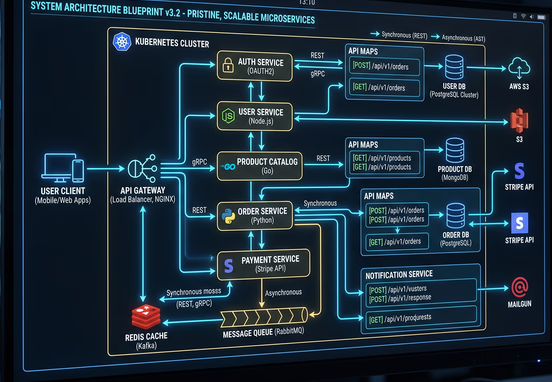
Documented direct web integrations transform abstract software code into a tangible, transferable corporate asset. When a business can hand an incoming tech team a comprehensive system blueprint, complete with API maps, data schemas, and explicit exception rules, the perceived risk of the acquisition plummets. Clean documentation proves that the business can be handed over to new ownership seamlessly, preserving the continuity of operations from day one.
The Components of M&A-Grade Technology Documentation
To ensure your web architecture maximizes your firm's market value, your technical documentation must be structured to survive intense institutional scrutiny. Casual internal notes or disorganized comment lines inside code repositories are wholly insufficient during formal due diligence cycles. Acquirers require a formalized system map that explicitly details how data flows across the corporate ecosystem.
Your technology blueprint should outline every endpoint, authorization protocol, and automated data synchronization schedule. To understand how these connections function fundamentally, refer to our foundational guide on what an API actually is. Providing clear visibility into these asset classes removes ambiguity and reinforces the enterprise value of your proprietary code.
| Integration Documentation Category | Critical Elements Required for Due Diligence | Valuation Impact |
|---|---|---|
| API Endpoint Ledger | Complete list of all point-to-point connections, webhooks, authentication methods, and rate-limiting thresholds. | Lowers structural risk scores by proving code stability and transparency. |
| Data Dictionary & Schema Maps | Explicit definitions of data fields, type constraints, and transformation rules between systems. | Prevents data corruption during transition; validates data integrity. |
| Automated Exception Rules | Clear mapping of fallback sequences, error-catching logic, and system recovery scripts. | Assures buyers that the platform can maintain uptime without manual patching. |
| Compliance & Security Logs | Records of data minimization protocols, token shield enforcement, and localized data isolation. | Eliminates regulatory penalties; confirms alignment with global privacy rules. |

Eliminating Key-Person Risk and Human Error
One of the steepest discounts applied to small and medium-sized enterprise valuations stems from key-person dependency. If a business cannot function because specific operational tasks require the selective memory or manual intervention of a founder or a handful of specialized employees, the business lacks structural autonomy. Buyers recognize that if those individuals exit the firm post-acquisition, the operational engine will stall.
Transitioning repetitive processes to automated systems solves this structural vulnerability completely. For instance, shifting beyond the virtual assistant to automate core website administration tasks ensures that system maintenance, user provisioning, and records management run independently of human schedules. This transition shifts operational knowledge out of individual employees' heads and embeds it directly into the firm’s permanent digital infrastructure.
Building Defensibility Through Institutional Automation
When your business logic is permanently codified into direct web integrations, the speed and accuracy of your business operations become entirely institutionalized. Human error is systematically removed from your customer onboarding pipelines, inventory management systems, and payment reconciliation loops. A business that processes data with absolute algorithmic precision is inherently more profitable and drastically less volatile than a manual alternative.
This high level of automation also directly improves customer retention metrics. Automated client retention systems can automatically route complaints, escalate urgent tickets, and tag high-value accounts based on web dashboard interactions without requiring an employee to manually review every line of text. Buyers pay top dollar for these automated retention engines because they guarantee predictable customer lifetime value long after the original management team departs.
Preparing the Digital Infrastructure for Institutional Audit
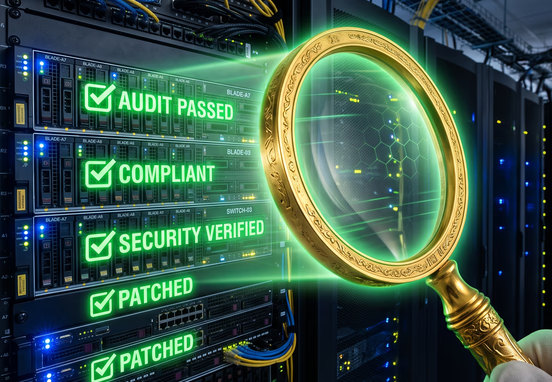
To extract the highest possible valuation multiple during an exit event, corporate leadership must proactively audit their technology assets long before entering the letter of intent phase. Waiting for the buyer's engineering team to uncover architectural flaws, outdated dependencies, or broken data schemas during due diligence invites aggressive price renegotiations and can easily cause a deal to completely fall apart.
Executing a comprehensive software stack audit allows your firm to identify hidden vulnerabilities, eliminate redundant software subscriptions, and clean up messy code bases ahead of time. This proactive preparation gives your executive team the data needed to confidently defend your technology choices, prove data compliance, and justify a premium valuation multiple based on documented architectural excellence.
Implementing Continuous Audit Protection
A highly effective method to demonstrate the institutional value of your web architecture to external investigators is through the deployment of automated compliance tracking. By establishing automated audit trails that keep a growing business audit-ready, your web system continuously logs every data modification, system access event, and automated transaction in an unalterable digital ledger. This real-time visibility proves to buyers that your firm operates with absolute transparency and remains continuously ready for external compliance reviews.
[Manual Business Model: Linear Scalability Valuation Drag]
Transaction Influx --> More Manual Headcount Needed --> Margin Compression --> Lower Multiple

[Automated Architecture Model: Exponential Scalability Valuation Premium]
Transaction Influx --> Direct API Integrations --> Automated Scale --> High Margins --> Premium Multiple
Structural Autonomy Is the Ultimate Value Multiplier
Ultimately, a company's terminal value is determined by how easily its operational success can be replicated at a larger scale under new ownership. High-value enterprises do not run on ad-hoc adjustments, unrecorded workarounds, or fragmented software tools. They operate on unified, custom-engineered digital systems that protect margins, preserve data ownership, and eliminate organizational friction.
Investing in direct web integrations is a direct investment in the equity value of your enterprise. By replacing vulnerable human processes with resilient, self-documenting code networks, you permanently separate your firm's growth potential from the constraints of manual labor hours. This strategic transformation maximizes your daily profitability while positioning your organization as a premium, highly coveted asset in the corporate acquisition market.
Engineering an enterprise-grade digital ecosystem requires a development partner who understands the profound intersection of software architecture and corporate valuation. If your leadership team is ready to eliminate technical debt, secure absolute data integrity, and build custom web pipelines engineered to maximize your firm's enterprise value, discover our specialized custom workflow and systems automation service. We build the high-performance, fully documented web infrastructure that modern businesses need to drive long-term operational autonomy and secure premium market valuations.