

How to Build a Self-Service Dev Environment with Automated System Documentation
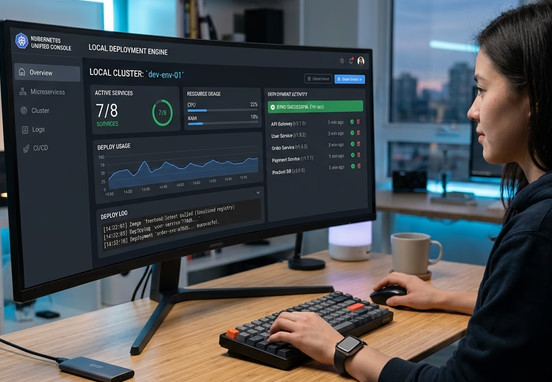
Engineering teams face massive productivity losses when onboarding developers into fragmented, poorly documented local environments. In standard software development cycles, setting up a local workstation involves navigating a chaotic list of manual configuration steps, compiling mismatched runtime versions, and resolving environmental dependencies by trial and error. When documentation is maintained manually, it becomes obsolete the moment a code branch is modified, leaving engineers to debug configuration drift rather than building core platform features.
Resolving these engineering bottlenecks requires building a programmatic, self-service development environment coupled with automated documentation pipelines. This framework converts infrastructure setup into an automated execution loop, allowing any engineer to spin up a fully operational clone of your enterprise ecosystem with a single command line routine. By treating development environments as code and automating system logs, organizations eliminate onboarding friction, protect code velocity, and ensure system changes are documented dynamically in real time.
When building a decentralized local infrastructure, your automation pathways must interlock smoothly with production configurations. Engineering teams looking to implement these environments often begin by standardizing local staging clusters. Learning how developers safely test automated web networks in sandbox environments serves as a vital first step toward creating isolated testing containers that mirror live operational logic without introducing security vulnerabilities.
The Pillars of a Self-Service Development Architecture
A highly available self-service environment operates on three absolute architectural requirements: containerized infrastructure isolation, declarative environmental configuration, and deterministic database seeding loops. Instead of installing tools directly onto local host filesystems, every service—from your front-end web engine to back-office relational databases and message brokers—is isolated within standalone software containers.
Declarative configurations ensure that your entire infrastructure topology is defined within plain-text configuration scripts managed inside your core version control repositories. This structure guarantees that every engineering team member executes commands across identical environment matrices.
- Containerized Virtual Isolation: Decouples core software dependencies from the host operating system, eliminating the classic "it works on my machine" engineering paradox entirely.
- Declarative Network Infrastructure: Configures local software networks, database communication ports, and access protocols explicitly via versioned infrastructure-as-code configuration scripts.
- Deterministic Database Seeding: Automates the injection of sanitized, structural mock datasets into local databases during initial initialization to simulate realistic enterprise scales instantly.
- Decoupled State Management: Instructs local container services to map persistent data volumes to temporary host folders, protecting data continuity during local service rebuilds.
Engineering the Self-Service Environment Provisioning Loop
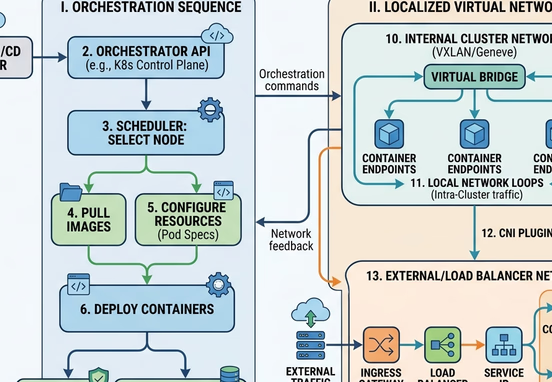
The provisioning engine operates as an automated state-machine pipeline that orchestrates container lifecycles, structural schema deployments, and local data transformations. When a developer triggers the initialization sequence, the system queries your centralized cloud registry, pulls targeted container baselines, configures local virtual networks, and initiates local database migrations sequentially.
To maintain maximum pipeline performance, the provisioning logic must run clear verification checks at each milestone. If a local database container fails to clear its health check within a specified execution window, the provisioning loop must pause, flag the specific runtime error code, and execute a graceful cleanup script rather than letting broken dependencies cascade into subsequent operations.
The technical workflow diagram below illustrates the sequential execution path of a self-service provisioning loop from initial command trigger to a fully verified dev environment:
[Developer Executes Orchestration CLI Trigger]
                      │
                      ▼
       [Query Infrastructure-As-Code Configs]
                      │
                      ▼
       [Pull Container Images From Secure Registry]
                      │
                      ▼
       [Construct Isolated Virtual Local Network]
                      │
                      ▼
         [Launch Local Service Clusters]
                      │
                      ├─► (Health Checks Fail: Execute Auto-Cleanup Routine)
                      │
                      ▼ (Health Checks Pass)
         [Execute Database Migration Schema Scripts]
                      │
                      ▼
         [Inject Sanitized System Mock Datasets]
                      │
                      ▼
         [Trigger Live Code File Watcher Processes]
                      │
                      ▼
[End: Local Environment Verified Active and Logged]
Optimizing Container Storage Architectures
When managing high-volume enterprise architectures locally, container configurations must feature explicit caching layers and layered disk image build steps. Re-compiling entire system dependencies during every local configuration update introduces major development latency. Implementing multi-stage container build strategies ensures that stable system baselines are securely cached, reducing container boot sequences from minutes to single-digit seconds.

The Architecture of Automated System Documentation
A self-service ecosystem remains incomplete without an automated documentation engine that dynamically tracks architectural shifts as code modifications occur. Relying on engineers to manually write Markdown files or update external company wikis is an unreliable strategy that quickly results in technical debt. Modern engineering pipelines treat documentation as a direct artifact of compilation, extracting structural descriptions straight from the active code base.
The automated documentation engine monitors your code repositories via git integration triggers. When a developer submits a merge request, the documentation pipeline scans the changed files, parses structured code comments, extracts database schemas, compiles interactive API reference guides, and publishes updated manuals automatically to an internal developer portal.
| Documentation Domain | Automated Data Extraction Source | Target Output Formats |
|---|---|---|
| API Endpoint References | Inline codebase decorators, routing files, and controller comment blocks. | Interactive OpenAPI Specs, Swagger Portals, Client SDK Stubs. |
| Database Schema Maps | SQL migration files, Object-Relational Mapping (ORM) structural models. | Dynamic Entity-Relationship Diagrams, Dictionary Tables. |
| Infrastructure Topologies | Declarative container configuration blocks, local network definitions. | Visual Infrastructure Vector Maps, Port Allocation Matrix Docs. |
| System Event Lifecycles | Central message queue configuration files, webhook listener models. | Event-Driven Architecture Graphs, State Machine Logs. |
Building a highly accurate documentation pipeline requires setting up strict validation rules within your local verification layers. If a developer attempts to register a new system endpoint without providing structural comment parameters, the local validation hook must intercept the action and block the execution thread until the documentation formatting fields match your organization's standard compliance framework.
System Engineering Tip
Connect your automated documentation scanner directly to your local code linting pipelines. This setup forces the system to run validation checks on every local file save, alerting developers to missing API parameters or undocumented database mutations long before code reaches your remote testing branches.
Integrating these robust data extraction pipelines ensures your technical documentation mirrors real-world system behaviors perfectly. Constructing your software architectures around native event paths allows your engineering teams to leverage highly structured trigger-action logic to manage continuous integration routines, validate structural payloads automatically, and push live system logs straight to your enterprise portals.
Securing Mock Data Pipelines and Regulatory Compliance
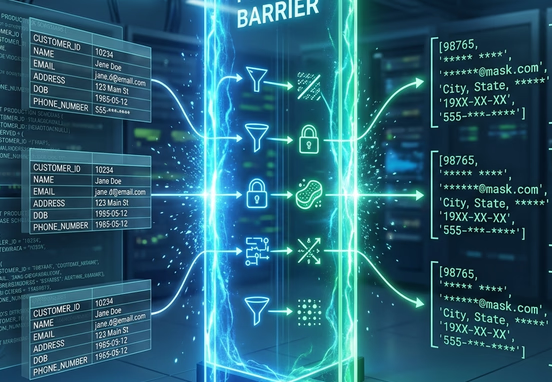
An enterprise development environment requires realistic, high-fidelity datasets to help engineers identify performance bottlenecks and edge-case errors before deploying code. However, copying production databases directly into local developer environments presents severe data privacy risks and violates international compliance frameworks like GDPR, HIPAA, and CCPA. If a developer's workstation is compromised, sensitive customer data points become immediately exposed to unauthorized access.
To eliminate these regulatory liabilities, your self-service environment must utilize an automated, isolated data-seeding pipeline that generates synthetic mock data or scrubs production database exports thoroughly. This scrubbing pipeline leverages specialized anonymization algorithms to substitute real identifiers with synthetic placeholders while preserving the underlying relational logic, mathematical balances, and cross-table foreign key constraints.
- Deterministic Data Generation: Utilize advanced fuzzing engines to generate realistic names, addresses, and email structures that conform precisely to standard validation patterns.
- Cryptographic Value Masking: Replace highly sensitive fields like financial records, passwords, or transaction tokens with mathematically irreversible hashes during database export routines.
- Granular Structural Truncation: Limit local mock databases to the minimum volume of rows required to test core indexing performance, keeping local storage footprints light and highly portable.
Ensuring your local architectures handle data masking flawlessly requires building strong, defensive data pipelines that actively respect user confidentiality constraints. Taking time to carefully align custom web data pipelines with global privacy rules helps insulate your organization from compliance risks while establishing an airtight foundation for all local testing procedures.
Integrating Continuous Health Monitoring and Failure Fallbacks
As development environments grow more complex, running multiple isolated container services concurrently can over-allocate developer workstation memory, causing local systems to stall. A self-service development framework must feature built-in, automated health monitoring scripts that keep local operations running smoothly by detecting and resolving resource exhaustion events before they freeze the host machine.
If an isolated container thread encounters an unhandled out-of-memory exception or an internal file watcher crashes during an intensive code compilation loop, the local orchestration layer must safely isolate that specific service node, execute an automated container restart, and restore the service's memory configurations without corrupting active local database tables.
Building these resilient, self-healing boundaries into your local environments requires deploying advanced error management protocols across your entire application framework. Implementing specialized code structures based on the bulletproof web pipeline: how custom error controls and smart fallbacks prevent system blackouts provides your development teams with the structural blueprint needed to isolate active runtime exceptions, manage system timeouts gracefully, and maintain continuous development uptime during complex code refactoring cycles.
Eliminating Manual Friction to Boost Team Velocity
Transitioning your engineering organization away from brittle, manually configured workstations and moving toward a fully automated, self-service development environment completely removes onboarding friction and accelerates features into production safely. By treating local infrastructure as versioned code and automating your system documentation, you ensure your development teams operate inside a unified, high-performance ecosystem free of technical debt and environmental discrepancies.
Designing, securing, and maintaining these advanced, automated developer environments requires deep expertise in container orchestration, data pipelines, and systems automation. Partnering with specialized system architects ensures your internal platform engineering tracks are optimized for maximum developer performance and total data security.
For enterprises focused on taking absolute ownership of their digital infrastructure and maximizing engineering productivity, utilizing professional custom workflow and systems automation services provides the technical expertise needed to deploy secure, high-performance self-service environments that eliminate configuration bottlenecks, safeguard corporate intelligence assets, and support long-term digital growth.