

How to Add Time Delays to Automated Workflows Without Breaking Code

Naive implementation of time delays inside web applications represents a silent performance killer. When developers need to pause a workflow—such as waiting twenty minutes before dispatching a follow-up email, holding an account provisioning step, or delaying an order fulfillment check—the immediate temptation is to use native language sleep utilities like sleep() or delay(). This approach works adequately in local development sandboxes with single-user execution tracks, but it introduces massive structural failures when deployed to high-traffic production servers.
A native sleep function works by blocking the active execution thread entirely. While that thread sits dormant waiting for the clock to run down, it continues to hold open its physical memory allocations, web socket connections, and database row locks. As concurrent users initiate additional delayed workflows, the server rapidly exhausts its available thread pool, memory limits spikes, and the entire web application crashes under a wave of generic gateway timeout errors.
Building a sustainable automation system requires moving away from thread-blocking commands and engineering decoupled, asynchronous time-delay architectures. This model allows systems to pause operations for minutes, hours, or weeks without consuming continuous server computing power or risking performance degradation. Moving past basic visual tools and manual adjustments means understanding the limits of your setup and recognizing when your business is ready for specialized backend optimization by bypassing the Zapier tax.
The Mechanics of Thread Blocking and Resource Exhaustion
To eliminate the code disruptions caused by poorly implemented delays, you must analyze how modern web servers manage incoming traffic. A standard web server relies on a finite pool of worker threads to process incoming HTTP requests and background actions. Each thread is optimized to execute code paths within fractions of a second, immediately releasing its memory footprint back to the operating system upon completion.
When a thread hits a blocking pause, it remains trapped in an unresolved state. The server cannot reallocate that thread to handle a new user interaction, forcing subsequent requests into an un-cached processing queue. If the ingestion queue fills up faster than the delayed threads can expire, the application engine encounters resource starvation, causing web requests to hang and database connections to drop out completely.
This compounding failure profile becomes highly destructive during multi-step customer lifecycles. If your system triggers a sequence that requires multiple independent wait windows, using thread-blocking pauses guarantees an eventual system collapse during peak traffic periods. Managing your operational pipelines efficiently requires setting up architectural barriers that decouple your server threads from the timeline of the business workflow.
| Delay Mechanism | System Resource Impact | Maximum Safe Duration | Core Failure Profile |
|---|---|---|---|
Thread-Blocking Sleep (sleep()) | Extreme; locks memory, holds database connections open, exhausts worker thread pools. | Milliseconds only; never use for business logic intervals. | Direct server crashes, gateway timeouts, locked database rows. |
| Loop-Based Polling Wait | Severe; drives CPU utilization to 100% via continuous empty iteration checks. | Seconds only; highly inefficient pattern. | Cloud infrastructure cost spikes, server throttling, process crashes. |
| Message Queue Visibility Timeout | Ultra-low; frees server memory entirely; payload sits dormant inside a message broker. | 15 Minutes to 14 Days depending on the broker architecture. | Network disconnection between broker and listener nodes. |
| Database State Machine Engine | Minimal; relies on localized status records evaluated via high-speed cron sweeps. | Unlimited; ideal for multi-week sequences and long retention terms. | Database index fragmentation if tracking tables are unoptimized. |
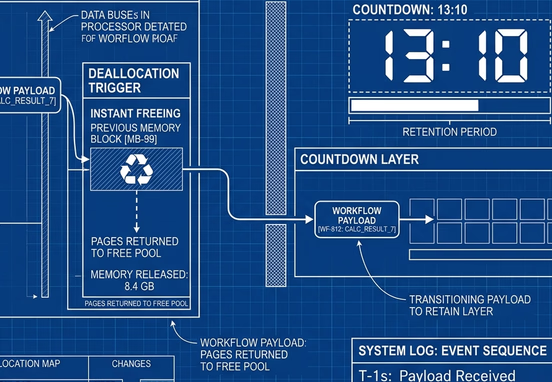
The Architecture of Asynchronous, Non-Blocking Time Delays
Resolving the resource issues of thread blocking requires a complete separation of ingestion and execution. Instead of forcing a single application thread to manage an entire multi-day workflow sequentially, the automation network divides the operation into standalone, stateless segments. When an event fires, the initial process runs its necessary computations, saves the current system state to a persistent database, and terminates the active thread immediately.
The time delay is managed outside the primary application runtime using dedicated message brokers, cloud event bridges, or persistent database state tables. These external scheduling layers hold the reference payload safely until the target timestamp is reached. Once the delay expires, the scheduling layer broadcasts a new, independent event that wakes up a fresh, unblocked worker process to execute the subsequent phase of the workflow.
This decoupled design ensures your web application remains completely responsive to user actions, regardless of how many delayed processes are currently waiting in the background. To build these scalable data pipelines safely, your foundational system infrastructure must be constructed on clear, deterministic event paths. Grounding your integration setups in robust trigger-action logic provides your development teams with the structural blueprints needed to isolate individual operations, manage state transitions cleanly, and handle multi-step workflows without resource friction.

Utilizing Message Brokers for Short-Term Delays
For time delays ranging from a few seconds up to several hours, using an asynchronous message broker queue is the most efficient engineering choice. Modern message brokers feature built-in delay mechanisms commonly known as visibility timeouts or delayed exchanges. When an event payload is written to a delayed queue, the broker intentionally hides the message from active worker processes for an explicit number of seconds.
While the message sits invisible inside the broker's optimized memory layer, your primary web servers consume zero compute power or memory allocations to track that specific countdown. The worker processes continue to clear unrelated active messages in parallel, maximizing system throughput.
The technical workflow diagram below illustrates how an event payload is ingested, deferred safely inside an asynchronous message broker, and processed later by a fresh worker without blocking active server threads:
[Primary Action Completed Successfully]
                     │
                     ▼  (1. Compiles Workflow State Payload)
    [Calculate Target Execution Timestamp]
                     │
                     ▼  (2. Appends Delay Parameter e.g., 900 Secs)
    [Publish Payload to Asynchronous Message Broker]
                     │
                     ├─► (Primary Application Thread Terminates & Frees Memory)
                     │
                     ▼
    [Message Broker Holds Payload in Hidden State]
                     │
                     ▼  (3. Visibility Timeout Clock Runs Down to Zero)
    [Message Transitions Instantly to Active Queue]
                     │
                     ▼  (4. Pulls Next Available Message From Queue)
         [Fresh, Unblocked Background Worker]
                     │
                     ▼  (5. Validates System Context Parameters)
    [Execute Secondary Action in Workflow Lifecycle]
Managing Broker Latency and Message Expiration
When relying on message brokers to handle delayed tasks, your background workers must process incoming messages using transactional acknowledgment loops. If a worker pulls a deferred message from the active queue but encounters a database timeout before completing the task, the message must not be lost. The broker must detect the lack of a success acknowledgment and automatically return the payload to the queue for a structured retry, protecting data continuity during infrastructure drops.
Furthermore, message broker configurations must be hardened with dedicated dead-letter exchanges (DLX) to handle corrupt payloads gracefully. If a delayed message repeatedly triggers application exceptions upon expiration, the broker should automatically isolate that specific item after a defined number of failed attempts. This isolation prevents a single malformed payload from continually recycling through your worker threads and clogging your system pipelines.
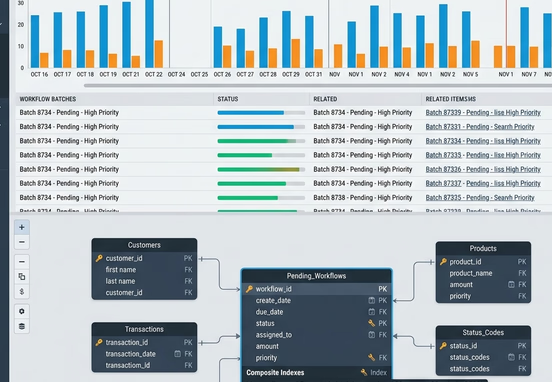
Database-Driven State Machines for Long-Term Delays
When business logic dictates time delays that extend across days, weeks, or variable contract terms, message brokers hit their architectural limits. Storing millions of long-lived, multi-week delayed payloads inside a high-speed memory cache broker exhausts server RAM and risks data loss if the broker cluster undergoes a hardware restart. Long-term delays are best managed by constructing a persistent database-driven state machine.
In a database-driven model, delayed workflows are tracked using explicit state records inside a relational database table. The table records the unique identifiers of the customer, the current step of the operation, the precise target execution time standardized to Coordinated Universal Time (UTC), and a status string such as pending_delay.
Systems Architecture Tip
Always apply a high-efficiency composite database index across the
statusandexecution_timestampcolumns within your delay tracking tables. This optimization ensures that your automated background sweep scripts can isolate upcoming tasks within single-digit milliseconds, protecting your primary database from performance drops during intensive query runs.
A lightweight, automated background task—configured via a high-frequency system cron or a cloud event scheduler—sweeps the delay tracking table at regular intervals, such as every sixty seconds. The script isolates rows where the status is set to pending_delay and the target execution time is equal to or less than the current system time. The engine updates the status field to processing, locks the row to prevent concurrent worker duplication, and pushes the data payload to a background worker for immediate fulfillment.
To execute this database lookup sequence with complete safety under extreme operational volumes, the sweep script must utilize strict row-level database locking directives like SELECT FOR UPDATE SKIP LOCKED. This command instructs the database engine to immediately pass over any records that are already being modified by an alternate active worker node. This mechanism completely eliminates race conditions, ensuring that no customer is processed twice even if multiple sweep scripts run concurrently.
Safeguarding Authentication Keys and Managing Errors After Pauses
A significant risk during prolonged workflow delays is the expiration of security contexts and authentication keys. If your automation pipeline pauses for three days before executing an API write to an external CRM, the access tokens utilized during step one will likely be expired by the time step two initiates. Attempting to execute a network call with an invalid token will cause an unhandled authentication failure that can break your workflow logic mid-stream.
To eliminate these security disruptions, your long-term delay workers must re-authenticate and validate connection keys immediately upon waking up, before attempting any downstream operations. For organizations processing sensitive corporate or client records, managing these credentials requires deploying highly secure abstraction layers. Integrating advanced protection frameworks like those explained in how token shields keep system authentication keys secure ensures your automated background workers can dynamically retrieve fresh, low-privilege access keys without exposing master security secrets to persistent database logs.
Furthermore, because external APIs frequently undergo schema updates or experience service blackouts while your workflows are waiting, your delayed worker scripts must feature comprehensive error containment boundaries. If a background thread wakes up after a five-day delay and encounters a destination server dropout, the script must handle that exception safely without crashing the execution engine.
Building these self-healing, defensive system boundaries requires deploying robust error management protocols across your entire web architecture. Implementing specialized code structures driven by the bulletproof web pipeline: how custom error controls and smart fallbacks prevent system blackouts provides your engineering teams with the technical blueprints needed to isolate active runtime exceptions, preserve delayed payloads within secure dead-letter queues, and execute intelligent, time-delayed retry loops automatically when connection channels recover.
Optimizing Enterprise Architecture for Non-Blocking Workflows
Transitioning your enterprise infrastructure away from brittle, thread-blocking sleep functions and moving toward structured, asynchronous time delays completely protects your application speed while unlocking unlimited scalability. By isolating delay countdowns within high-performance message brokers or persistent database state tables, you eliminate the threat of unexpected server blackouts and ensure your systems remain completely responsive to user interactions.
Designing, securing, and maintaining these advanced, non-blocking automation networks requires specialized backend systems engineering, strict database schema mapping, and deep workflow architecture expertise. Partnering with professional software architects ensures your system pipelines are engineered to navigate prolonged processing intervals with absolute security.
For organizations focused on taking complete ownership of their digital infrastructure and achieving peak operational efficiency, utilizing professional custom workflow and systems automation services provides the technical expertise required to deploy secure, high-performance direct API pipelines that eliminate middleware dependencies, maximize data accuracy, and protect long-term digital growth.