

How to Lower Your Cost Per Transaction Using Custom System Pipelines

Every digital transaction processed through a standard web application carries a layered stack of invisible costs. While operations teams focus heavily on the base interchange rate set by card networks, the actual drain on corporate profitability stems from intermediary software layers, third-party platform markups, and unoptimized transaction payloads. Relying on out-of-the-box merchant setups means accepting generalized pricing models designed for low-volume sellers, forcing scaling enterprises to pay an unnecessary tax on their hard-earned revenue.
Lowering your cost per transaction requires moving away from heavy, generalized payment aggregators and building proprietary, direct-to-gateway pipelines. By taking control of the transactional architecture, an enterprise can eliminate middleman software fees, implement dynamic payment routing, and leverage advanced data delivery standards. This strategic engineering shift converts transactional costs from an uncontrollable variable expense into a finely tuned, highly optimized operational workflow.
Many growing companies inadvertently stack multiple platform fees on top of their primary payment processor's rates by using bloated automation plugins or visual integration builders. These tools often charge a percentage of total revenue or an arbitrary fixed fee per api call simply for moving data from a web form to a gateway. Eliminating these unnecessary expenses means bypassing the Zapier tax and building direct code integrations that communicate straight with your core infrastructure.
The Anatomy of Transaction Fees and Middleman Markups
To strip out unnecessary costs, you must first dissect the components of a digital payment. A standard transaction includes the interchange fee (paid to the card-issuing bank), the assessment fee (paid directly to the card brand like Visa or Mastercard), the payment processor markup, and frequently, an application or platform fee charged by the software used to manage the checkout experience.
Interchange and assessment fees are non-negotiable baselines set by the card networks, but processor markups and software platform fees are highly variable. When an application passes a payment request through an off-the-shelf software-as-a-service billing platform, that platform overlays its own processing premium, which can range from 0.5% to 2.0% of the entire transaction volume. For an enterprise processing millions in gross sales, this single layer extracts tens of thousands of dollars monthly for basic data-routing services.
Custom pipelines completely bypass these intermediate application layers by establishing clean, direct authenticated connections to the processor's underlying API. This direct communication structure ensures that your platform pays only the raw gateway fee and the direct interchange cost, completely eliminating the secondary software tax.
Level 2 and Level 3 Data Optimization
B2B and corporate credit cards qualify for significantly lower interchange rates if the processor receives structured itemized data alongside the charge amount. Standard payment gateways default to Level 1 processing, which only includes basic parameters like the total amount and cardholder zip code. Because Level 1 data provides minimal fraud protection indicators to the card issuer, the transaction is categorized as higher risk, triggering the maximum possible interchange rate.
By building custom system pipelines, developers can automatically inject Level 2 and Level 3 data into the API payload, unlocking direct savings of up to 50 to 100 basis points on corporate credit card transactions. This capability is particularly critical for enterprises operating high-volume wholesale, manufacturing, or corporate service portals where corporate purchasing cards represent the primary payment method.
| Data Processing Level | Required Parameters in API Payload | Target Interchange Impact |
|---|---|---|
| Level 1 | Transaction Amount, Date, Cardholder Zip Code | Base Rate (Highest Cost / Max Risk Profile) |
| Level 2 | Level 1 Data + Sales Tax Amount, Customer Code, Invoice Number, Merchant Tax ID | Reduced Rate (Save 15 - 30 Basis Points) |
| Level 3 | Level 2 Data + Itemized SKU, Product Description, Quantity, Unit Price, Shipping Zip, Duty Amount | Optimized Rate (Save 50 - 100 Basis Points) |
To achieve Level 3 qualification consistently, your core web logic must seamlessly map database fields directly to the payment gateway's structural payload requirements. Integrating this complex mapping protocol directly within your fulfillment loops ensures that custom web checkout pipelines automate ledger sync, variable sales tax, and split payments without manual intervention or third-party mapping software. You can learn more about how these specialized checkout systems operate by reviewing the architectural mechanics of custom web checkout pipelines.
Designing a Direct Gateway Architecture
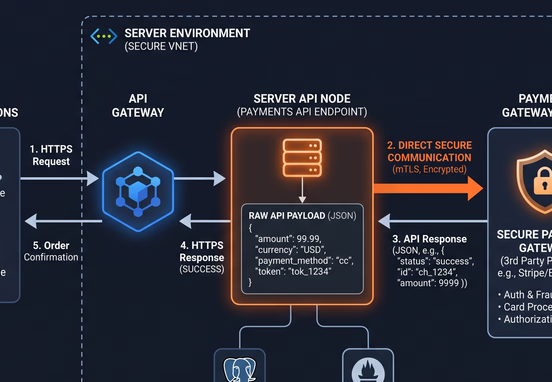
Shifting to a direct-to-gateway model involves configuring your application server to securely compile, validate, and sign transaction payloads before transmitting them directly to the merchant account provider's tokenized endpoints. This removes dependencies on external software wrappers, reducing network latency and eliminating third-party API dependencies that frequently break during high-traffic checkout events.
The custom architecture uses secure server-to-server calls protected by hardware security modules or encrypted environment variables to handle the final payload delivery. Sensitive customer payment data is tokenized directly at the client browser level using the core processor's secure iframe components, keeping your web server completely out of scope for restrictive PCI-DSS compliance audits while maintaining absolute control over the data pipeline.
The structural contrast between a bloated, multi-layered payment setup and a streamlined, custom transaction pipeline highlights the efficiency gains of direct architectural engineering:
[Legacy Multi-Layered Flow]
[Customer UI] ──> [SaaS Plugin] ──> [Automation Tool] ──> [Gateway API] ──> [Processor Ledger]
                                                                                │
                                                            (Accumulated Middleware Fees Applied)

[Optimized Custom Pipeline Flow]
[Customer UI] ──> [Custom System Pipeline] ────────────────> [Gateway API] ──> [Processor Ledger]
                        │                                        ▲
                        └─ (Appends Level 3 Data & Smart Routes) ┘
                                                                                │
                                                            (Zero Middleman Markups Incurred)
Managing Direct Gateway Handshakes Securely
When executing direct handshakes, your application backend must be optimized to manage connection states, handle dropouts, and parse responses with absolute precision. Implementing light, raw HTTP clients written in native server code rather than using monolithic external SDKs reduces the system's memory footprint and increases processing speeds. This lean code execution directly lowers cloud infrastructure costs while preventing payment page abandonment caused by slow processing times.

Dynamic Smart Routing and Multi-Processor Cascading
If a business processes transactions across multiple currencies, geographic territories, or business entities, relying on a single payment processor is rarely the most cost-effective approach. Custom pipelines can evaluate incoming transaction parameters in real time—such as card brand, issuing country, currency, and purchase value—before deciding which gateway to target. This process, known as dynamic transaction cascading or smart routing, ensures that every charge is pushed through the path of lowest cost.
For example, a transaction initiated by a European customer using an international processor might incur steep cross-border processing premiums and currency conversion penalties. A smart custom routing pipeline identifies the regional origin of the payment card and routes the transaction payload directly to a local domestic acquirer, instantly converting an expensive international charge into a low-cost domestic transaction.
Operational Strategy
Always configure your system to dynamically split transaction volumes across multiple merchant accounts based on monthly processing thresholds. Many merchant providers offer steep volume discounts once specific transactional tiers are reached, allowing your routing logic to automatically shift traffic to the most cost-effective gateway as your business grows throughout the month.
Enhancing Reliability Through Smart Failovers
Smart routing also serves as an automated insurance policy against transaction failures and gateway blackouts. If your primary low-cost payment processor returns a temporary routing error or a soft network decline, the custom system pipeline can capture that failure instantly and securely cascade the transaction token to a secondary fallback processor. This automated migration happens invisibly in the background within milliseconds, preserving the sale and protecting overall system health.
Integrating these automated workflows across your payment infrastructure allows you to protect your business continuity while utilizing advanced custom billing logic to handle edge cases gracefully.
Reducing Compute and Operational Overheads in Batch Processing
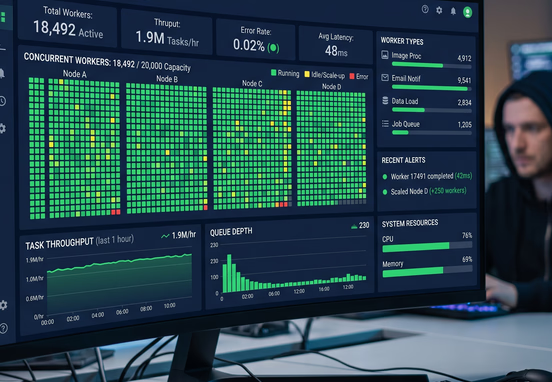
Transaction costs are not limited exclusively to credit card processing fees; they also encompass the server compute power and engineering hours required to manage high-volume transactional flows. Monolithic frameworks that handle subscription renewals or invoice distributions using unoptimized, synchronous database queries quickly encounter performance degradation, driving up cloud database expenses and causing unexpected processing bottlenecks.
Custom system pipelines resolve these efficiency bottlenecks by utilizing asynchronous background workers and lightweight database micro-queries to handle batch financial processes. By optimizing how your database reads and writes transaction records, you drastically minimize server CPU utilization and prevent system timeouts during heavy batch processing windows.
- Optimized Database Indexes: Ensure that core fields like
transaction_status,payment_token, andnext_billing_dateare heavily indexed to reduce query execution times from seconds to milliseconds. - Lightweight Asynchronous Workers: Use fast key-value data stores to manage transaction queues, allowing multiple decoupled server processes to clear payments in parallel without locking the primary relational database.
- Streamlined Webhook Listeners: Build ultra-lean webhook endpoints designed solely to ingest event data, verify signatures, and dump payloads into a message broker for delayed processing, freeing up server resources immediately.
Building this level of efficiency into your core architectural design allows you to scale up transaction volumes without experiencing a linear increase in hosting fees or operational maintenance costs. Enterprises that invest in proprietary scheduling architectures can successfully run high-volume recurring billing models while maintaining a custom subscription engine that operates completely free of third-party platform taxes.
Long-Term Data Security and Sovereign Pipeline Control
Transitioning to custom system pipelines provides enterprises with complete sovereign ownership over their financial datasets and payment infrastructure. When relying entirely on proprietary third-party software tools, your company's transactional history, customer token databases, and subscription metrics remain locked behind a vendor's closed environment. This structural vulnerability leaves your business highly exposed to sudden software price increases, mandatory platform migrations, and unexpected policy shifts.
Constructing independent data pipelines ensures that all historical transaction information, raw API logs, and customer interaction records are stored within secure database environments owned entirely by your organization. This structural freedom allows your engineering team to modify, expand, or completely overhaul individual components of your payment stack without risking data loss or interrupting cash flow.
Ensuring complete control over your technical pipelines requires building secure, direct integrations that protect intellectual property while establishing a solid foundation for future operational expansion. Designing systems that leverage why custom api pipelines guarantee data ownership (and the critical features to look for) helps insulate sensitive business infrastructure from platform vulnerabilities while maintaining peak operational efficiency.
Scaling Your Infrastructure for Peak Transaction Efficiency
As your transactional volume expands, maintaining low processing costs requires continuous performance tuning, rigorous security auditing, and targeted code optimization. Eliminating intermediate software dependencies and deploying direct, intelligent data pipelines converts your transactional framework into a high-efficiency asset that actively protects corporate margins.
Building, maintaining, and scaling these specialized, high-performance financial architectures requires precise systems engineering and deep workflow expertise. Utilizing expert custom workflow and systems automation services allows your enterprise to deploy optimized, secure, and fully customized transactional pipelines that eliminate unnecessary platform fees, lower overhead costs, and secure long-term operational independence.