

Using Automated Code Logic to Launch and Replicate Local Business Branches
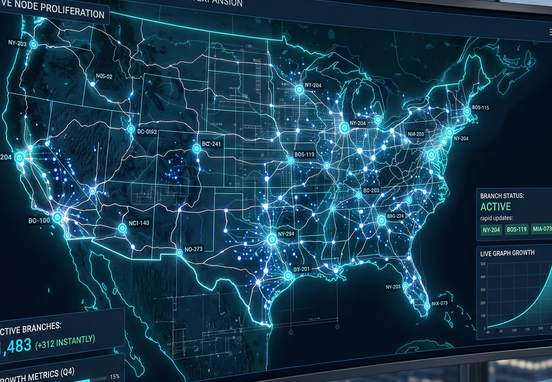
Scaling a localized business model across multiple physical regions or regional digital markets traditionally requires massive operational friction. Corporate expansion teams frequently spend weeks provisioning standalone software instances, configuring separate site directories, manually building local point-of-sale connections, and structuring localized web portals. This fragmented, manual method introduces configuration errors, delays time-to-market, and creates vast inconsistencies that drain corporate tech resources for months after a branch opens.
By shifting away from manual checklists and adopting automated code logic, modern enterprises treat each new business branch as an isolated software instance deployed from a single core repository. When a company can programmatically instantiate a new branch location, scaling operations transforms from an administrative hurdle into a fast, predictable automation sequence. This systemic methodology forms the backbone of an enterprise-grade workflow and systems automation service, converting geographic expansion into an instant deployment routine that takes minutes instead of weeks.
The Architectural Blueprint of Code-Driven Branch Replication
Programmatic branch replication relies entirely on decoupling your core website and system architecture from localized business variables. Instead of building entirely separate websites or isolated application instances for each territory, developers build a single centralized logic engine. This core infrastructure reads localized configuration scripts to determine what data, branding, pricing, and operational rules to surface to a given regional user base.
This structural approach operates much like modern cloud infrastructure platforms that spin up new server containers dynamically based on predefined configuration parameters. When a new brick-and-mortar or digital branch is formally approved, an administrative user inputs basic localized datasets into a centralized dashboard. The automation engine processes these inputs, injecting them into a standardized code blueprint that instantly constructs the necessary web environments, database routing rules, and local operational schemas.
Core Database Matrices for Instantiating Local Nodes
To guarantee a flawless programmatic launch, the master system relies on an immutable schema matrix that dictates how data is distributed for new locations. The core database treats the incoming branch data as an isolated relational entity, automatically populating linked records across your entire corporate system architecture.
| Data Domain | Automated Provisioning Actions | System Outputs Generated |
|---|---|---|
| Geographic Logic | Resolves local delivery radiuses, localized page subdirectories, and nearest-fulfillment routing parameters. | Localized CDN routing rules and specific /locations/ URL mappings. |
| Identity & Access | Generates system profiles for local managers, warehouse personnel, and field technicians automatically. | Restrictive system login keys and local management directory access. |
| Financial Routing | Connects region-specific merchant accounts, maps local sales tax parameters, and sets base currencies. | Dedicated point-of-sale webhooks and unique localized accounting ledger tokens. |
| Inventory Mapping | Generates a localized inventory ledger, linking the physical warehouse node to the digital storefront storefront. | Real-time stock status sync channels and local SKU availability logic. |

The Automated Replication Engine Pipeline
To visualize how these automated actions execute without human intervention, we must look at the backend sequence triggered during a branch launch event. When an administrative command is executed via the centralized management panel, a secure script initiates a sequence of precise system deployments.
[Admin Dashboard Form Submission]
               │
               ▼
   [Webhook Listener Triggers]
               │
               ▼
 ┌─────────────┴─────────────┐
 │                           │
 ▼                           ▼
[Provision Database Rows]   [Generate CDN Routing Rules]
 │                           │
 └─────────────┬─────────────┘
               │
               ▼
[API Token Provisioning Engine]
               │
               ▼
[Third-Party Software Integrations]
               │
               ▼
[Automated System Audit Log Written]
Step-by-Step Execution Sequence
- Parameter Ingestion: The administrative team inputs the new branch parameters, including location code, regional tax ID, base inventory templates, and administrative user details into the master configuration interface.
- Database Record Generation: The system inserts a new primary key for the location into the master database database, triggering downstream relational tables to create local storefront views, custom pricing arrays, and specific localized booking channels.
- Subdomain and Folder Mapping: Edge server routing scripts automatically intercept the configuration, establishing clean, localized URL lines like
/locations/austin/without requiring manual server restarts or DNS modifications. - API and Security Token Provisioning: The automated security layer generates unique, cryptographically signed access tokens designed to isolate local front-end client requests from adjacent branch data ecosystems.
- Third-Party Integration Mapping: Outbound webhooks instantly notify external software systems, automatically spinning up new localized channels in your accounting tools, email marketing modules, and shipping providers.
- System Verification & Health Check: An automated verification protocol executes dummy transactions and reads database return speeds, ensuring the entire local infrastructure is fully operational before changing its state to live.

Overcoming Database Isolation and Synchronicity Pitfalls
A frequent structural misstep made by expanding organizations is spinning up completely isolated databases for every individual branch location they launch. While this approach appears to offer straightforward separation, it creates massive visibility blind spots for corporate executives and breaks data aggregation across the company. The ideal approach relies on an unified database architecture where local branches navigate isolated logical views but read from and write to a single, centralized network.
Understanding how to connect multiple global office databases into one secure logic network ensures that regional transactions, staff performance metrics, and inventory updates remain queryable by the corporate office in real time. Without this structural backend cohesion, compiling high-level financial snapshots or analyzing regional trends becomes a chaotic manual chore dependent on disjointed spreadsheet aggregation and broken CSV exports.
Furthermore, this unified approach prevents devastating synchronization conflicts when inventory or customer profiles overlap across neighboring districts. When regional customer interactions modify data frameworks seamlessly, the entire company ecosystem retains deep historical context. Constructing this flawless foundation requires an organizational understanding of the operational map why scaling services requires structured workflow logic, where every automated event maps back to clear, mathematically predictable architectural constraints.
Localizing Content, Financial Pipelines, and Compliance Rules
Deploying a business node in a completely new state or territory means navigating local sales tax nuances, unique delivery limitations, and region-specific merchant configurations. Hardcoding these regional parameters into your website engine is an architectural anti-pattern that creates broken codebases and high maintenance costs as your list of physical locations grows.
Instead, the core transactional infrastructure must evaluate the structural attributes of an incoming web request or customer location profile to adjust processing logic instantly. Utilizing programmatic frameworks that understand how custom web checkout pipelines automate ledger sync variable sales tax and split payments ensures that all regional revenue streams seamlessly conform to localized financial laws without demanding manual monitoring from corporate accounting teams.
Operational Mechanics for Localized Automation Nodes
- Dynamic Geofencing Logic: The website's front-end engine automatically tracks customer zip codes against your branch database metrics to display only relevant local inventory, accurate delivery estimates, and native branch pricing structures.
- Smart Merchant Account Routing: The checkout engine reads the location identifier linked to the order and instantly directs the payment to the correct local bank account, minimizing cross-district transfer fees and clarifying branch-level profit calculations.
- Automated Operational Schedules: Holiday calendars, regional operating hours, and localized staff availability rules are parsed via code configuration arrays, dynamically adjusting booking tools and appointment slots on the fly.
- Automated Translation and Terms Injection: If a branch expands across international borders, the programmatic engine dynamically injects localized legal waivers, terms of service agreements, and currency symbols based on the branch configuration file.

Securing Access Control and Maintaining Organizational Identity
As a business grows from a handful of regional storefronts to dozens of operational nodes, the security vulnerability surface expands dramatically. While local managers require deep administrative access over their staff schedules, local inventory settings, and regional customer tickets, they must never possess access to master system architecture, adjacent branch analytics, or global payment logic.
System Architecture Tip: Always enforce highly restrictive attribute-based access controls and role-based system permissions keeping sensitive data safe at scale. By binding your branch generation code to strict scope limitations, you guarantee that a security incident at a single local branch remains completely isolated and cannot compromise the core company directory.
Tracking every system-level modification during an automated branch launch is also vital for ensuring thorough financial and operational compliance. When backend scripts are generating hundreds of unique configuration items across disparate databases and external systems, having a crystal-clear paper trail is mandatory.
Enforcing protocols that dictate how automated audit trails keep a growing business audit-ready means that every automated creation event, server allocation, and administrative access credential change is permanently committed to an unalterable log file. This meticulous record-keeping provides instantaneous compliance verification for internal corporate stakeholders and external regulatory auditors alike.
Ensuring System Stability via Self-Healing Logic
The true power of an automated replication framework lies in its ability to manage errors during deployment without breaking down. When a new branch is launched, API slowdowns or temporary third-party service outages can disrupt the provisioning pipeline mid-sequence. A robust automation engine relies on self-healing retry logic, database transaction rollbacks, and detailed error notifications to handle these anomalies seamlessly.
If an external software integration fails to respond while a new location is being provisioned, the central engine catches the exception, pauses the pipeline, and systematically attempts to re-establish the connection. If the issue persists, the platform safely rolls back all newly created database records to prevent half-provisioned configurations from corrupting your live systems. This resilient engineering pattern allows enterprises to scale their infrastructure infinitely, knowing that their branch replication network remains perfectly secure, highly reliable, and operationally stable over the long term.