
How Shadow IT Costs Enterprises Millions in Hidden Software Fees

Corporate technology stacks expand organically, but this growth often occurs outside the purview of centralized procurement and IT governance. When an operations team encounters software friction or a marketing division requires immediate data processing capabilities, the traditional corporate IT ticketing pipeline can feel like a bottleneck. Rather than waiting weeks for corporate security validation and architectural reviews, departmental heads frequently deploy independent credit cards to purchase off-the-shelf software-as-a-service (SaaS) tools. This practice—known as Shadow IT—rapidly creates an unmonitored ecosystem of duplicate platforms, abandoned user accounts, and unmapped database connections.
While individual subscription costs may appear negligible on a single department's monthly ledger, the aggregate macroeconomic impact across a decentralized enterprise is severe. Thousands of unmanaged software endpoints quietly accumulate automated renewal fees, variable data overage penalties, and hidden implementation expenses. This fractured technical environment drains millions of dollars in corporate capital annually while exposing the parent enterprise to substantial regulatory compliance risks and catastrophic security footprints.
The Financial Cascade of Unmonitored SaaS Subscriptions
The primary driver of escalating technology costs in the enterprise is the volume of redundant software deployments. When individual business units operate as isolated purchasing islands, they inadvertently buy separate licenses for tools that perform identical operational functions. A single enterprise might simultaneously pay for three separate project management systems, four distinct file-sharing environments, and multiple premium data enrichment plugins across different regional branches.
This fragmentation strips procurement of collective bargaining power. Instead of negotiating volume discounts, the organization pays top-tier pricing across dozens of smaller, individual accounts. Furthermore, when employees leave the company, their software seats are rarely de-provisioned manually. These ghost licenses continue to run on automated billing loops for years, drawing down capital for software that no one is logging into.
Beyond licensing fees, hidden operational integrations create variable costs that catch accounting teams off guard. Unmonitored software dependencies often rely on third-party middleware or basic automation connectors that charge dynamic fees based on data transfer volume. When an unmapped application triggers a massive volume of data processing cycles, the enterprise faces unexpected overage penalties without centralized visibility.
Security Vulnerabilities and Regulatory Exposure
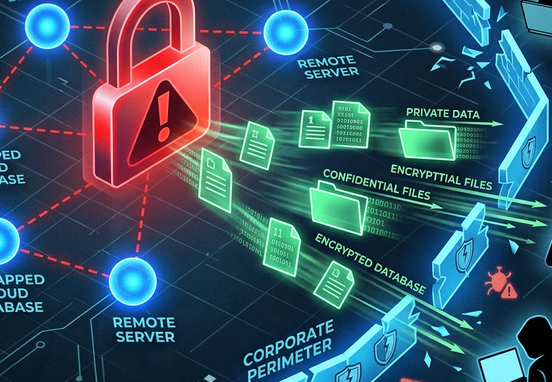
Shadow IT presents a severe threat to corporate data integrity and long-term valuation. When corporate data moves into unapproved cloud applications, the centralized IT security team loses its ability to monitor data access or enforce standard security measures. If an employee connects an unvetted artificial intelligence tool to proprietary customer records, sensitive intellectual property and protected customer data instantly exit the company's protected network perimeter.
This uncontrolled data distribution violates global compliance standards such as GDPR, HIPAA, and CCPA, which mandate that enterprises know exactly where consumer records are stored and processed at all times. Discovering that a single marketing team uploaded thousands of customer leads into an unvetted tracking platform can result in massive regulatory fines and brand damage. To avoid these vulnerabilities, scaling companies must establish rigorous access control parameters, restricting sensitive structural assets using strict role-based system permissions across all operating platforms.
The Technical Cost Matrix: Monitored vs. Unmonitored Stacks
Understanding the financial impact of tech stack fragmentation requires directly comparing managed architectures with unmonitored software environments. The matrix below outlines how costs and systemic risks escalate when organizations allow decentralized software procurement to replace structured engineering oversight:
| Operational Factor | Managed Enterprise Architecture | Unmonitored Shadow IT Ecosystem |
|---|---|---|
| Licensing Efficiency | Consolidated accounts with discounts. | Fragmented retail-price seats spread across cards. |
| User De-provisioning | Automated SSO termination upon employee exit. | Ghost accounts that continue auto-renewing. |
| Data Security & Privacy | Centralized tracking and permissions. | Unmapped endpoints vulnerable to external breaches. |
| Integration Stability | Custom API nodes built for high resilience. | Fragile plugins susceptible to unexpected blackouts. |
| Audit Readiness | Continuous log capturing for compliance. | Chaotic, manual spreadsheet tracing across teams. |

Programmatic Discovery and Stack Remediation
Eradicating Shadow IT requires an intentional shift from manual expense tracing to systematic, programmatic network auditing. Reviewing credit card receipts is an inefficient strategy that fails to identify free software tiers that capture corporate data. Enterprises must instead implement deep network discovery workflows, monitoring database connections, API calls, and browser extension permissions across the corporate network footprint.
Before allocating capital toward custom application development, leadership must map out every active software asset used across departments. Executing a comprehensive software audit before hiring an agency provides the visibility needed to identify redundant software lines, isolate unmapped tools, and discover exactly where staff bypass standard tools. Once this baseline visibility is achieved, internal teams can systematically consolidate operations into verified environments.
+-----------------------------------------------------------------+
|              NETWORK BOUNDARY & API LOG INGESTION               |
+--------------------------------+--------------------------------+
                                 |
                                 v
+-----------------------------------------------------------------+
|                  ANOMALY & UNAPPROVED APP DETECTION             |
+--------------------------------+--------------------------------+
                                 |
         +-----------------------+-----------------------+
         v                                               v
+--------------------------------+               +--------------------------------+
|    AUTOMATED RISK TRIAGE NODE  |               |  CENTRAL ASSET REGISTRY SYNC   |
| - Flag Variable Billing Loops  |               | - Monitor Resource Allocations |
+--------------------------------+               +--------------------------------+
                                 |
                                 v
+-----------------------------------------------------------------+
|                CENTRALIZED WORKFLOW INTEGRATION                 |
+-----------------------------------------------------------------+
Operational Governance Without Stifling Innovation
The primary reason employees turn to Shadow IT is that centralized corporate software fails to keep pace with daily operational requirements. If the official CRM requires ten manual clicks to update a single lead status, staff will naturally seek out basic, unapproved browser extensions to automate the task. Effective governance cannot simply rely on strict software bans; it must focus on building highly adaptable, responsive internal systems.
Procurement Risk Tip: Do not mistake a reduction in immediate IT support tickets for operational efficiency. When departments stop asking the central IT team for software integrations, it rarely means their technical challenges have disappeared. More often, it indicates they have quietly built a fragile network of unvetted third-party plugins that could cause an unexpected data blackout at any moment.
Enterprises must provide internal teams with rapid access to clean data pipelines while ensuring every event remains thoroughly logged. By building comprehensive internal architectures that feature automated audit trails into every operational node, corporate leadership maintains compliance visibility without slowing down daily innovation. This transparent framework allows departments to test new processes safely while ensuring all financial allocations remain visible to corporate accounting.
Reclaiming Capital Through Centralized Infrastructure Architecture
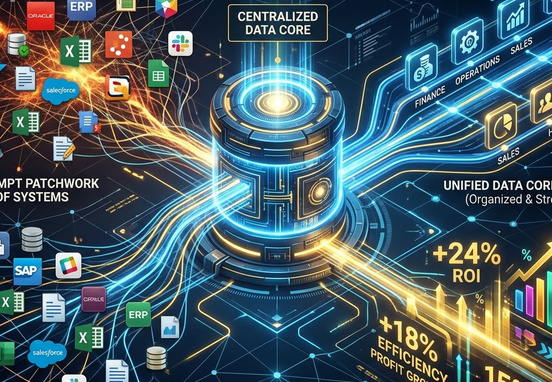
Eliminating the multimillion-dollar financial drain of Shadow IT requires replacing fragmented third-party applications with optimized, proprietary infrastructure. Relying on an endless patchwork of disconnected cloud subscriptions creates long-term technical debt, inflates operational overhead, and leaves the enterprise vulnerable to unpredictable vendor pricing changes.
The path to true long-term scaling involves working directly with specialized web engineers to build a bespoke workflow and systems automation engine that unifies your entire business landscape. Designing custom database nodes and processing pipelines tailored exactly to your unique organizational workflows allows you to replace dozens of redundant SaaS subscriptions with a single, highly secure corporate asset. This architectural shift eliminates hidden monthly software fees, protects proprietary data fields behind robust security layers, and provides leadership teams with clear operational visibility.