

How to Connect a Core Code Base to CRMs and Automation Software
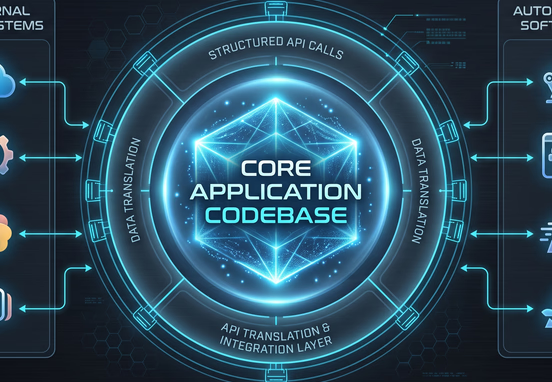
Isolating a proprietary application core while keeping it seamlessly synchronized with customer relationship management (CRM) tools and external automation suites is one of the most critical challenges in enterprise software engineering. When developer teams directly hardcode API requests into main application controllers, they introduce brittle dependencies that break during third-party platform upgrades. Maintaining clean operational boundaries between your primary code base and external marketing or sales software requires a deliberate, decoupled architecture built on structured integration layers.
As data volumes scale, native sync operations create compounding performance liabilities if handled synchronously. A modern web application must process front-end user actions without waiting for external API endpoints to acknowledge receipt. Achieving this level of architectural separation prevents external network latency from degrading the user experience, while simultaneously guaranteeing that critical operational records move reliably between databases and commercial automation suites.
Core Architecture: Designing an Integration Isolation Layer
Directly injecting third-party client SDKs into core business logic models leads to structural rot. If a CRM vendor depreciates an endpoint version or alters their data validation parameters, developers must audit and refactor the entire application repository to find broken references. Instead, technical architects implement a dedicated integration abstraction layer that isolates external platform requirements from core application code.
This architecture acts as an internal translation gateway. The application core communicates strictly with an internal service container, using a standardized, predictable format. The abstraction layer receives this clean data payload, translates it into the specific structures required by external vendors, and manages the network transaction safely.
The Role of Repository and Adapter Design Patterns
Utilizing structural design patterns allows engineering teams to construct modular code bases where external platforms can be swapped or upgraded with zero impact on core functionality.
- The Adapter Pattern: This pattern wraps the vendor-specific API code inside a standardized interface. If your business shifts from one CRM vendor to another, engineers write a new adapter to map existing data commands to the new vendor's API specifications, leaving the core application logic untouched.
- Service Interfaces: By defining strict interfaces, the main codebase remains agnostic about which specific software is processing the background automation task. It simply sends a data payload to the gateway interface.
- Decoupled Contracts: Establish strong internal data models that represent entities like accounts, users, and transactions independently of how external CRMs structuralize those exact same data fields.
Establishing Secure Authentication Protocols
Connecting an application core to external automation environments requires moving away from fragile, static credential management. Hardcoding authentication keys or storing them inside code repositories exposes systems to critical breaches. Authentication routines must operate dynamically, parsing cryptographically secure tokens through strictly controlled, isolated system environments.
For growing development teams transitioning away from basic automation frameworks to scalable enterprise architectures, building out bespoke API integration frameworks is standard practice. Organizations often find themselves bypassing the Zapier tax by writing direct integration code once operational volume demands lower latency, enhanced security, and direct data custody.
Security Tip: Never allow automated data integration scripts to use global administrative API credentials. Always enforce the principle of least privilege by provisioning dedicated API keys locked down to specific scopes, endpoints, and read-write permissions.
Token Management and Rotation Workflows
Managing continuous connection cycles with high-level automation networks requires robust token lifecycle handling.
- Environment Isolation: Store primary access credentials, customer secrets, and webhook tokens exclusively within secure environment variables or dedicated secret management vaults.
- Automated Refresh Handlers: Implement middleware engines that automatically check the expiration time stamps of OAuth 2.0 access tokens prior to launching outbound requests.
- Graceful Re-authentication: Design token interceptors that detect unexpected authentication failures, automatically execute token refresh routines, and replay the stalled payload smoothly.
- Enforced Encryption: Encrypt all tokens stored in internal configuration tables at rest using authenticated encryption algorithms like AES-256-GCM.
Managing Structural Data Payload Mismatches
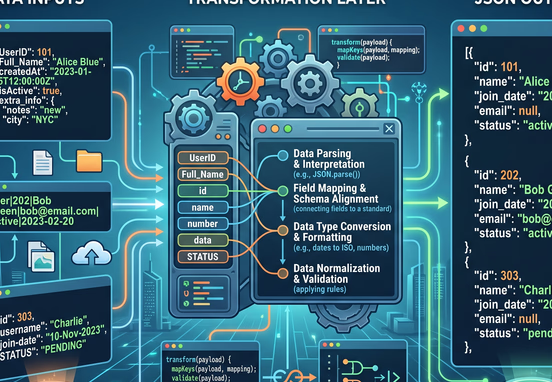
An internal application database might store user phone records as clean integers, while an external sales CRM expects an internationally formatted string with explicit country codes. Bridging this structural gap requires data translation engines that serialize and format payloads into valid JSON objects prior to departure. Before writing custom code for these connections, technical leaders must ensure they understand what an API is and how web integrations function at a foundational level to accurately design these data mapping layers.
Architectural Comparison of Synchronization Strategies
Selecting the appropriate integration paradigm alters how systems allocate infrastructure resources and manage pipeline latency.
| Sync Methodology | Network Mechanics | Infrastructure Load | Target Use Case |
|---|---|---|---|
| Direct API Requests | Synchronous HTTP calls executed inline | High; stalls main code execution | Non-critical, low-volume lookups |
| Asynchronous Queues | Jobs pushed to memory workers | Distributed; highly efficient | High-volume CRM record creations |
| Custom Webhooks | Event-driven HTTP POST payloads | Event-based; immediate execution | Real-time system notifications |
| Scheduled Polling | Interval-based database checking | Inefficient; high database read overhead | Legacy software reporting syncs |
Eliminating Sync Delays with Background Job Queues
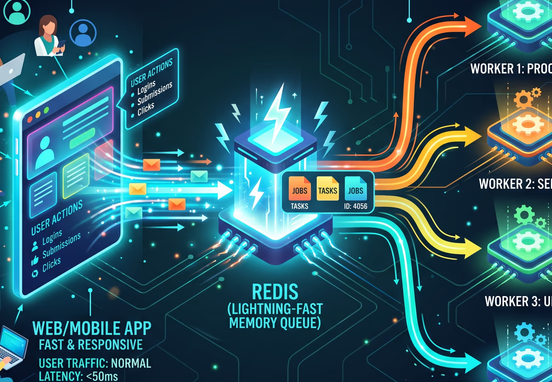
Executing external API connections inside the main user-request cycle introduces massive system instability. If an automation suite experiences an outage or a slow response time, the main application thread remains blocked, resulting in timed-out page views and corrupted data records for end users. Secure platforms utilize background workers and memory-managed queues to process integrations completely outside the user-facing lifecycle.
When a critical action occurs—such as a new enterprise user account registration—the core codebase instantly records the event to its internal database and fires a lightweight payload into a local queue runner like Redis or RabbitMQ. The application immediately returns a successful response to the user's web browser, while separate background processes pick up the queued integration job and complete the complex external CRM sync quietly in the background.
To build out these enterprise-grade data pathways cleanly, engineering teams leverage specialized workflow and systems automation services to model background pipelines that scale efficiently under heavy concurrent database loads.

Processing Outbound Event Triggers via Custom Webhooks
While outbound API calls push data from your core application to a CRM, you must also architect a secure ingestion path for inbound events. When a sales representative updates an account status inside a CRM platform, that change must flow back into your native application database automatically. Rather than repeatedly polling the external platform for changes, deploying event-driven architectures keeps systems perfectly aligned.
Using custom webhooks provide superior speed and security over traditional interval polling, as external servers push instant HTTP POST requests to your infrastructure only when a verified event occurs.
Inbound Ingestion Pipeline Mechanics
Processing inbound webhooks from external systems requires strict architectural patterns to prevent security exploits and server overloads.
- Signature Validation: Every inbound webhook must pass through an authentication filter that cryptographically verifies its cryptographic signature against your unique webhook secret key to prevent spoofing.
- Idempotency Safeguards: Log incoming unique event IDs inside a temporary database register to prevent your system from processing duplicate webhooks twice if the sender retries a request.
- Immediate Acknowledgement: Your endpoint must return a rapid status response back to the sending platform within milliseconds, then move the payload into an internal background queue for actual data processing.
Defensive Strategies for External Outages and Rate Boundaries
External automation platforms enforce rigid API rate restrictions to protect their own cloud infrastructure. If your application sends a massive burst of user updates simultaneously, the external CRM will respond with rate limiting headers, abruptly dropping your connection payloads. Your integration layer must incorporate defensive mechanisms to handle these limits, alongside smart error routines to deal with external service outages.
Building a resilient codebase means anticipating these structural failures. When designing these layers, engineers prioritize building a bulletproof web pipeline with custom error controls to prevent external API drops from triggering full application blackouts.
Implementing Exponential Backoff and Circuit Breakers
When an outbound integration job encounters an error or a rate limitation, the integration engine applies strict mitigation workflows.
- Rate Detection: The adapter parses the response headers to extract remaining quota limits and clear windows.
- Exponential Backoff: If a connection fails, the queue worker reschedules the integration task, multiplying the delay time after each consecutive failure.
- Circuit Breaking: If an external CRM remains completely unresponsive across multiple attempts, the circuit breaker trips, routing all new integration tasks directly to local storage to protect application performance.
- Manual Overrides: Provide administrative control screens within your internal operational tools to allow system managers to manually re-queue failed integration batches once external vendor services recover.
Data Validation and Ongoing Integration Maintenance
Connecting systems requires continuous schema testing to prevent data drift over time. When external software updates field configurations or introduces mandatory parameters, the code base must warn administrators before data streams fail. Running regular regression tests inside staging and sandbox environments allows development teams to verify integration stability against live mock payloads, keeping data exchanges flawless across the lifetime of the application.