

Blogging for Growth: The Anatomy of a High-Ranking Web Article

Content production without structural engineering fails to achieve commercial visibility. Many organizations treat web publishing as a purely creative exercise, pouring hours into editorial prose while completely ignoring the parsing mechanics of search engine crawlers. A high-ranking web article must serve two distinct masters simultaneously: the human reader seeking clear answers and the programmatic bot evaluating semantic data.
To build sustainable organic growth, articles must be treated as pieces of software infrastructure. Every element, from heading hierarchy to raw asset sizes, dictates whether search engine algorithms classify your content as an authoritative marketplace resource or index it deep beneath your competitors. When content architecture aligns perfectly with search intent, visibility climbs predictably.
The financial return on organic search authority scales over time, contrasting sharply with paid media loops. Organizations must recognize the long-term compounding value of building true domain equity rather than relying on closed newsletter ecosystems. A single high-ranking informational asset can pull in qualified customer inquiries for years with zero ongoing click costs. Achieving this state requires moving past baseline keyword stuffing and adopting a strict, data-driven approach to content anatomy.
Semantic HTML Architecture and Structural Hierarchy
Search engine crawlers do not read articles the way human beings do; they parse code to determine semantic relationships. Wrapping your text in generic layout containers like unstyled division blocks forces algorithms to guess the relative importance of your copy. Utilizing pure, semantic HTML eliminates this calculation overhead and passes crystal-clear contextual signals.
An optimized article utilizes a strict cascading structural framework. The primary subject matter lives within a dedicated semantic container, clearly demarcating the core content from global header nodes, sidebar widgets, and footer navigation structures. This formatting prevents algorithmic confusion and concentrates search engine focus directly on your primary textual assets.
The Cascading Heading Priority Framework
Headings must follow a logical numeric path to map out your article's structural taxonomy. The primary heading must be reserved exclusively for the core document identifier, serving as the semantic root of the page. Subordinate concepts branch out in an ordered sequence that establishes a clear information architecture.
+-----------------------------------------------------------------------------+
|                         PRIMARY STRUCTURAL LEVEL (H1)                       |
| - Reserved for absolute document title summarizing exact topical focus      |
| - Strict rule: Only one H1 tag per document                                 |
+-----------------------------------------------------------------------------+
                                       │
                                       ▼
+-----------------------------------------------------------------------------+
|                         SECONDARY CORE CONCEPTS (H2)                         |
| - Breaks down the primary title into major thematic pillars/modules         |
+-----------------------------------------------------------------------------+
                                       │
                                       ▼
+-----------------------------------------------------------------------------+
|                        TERTIARY DETAILED BREAKDOWNS (H3)                    |
| - Separates specific tactics, operational formulas, or case examples        |
+-----------------------------------------------------------------------------+
                                       │
                                       ▼
+-----------------------------------------------------------------------------+
|                        QUATERNARY FUNCTIONAL SEGMENTS (H4)                  |
| - Used rarely for granular list breakdowns, code blocks, or ref indexes    |
+-----------------------------------------------------------------------------+
This disciplined sequencing allows search engine crawlers to build an instant layout map of your information depth. If your structure jumps from an H2 directly to an H4 or skips numeric levels entirely, you introduce structural debt that harms how algorithms rank your topical relevance.
On-Page Technical SEO Elements and Meta Integration
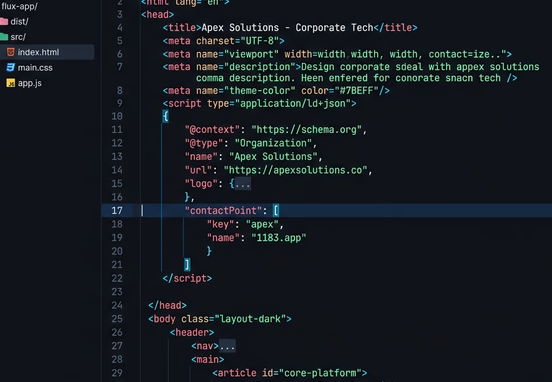
The hidden code elements wrapping your content are just as critical as the visible words on the page. Search engines rely heavily on programmatic tags to determine how to display your asset within search engine results pages (SERPs). Neglecting these fields guarantees a low click-through rate, even if your content is exceptionally deep.
Optimizing your underlying metadata guarantees that search bots interpret your content intent without translation errors. When you master writing a compelling meta description, you create an explicit click incentive that drives targeted traffic directly out of the search results and onto your domain.
| On-Page Metadata Component | Target Character Constraint | Algorithmic Function | Commercial Optimization Priority |
|---|---|---|---|
| Primary Title Tag | 50 - 60 Characters | Core ranking signal; establishes the explicit document focus in SERP links. | Must place primary target keyword at the absolute front of the string. |
| Meta Description String | 140 - 155 Characters | High-influence conversion text; summarizes value proposition to drive CTR. | Include a direct, active verb and a clear, natural call to action. |
| Canonical URL Tag | Unlimited | Identifies the master version of the file, neutralizing duplicate content flags. | Must be self-referencing and utilize secure, absolute URL paths. |
| Open Graph Directives | Vector Specific | Controls asset appearance across external social media distribution nodes. | Map optimized imagery parameters to maintain corporate brand equity. |
Failing to programmatically declare these variables forces search engines to automatically scrape random strings of text from your first paragraph. This automated clipping often results in fragmented, broken sentences that look highly unprofessional to prospective readers browsing the web.

Keyword Intent Mapping and Entity-Based Semantic Density
Modern search engines have evolved past primitive keyword frequency matching. Algorithms now leverage natural language processing and entity-based relationship graphs to evaluate content depth. Writing high-ranking content requires understanding how individual topics connect within a broader network of concepts.
Before writing a single sentence, you must isolate the explicit intent category of your target search term. If an audience searches for a phrase with informational intent, serving them a hard-selling promotional sales page creates immediate alignment failure. Your structure must match what the user is actively trying to accomplish at that exact moment.
When you focus your efforts on crafting high-converting website copy, you bridge the gap between technical keyword positioning and psychological user persuasion. This intersection ensures that traffic arriving via informational searches naturally moves forward into your primary sales ecosystem.
Structuring Content Around Core Marketplace Entities
Entities are clearly defined concepts, places, objects, or organizations that search engines recognize as unique nodes within their knowledge graphs. To rank for a complex industry topic, your article must contain a naturally distributed web of secondary terms that give context to the primary subject matter.
- Primary Entity Nodes: The absolute core subject of your article (e.g., "Web Infrastructure").
- Related Sub-Entities: Mandatory contextual terms that define the scope of the core asset (e.g., "Server Response Latency," "DOM Parsing Engines," "Data Serialization Protocols").
- Semantic Functional Context: Action verbs and industry-standard phrases that prove operational experience (e.g., "compiling modern codebases," "decoupling front-end architectures," "optimizing processing loops").
The Technical Math Behind Content Extraction and Readability
Search engine ranking systems use mathematical equations to analyze text complexity and verify content quality. High-ranking pages balance detailed information depth with absolute layout clarity, keeping reading fatigue to a minimum.
One core metric used in text evaluation is the Flesch-Kincaid Readability scale. This formula tracks sentence length and syllable density to assign a clear comprehension score to your digital document.
$$\text{Readability Score} = 206.835 - (1.015 \times \text{Average Sentence Length}) - (84.6 \times \text{Average Syllable Density})$$
Aiming for a balanced score between 50 and 70 ensures your technical insights remain completely accessible to corporate decision-makers without sacrificing necessary industry terminology. Short, active sentences prevent cognitive fatigue and keep users scrolling deeper into your article.
Technical SEO Directive: Always pair your long-form web text with clean, structured JSON-LD schema data injected directly into your document header node. This programmatic code provides search engine crawlers with clean, pre-parsed data about authors, publishing dates, and organizational credentials, boosting your eligibility for rich snippet search features.
User Engagement Telemetry and Indexing Management
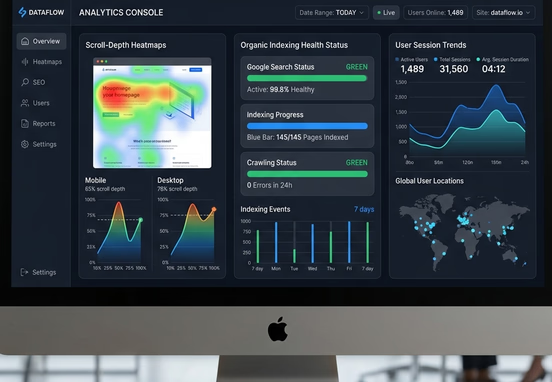
The performance metrics of your hosting server directly impact your search engine visibility. If your site suffers from indexing errors, broken cross-links, or slow server response times, search crawlers will lower your crawling budget and reduce your visibility.
Regularly monitoring your technical health via webmaster tools keeps your indexing pipelines running clean. If your content drops in visibility, your first step should always be troubleshooting why your website isn't showing up on search engines, clearing out the infrastructure issues that hold back content performance.
Real-Time User Behavioral Tracking
Once a page is fully indexed, modern search engines monitor real-time user behavior to verify content quality. Metrics like session duration, scroll tracking depth, and secondary click actions tell algorithms whether your page truly satisfied the user's initial search query.
When you implement comprehensive analyzing organic visitor data tracking workflows, you see exactly how real users engage with your structural content. Identifying the specific paragraphs where readers drop off allows you to continuously tune your copy for maximum reader retention.
The Structural Checklist for High-Ranking Content
Building a continuous search-driven asset requires maintaining a consistent, repeatable editorial workflow. Run this functional checklist against every piece of draft copy before pushing code changes to your live production server:
+-----------------------------------------------------------------------------+
| 1. VERIFY TARGET TERM                                                       |
| - Present within H1 title, initial 100 words of copy, and primary URL slug  |
+-----------------------------------------------------------------------------+
                                       │
                                       ▼
+-----------------------------------------------------------------------------+
| 2. AUDIT HEADING PATH                                                       |
| - Confirm no numeric heading levels are skipped across the document         |
+-----------------------------------------------------------------------------+
                                       │
                                       ▼
+-----------------------------------------------------------------------------+
| 3. CHECK IMAGERY ASSETS                                                     |
| - Ensure explicit alt attributes are set with descriptive keyword text      |
+-----------------------------------------------------------------------------+
                                       │
                                       ▼
+-----------------------------------------------------------------------------+
| 4. CONFIRM HYPERLINKS                                                       |
| - External resource links open inside isolated contexts to prevent bounce   |
+-----------------------------------------------------------------------------+
                                       │
                                       ▼
+-----------------------------------------------------------------------------+
| 5. ENSURE LAYOUT ELEMENTS                                                   |
| - Custom code displays or math preserve mobile responsive scaling frameworks|
+-----------------------------------------------------------------------------+
Enhancing Content Delivery via Fast Infrastructure
The ultimate success of your search positioning strategy relies heavily on the speed of your underlying hosting framework. A deeply researched, perfectly optimized article will still fail to rank if users bounce because the page takes seconds to load on a mobile device.
To secure top search rankings and capture maximum organic value, your digital platform must be engineered for rapid asset delivery, minimal code footprints, and clean structural stability under high visitor volumes.
Build custom, highly search-optimized content architectures designed to dominate search engine results pages using our premium speed-first design and development services.