

How to Define Operational Success Metrics for Long-Term Brand Growth
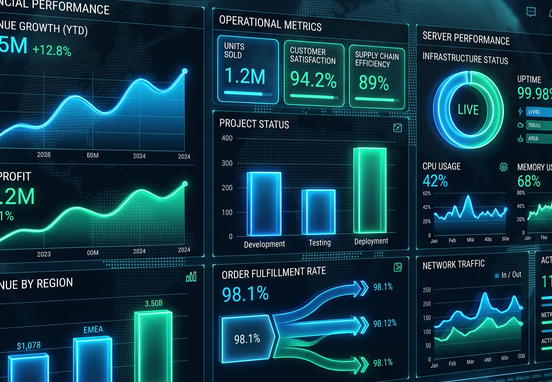
Evaluating business health based on superficial indicators like raw traffic counts, social media impressions, or casual email sign-ups introduces severe operational vulnerabilities. These data points represent vanity metrics. They offer an illusion of brand expansion while completely masking structural inefficiencies, high customer churn rates, and negative return on capital investments. Long-term commercial growth requires an infrastructure built around operational success metrics—empirical data flows that link frontend web performance directly to backend financial margins.
When an organization fails to connect its digital assets to primary business operations, its technical infrastructure becomes a cost center rather than a growth lever. Every modern web application, marketing landing page, and customer touchpoint must function as an automated data engine that records real-world customer behavior, operational costs, and transactional velocity. By shifting from subjective tracking models to rigorous data diagnostics, leadership can make strategic capital decisions based on hard statistical performance rather than guesswork.
Establishing clear, sustainable KPIs requires a deep understanding of structural economics, tech infrastructure health, and client retention funnels. When your data pipelines are clean, you gain the ability to pinpoint exactly where your customer acquisition efforts are succeeding and where your digital systems are bleeding capital. This data-driven clarity ensures that your brand remains highly resilient, scalable, and prepared to outpace market competitors over a multi-year horizon.
Deconstructing Vanity Metrics vs. Operational KPIs
To build an enterprise that scales efficiently, you must separate surface-level digital noise from your core revenue engines. A high volume of monthly visitors looks impressive on a presentation slide, but if those visitors bounce within three seconds due to slow page layouts, that traffic represents a net drain on server bandwidth rather than a commercial win. Operational success metrics prioritize efficiency, financial value, and long-term sustainability over raw volume.
Vanity tracking measures actions that are easy to manipulate but have minimal correlation with true profitability. For example, a marketing campaign might generate thousands of ad clicks, but if your conversion pipeline contains friction, those clicks fail to translate into qualified leads. True operational metrics analyze structural efficiency indicators, such as customer acquisition cost velocity, lifetime value alignment, data throughput, and server overhead management.
By re-orienting your team around operational KPIs, you establish a culture focused completely on performance optimization. Instead of celebrating an arbitrary increase in total web impressions, your engineering and marketing teams begin tracking conversion path velocity, database query speeds, and lead-to-opportunity ratios. This operational alignment directly prevents resource misallocation, allowing you to maximize the financial utility of your digital assets.

The Core Operational Pillars of Long-Term Growth
Every sustainable corporate strategy relies on tracking data across three major structural areas: acquisition efficiency, platform performance, and customer lifetime value optimization. When these three pillars operate in unison, your digital presence shifts from a passive information portal into a high-performance engine for brand equity.
Acquisition efficiency focuses heavily on the direct financial cost required to win a single customer account within a specific vertical. If your acquisition costs steadily rise while your contract values remain static, your business model will face scaling challenges over time. Tracking these metrics accurately requires a highly integrated analytics framework that traces consumer paths perfectly across multiple devices and sessions.
To eliminate tracking errors and build an accurate view of your customer pipeline, you must implement specialized session attribution systems. Reviewing the technical steps to track your customer journey from discovery to final purchase clarifies how to eliminate data blind spots across your marketing assets, giving your operations team the precise information needed to optimize your capital efficiency.
System Infrastructure and Operational Costs
The technical performance of your web infrastructure directly impacts your operational margins. Slow rendering speeds, broken mobile layouts, and unexpected platform downtime actively destroy consumer trust while driving up your long-term customer acquisition costs.
To quantify these impacts, your team must track performance metrics such as Time to First Byte (TTFB), server response latencies, and third-party API execution times. When a website relies on heavy, unoptimized software dependencies, your server costs scale unsustainably relative to your active user growth. Building a lightweight, custom platform allows you to maintain exceptionally low server overhead while providing a premium user experience.
The Lifetime Value Equation
Customer Lifetime Value (LTV) measures the total gross profit generated by a single client account over the entire duration of their relationship with your brand. Increasing your LTV requires building consistent customer retention loops, lowering service friction, and maintaining high platform utility. The table below details how to evaluate these core operational indicators against modern industry benchmarks:
| Operational Metric Category | Legacy System Average | Optimized Target Threshold | Direct Commercial Impact |
|---|---|---|---|
| Customer Acquisition Cost (CAC) | Volatile / Escalating | Linear / Decreasing | Maximizes marketing capital efficiency and improves net profit margins. |
| Customer Lifetime Value (LTV) | Short-Term Lifecycle | Multi-Year Compounding | Sustains long-term brand equity and funds ongoing research. |
| LTV to CAC Ratio | < 2:1 (Sustained Loss) | > 4:1 (High Efficiency) | Signals an incredibly stable, highly scalable commercial business model. |
| Server Resource Efficiency | High CPU / High Memory | Low CPU / Lightweight | Lowers operational infrastructure bills and speeds up global rendering. |
| Platform Conversion Velocity | Fragmented Funnel Paths | Clean Seamless Pipeline | Accelerates sales cycles and prevents user abandonment at checkout. |
When your core operational ratios consistently meet or exceed these target thresholds, your digital asset transforms into a highly secure wealth-generating mechanism. Understanding the long-term economics of custom web development highlights how to transition your digital setup from an ongoing cash drain into a highly valuable corporate asset. Reading our analysis on website ROI and shifting from a tech expense to an asset shows how top-tier engineering choices maximize long-term customer lifetime values.

Step-by-Step Architecture for Metric Definition
Deploying an operational success framework requires a structured data strategy. Follow this clear development sequence to integrate technical performance metrics directly into your company's executive workflows.
Step 1: Clean Your Core Analytical Data Layers
Before defining corporate success targets, you must confirm that your tracking tools capture clean, unadulterated interaction data. If your tracking pixels record duplicate transactions or fail to screen out internal corporate IP traffic, your operational reports will be fundamentally flawed. Clean your analytics architecture by implementing server-side tag verification and establishing strict tracking parameters for all external data sources.
To achieve absolute precision over your tracking systems, you must move past basic software dashboards and configure custom event parameters within your application's base source code. Reviewing our technical guide on demystifying analytics data to track organic visitors gives your developers the exact blueprint required to deploy secure pixels and capture highly reliable user analytics without slowing down page load speeds.
Step 2: Establish Your True Cost of Acquisition Baseline
Calculate your true customer acquisition cost by pooling your total marketing spend, sales software licensing fees, creative production costs, and administrative staff overhead across a specific quarterly window. Divide this aggregated capital pool by the exact number of new client accounts secured during that period. This calculation gives you an honest look at your real unit economics, bypassing the skewed numbers common in siloed ad dashboards.
Step 3: Define Contextual Conversion Milestones
Break down your primary sales funnels into measurable, bite-sized event milestones. For a corporate B2B service platform, this means monitoring the exact percentage of users who move from reading an informational case study to completing a formal consultation request. Track the velocity of these micro-interactions to isolate hidden friction points in your layouts before they impact your quarterly revenue goals.
Step 4: Automate System Performance Monitoring Loops
Configure automated server-side cron jobs or cloud monitoring microservices to continually test your platform's operational health. Your engineering team should receive instantaneous alerts whenever your application's global response times slow down or database query latencies exceed safe thresholds. For example, you can deploy a lightweight shell script to measure server response speeds and log performance trends directly into an internal analytics file:
+---------------------------------------+
|        Automated Timer Trigger        |
|         (Cron Job / Service)          |
+-------------------+-------------------+
                    |
                    v
+-------------------+-------------------+
|      Execute cURL Network Probe       |
|  Target: https://yourbranddomain.com  |
+-------------------+-------------------+
                    |
                    v
+-------------------+-------------------+
|  Extract Server Health Diagnostics    |
|  - HTTP Status Code (%{http_code})    |
|  - Connection Time (%{time_connect})  |
|  - Total Latency Time (%{time_total}) |
+-------------------+-------------------+
                    |
                    v
+-------------------+-------------------+
|     Format & Append Metric Data       |
|  Path: /var/log/site_performance.log  |
+---------------------------------------+
Step 5: Conduct Regular Core Retention Audits
Track your client churn rates and repeat engagement metrics every month. If your data reveals that users drop off quickly after completing an initial purchase, focus your resources on improving your onboarding UX, upgrading support responsiveness, and adding useful platform features. Retaining an existing client account costs significantly less than winning a new one, making retention optimization a major driver of operational growth.

Aligning Platform Architecture with Financial Goals
You cannot build a scalable brand if your website infrastructure is clunky, slow, or difficult for your target audience to navigate. When users run into slow rendering speeds, broken responsive layouts, or confusing user pathways during critical evaluation steps, they will abandon your platform and turn to your competitors. This structural abandonment drives up your marketing costs while lowering your overall customer acquisition efficiency.
To prevent these losses, your corporate web assets must be engineered with speed, security, and clean code infrastructure as primary requirements. Investing in a high-performance, optimized web design and development service gives your brand a streamlined, hand-coded framework that loads almost instantly on mobile devices and functions flawlessly across all global locations. This technical optimization removes friction from your user paths, helping your company maximize its traffic investments and achieve its core financial milestones.
Furthermore, a clean, custom-coded platform eliminates the excessive script debt, security risks, and broken code common in cookie-cutter page builders. This lightweight development path ensures that when you integrate complex data layer tracking tools, automated webhooks, and advanced user engagement analytics, your site's load speed remains uncompromised, allowing you to capture actionable operational intelligence while maintaining a premium user experience.
Operational Engineering Tip: Always remember that your digital platform's underlying code structure directly dictates its long-term financial efficiency. Heavy scripts and unoptimized database queries act as an ongoing hidden tax on your business operations, quietly inflating your hosting bills while dragging down your organic search engine visibility. Prioritize clean, modern development architectures to keep your system overhead low and your scaling speeds high.
When you remove technical friction from your frontend interface, you systematically lower user bounce rates, increase interaction depth, and boost conversion velocity across all marketing channels. Reviewing our strategic brief on how great user experience lowers customer acquisition costs clarifies the direct financial relationship between clean structural development choices and long-term customer acquisition efficiency.
Validating Long-Term Data Infrastructure Resilience
Maintaining a highly profitable corporate asset requires ongoing data hygiene, infrastructure health reviews, and strategic goal updates. Audit your analytics tracking configurations quarterly to remove obsolete tracking pixels, confirm your server auto-scaling rules function correctly during high-traffic events, and ensure your marketing spend aligns with your customer lifetime value goals.
By moving your brand past superficial vanity tracking and anchoring your organization around rigorous operational KPIs—such as infrastructure performance, customer lifetime values, and optimized conversion pathways—you protect your business from market volatility. This disciplined focus on clean data ensures your corporate assets remain secure, fast, and fully prepared to drive compounding financial growth over the long term.