

How to Close the Marketing-to-Sales Loop with Automatic Lead Attribution

Marketing teams frequently celebrate metric spikes in click-through rates, form submissions, and cost-per-lead drops. At the exact same time, sales departments often complain about a lack of pipeline depth and low-quality inquiries. This historical misalignment stems directly from a broken tracking loop. When a website fails to programmatically capture a lead's original touchpoints and bind that data permanently to the resulting revenue record, evaluating marketing return on investment (ROI) accurately becomes impossible.
Closing the marketing-to-sales loop requires an automated lead attribution system embedded directly into your digital architecture. Instead of relying on manual data entry or retroactive matching spreadsheets, an integrated system captures source mechanics at the moment of discovery, preserves them across multi-day browser sessions, and injects them cleanly into downstream platforms. This infrastructure gives organizations precise visibility into which specific campaigns drive closed-won contracts and which ones merely generate hollow traffic.
The Architectural Mechanics of Automated Tracking
To capture data without relying on manual user input, your web engineering team must deploy scripts that continuously monitor inbound click signals. When a prospect lands on your website from a paid ad, organic search query, or referral link, the browser URL contains explicit queries known as UTM (Urjit Tracking Module) parameters. An automated system immediately reads these values and caches them locally before the user clicks to another internal page.
Relying entirely on short-lived page state variables causes tracking to break the second a user navigates away from the landing page. Robust tracking frameworks write these parameters directly into the browser’s local storage or first-party cookie records. This preservation step ensures that even if a visitor browses twenty different service pages over a two-week period before filling out a contact box, their original acquisition source remains perfectly intact.
Capturing Inbound Metadata Signals
The system should look for several core parameters on every single inbound page load session.
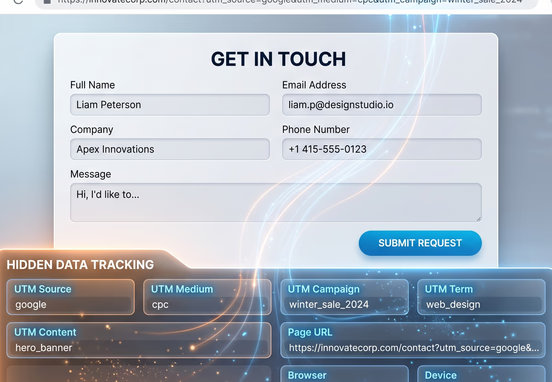
- utm_source: Identifies the specific platform or publisher sending the traffic (e.g., Google, LinkedIn, Newsletter).
- utm_medium: Identifies the broader channel type or tactical delivery method (e.g., CPC, organic, email, social).
- utm_campaign: Identifies the specific strategic marketing initiative or asset promotion associated with the click.
- utm_content: Distinguishes between different creative variants or ad links within the exact same campaign file.
- gclid / msclkid: Captured click identifiers from major search ecosystems that enable deep, server-side revenue sync matching.
Designing the Data Capture and Form Injection Infrastructure
Once tracking scripts successfully store acquisition metadata inside a user's browser, that data must be safely extracted during a conversion event. This is achieved by building hidden form fields directly into your website's front-end code components. When a user loads a contact, quote, or registration form, background scripts immediately pull the stored cookie data and use it to populate these hidden input fields silently.
Because this processing occurs entirely in the background, the user experience remains fast and clean. This technique operates as a foundational layer for wider optimization strategies, such as building out the automated lead engine via dynamic form logic, where front-end interfaces mold themselves dynamically based on user profiles while hidden fields capture structural attribution metrics simultaneously.
Operational Tip: Ensure your script checks for existing session data before overwriting cookie values. If a prospect first finds your site via an organic search query and returns the next day via a paid remarketing ad, your system must record both touchpoints to enable accurate multi-touch attribution reports later on.
Evaluating Technical Attribution Models
Selecting how your database allocates financial credit across multiple user interactions alters how marketing budgets are deployed. Relying blindly on standard third-party analytics dashboards often limits companies to rigid, single-touch tracking perspectives that fail to reflect complex B2B buying cycles.
A Comparative Analysis of System Attribution Logic
The table below breaks down the primary attribution calculations that can be programmatically mapped into your application's data processing pipelines.
| Attribution Model | Technical Calculation Logic | Core Operational Advantage | Primary System Limitation |
|---|---|---|---|
| First-Touch Logic | Allocates 100% of conversion value to the initial discovery channel. | Highlights top-of-funnel awareness drivers and content. | Completely ignores mid-funnel nurture tactics and direct traffic. |
| Last-Touch Logic | Allocates 100% of conversion value to the final conversion link. | Cleans up short-term optimization for transactional forms. | Fails to show the original source that brought the lead in. |
| Linear Logic | Distributes financial credit equally across every documented interaction. | Provides balanced view of entire customer journey map. | Dilutes clarity on high-performance closing triggers. |
| Position-Based (W-Shape) | Grants 40% to first, 40% to last, and splits 20% across middle touches. | Rewards both discovery and execution heavily. | Requires deep custom database tables to manage. |
| Time-Decay Logic | Exponentially increases credit to actions closest to the sale date. | Maps accurately to short, high-urgency buying windows. | Under-represents long-term organic branding initiatives. |

Integrating Attribution Payloads into Your Core Architecture
Once a user hits the submit button, your front-end code must package the hidden attribution inputs alongside standard customer responses into a unified, secure data object. This data payload travels down your network pipelines via structured API commands. To prevent data corruption or loss, your engineering team must establish clear data contracts between your web applications and external customer relation managers.
Mapping these payloads requires creating dedicated custom fields inside your enterprise CRM that directly mirror your website's tracking architecture. When designing these systems, teams benefit from deploying comprehensive workflow and systems automation services to handle the underlying data transformations, ensuring information flows seamlessly without creating manual data bottlenecks for sales representatives.
+-----------------------------------------+
|   User Clicks Inbound Link with UTMs    |
+-----------------------------------------+
                   |
                   v
+-----------------------------------------+
|  Tracking Script Reads URL Parameters   |
+-----------------------------------------+
                    |
                    v
+-----------------------------------------+
|  Cache Data in Cookies / Local Storage  |
+-----------------------------------------+
                    |
                    v
+-----------------------------------------+
|  User Navigates Pages (Data Preserved)  |
+-----------------------------------------+
                    |
                    v
+-----------------------------------------+
|  User Loads Form -> Extract Metadata    |
+-----------------------------------------+
                    |
                    v
+-----------------------------------------+
|  Silent Injection into Hidden Fields    |
+-----------------------------------------+
                    |
                    v
+-----------------------------------------+
|   Form Submit Packages JSON Payload     |
+-----------------------------------------+
                    |
                    v
+-----------------------------------------+
|   Secure API Pipeline Transmits Data    |
+-----------------------------------------+
                    |
                    v
+-----------------------------------------+
|  Downstream CRM / Database Injection    |
+-----------------------------------------+
For companies running proprietary web tools or decoupled application frameworks, these JSON payloads must connect natively to external tracking structures. Setting up custom data controllers allows developers to establish direct data integrity pipelines, an operational practice detailed further in our guide on connecting a core code base to CRMs and automation software.

Handling Privacy Protocols and Server-Side Attribution
Modern attribution tracking must adapt to tightening browser privacy standards, ad-blocking software extensions, and international compliance laws. Standard client-side tracking scripts that run entirely inside the user's browser are increasingly intercepted or blocked by modern browser configurations. To maintain accurate data reporting, organizations must transition toward server-side attribution tracking methods.
Server-side tracking shifts the data collection layer from the user's browser to your own cloud infrastructure. When an ad click occurs, your server logs the interaction directly into an isolated database record linked to a unique, anonymized session identifier. Because these data points are recorded directly on your own infrastructure rather than using third-party browser cookies, they remain unaffected by ad blockers while fully respecting local data minimization principles.
- Consent Verification: The attribution initialization engine must query the site's local cookie consent banner status prior to dropping tracking cookies.
- Anonymized Identifiers: Store data paths using hashed customer tokens rather than plain-text personal details to remain compliant with privacy guidelines.
- First-Party Domain Mapping: Route tracking signals through subdomains that match your core website root to maximize delivery success across privacy-first browsers.
- Server-to-Server Sync: Push attribution data to advertising networks and CRM systems via secure server-side API webhooks instead of client-side pixels.
Transitioning From Raw Data Streams to Executive Insights
Capturing granular attribution logs provides minimal organizational value if the data remains trapped inside isolated developer environments or sales records. The ultimate goal of closing the marketing-to-sales loop is to surface these insights directly to executive leadership, allowing for data-driven adjustments to capital allocation and corporate strategy.
By aggregating clean attribution records inside structured data warehouses, leadership can review comprehensive revenue metrics in real time. This operational integration shows how centralized web data hubs support executive decision-making, converting raw attribution strings into highly actionable dashboards that clearly display the exact cost-per-acquisition for closed enterprise deals.
Optimizing Workflows Based on Attribution Truths
When your attribution pipelines function flawlessly, your business gains complete clarity over its customer acquisition journey. Marketing teams can boldly shut down expensive, high-volume ad campaigns that fail to generate actual down-funnel sales. Simultaneously, sales teams can prioritize inbound inquiries that match the exact attribution profiles of historically high-value, fast-closing corporate accounts.
This unified approach removes guesswork from your commercial scaling efforts. By treating attribution as an essential technical requirement rather than an optional marketing add-on, you build a sustainable digital framework where every marketing dollar spent directly validates itself against verified bottom-line growth.