How to Choose a Brand Name with an Available .Com Domain That Builds Buyer Trust
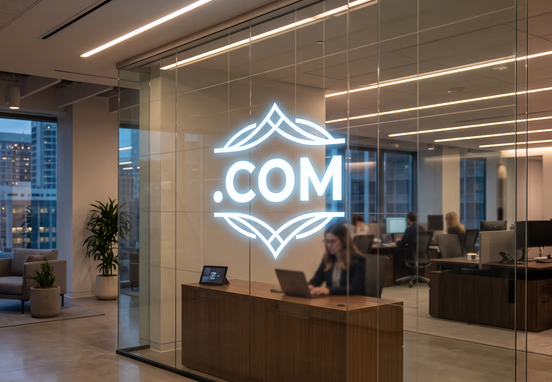
Selecting a brand name is not merely a creative exercise in corporate identity; it is the architectural foundation of your digital discovery engine. In an online marketplace crowded with synthetic extensions and alternative top-level domains (TLDs), the .com registry remains the undisputed gold standard for institutional trust and user retention. Buyers harbor a deep, systemic bias toward this legacy extension, treating it as an implicit verification of corporate stability and market authority.
When a growing business settles for a convoluted brand name or compromises on an obscure domain extension, it introduces immediate cognitive friction into the customer acquisition funnel. Every added hyphen, misspelled modifier, or secondary extension acts as a barrier to direct traffic, leaving your business vulnerable to competitors who possess a cleaner digital entry point.
A business domain operates as the permanent digital real estate upon which your entire corporate value is constructed. Relying on third-party platforms compromises this foundation, which highlights the critical trade-offs between a proprietary digital footprint and rented platform equity. If your target market cannot instinctively type your URL on a smartphone screen without looking up the exact spelling, your brand identity suffers from an architectural deficit that marketing spend cannot easily fix.
The Cognitive Trust Premium of Legacy Extensions
Consumers view the digital landscape through established patterns of risk and validation. For over three decades, the .com extension has served as the baseline for legitimate global commerce, meaning alternative top-level domains face uphill battles in user perception.
While tech-savvy audiences may tolerate niche extensions, mainstream B2B decision-makers and high-value consumer demographics frequently associate non-standard extensions with transient startups, speculative ventures, or unverified entities. This implicit bias affects click-through rates across organic search results and direct navigation performance.
| Domain Extension Category | User Trust Rating | Cognitive Friction Level | Strategic Market Implication |
|---|---|---|---|
| Legacy .Com Registry | Absolute High | Zero Friction | Maximum authority, native keyboard shortcuts, high asset valuation. |
| Traditional (.Net / .Org) | Moderate | Low to Medium | Generally restricted to technical infrastructure or non-profit entities. |
| Trendy Niche (.Io / .Ai) | High (Tech Only) | Medium | Effective for early-stage software, but risks alienating traditional enterprise buyers. |
| Generic TLDs (.Biz / .Info) | Critical Low | Extreme Friction | Heavily associated with low-tier web spam and insecure landing pages. |
Choosing an alternative TLD to save capital upfront is a strategic miscalculation. The long-term costs of correcting user misdirection, running corrective brand campaigns, and losing organic referral traffic heavily outweigh the initial investment required to secure a clean, authoritative corporate address.
Structural Frameworks for Domain-Ready Naming
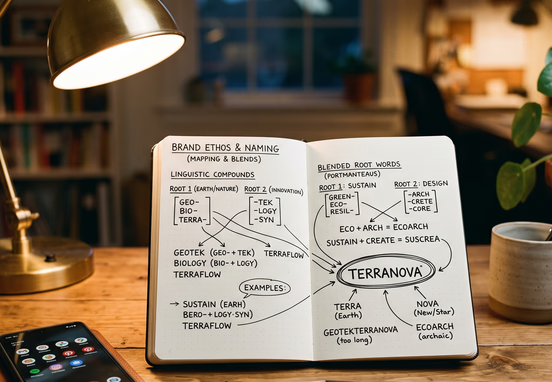
To secure an available .com without relying on awkward modifiers, you must approach the naming process through structured linguistic frameworks. Rather than searching for isolated dictionary words that were claimed in the late 1990s, strategic copywriters engineer brand names by combining specific semantic elements.
Compound and Blended Nomenclature
Blended names fuse two distinct root words to create an entirely new, highly trademarkable corporate noun. This approach allows you to retain industry relevance while bypassing the saturated market of single-word domains.
By combining an operational verb with a structural noun, you create a name that hints at your company's core function while remaining easy to spell. This method yields clean, balanced configurations that look highly professional in browser navigation bars and mobile applications.
Portmanteaus and Neologisms
A portmanteau clips parts of two existing words and welds them together, while a neologism invents a new word entirely using classic phonetic roots. These structures are highly effective for securing clean .com domains because the exact linguistic combination rarely exists in legacy registries.
When engineering a neologism, you must stick strictly to natural phonetic rules. The word must look balanced when written out in lowercase characters, ensuring that adjacent letter combinations do not create visual confusion or awkward reading speedbumps for the user.
The Radio Test and Linguistic Engineering
A flawless corporate name must pass the phonetic clarity test, commonly referred to in digital marketing as the radio test. If a customer hears your brand name spoken on a podcast, a video advertisement, or a casual referral conversation, they must be able to type the exact spelling into a browser on their first attempt without instructions.
Linguistic engineering requires eliminating specific structural hazards that compromise human memory and navigation efficiency. If you have to spell out your brand name syllable by syllable during a sales call, your name is a conversion liability.
- Avoid double letters at the junction of compound words, as users will consistently drop one of the characters when typing quickly.
- Eliminate homophones or words that can be spelled many ways, which completely fractures direct navigation traffic.
- Completely banish hyphens, numbers, or deliberate misspellings designed to mimic trendy application names.
A domain that requires explanation is an inefficient asset. When your corporate identity is clean, it integrates perfectly with your technical web architecture, allowing you to deploy a high-performance, speed-first web design service that captures and converts traffic instantly without losing users to layout confusion or typos.
Safe Search Protocols and Avoiding Domain Front-Running
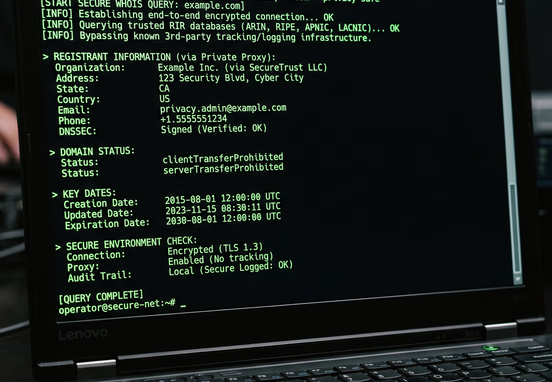
The process of uncovering an available .com domain requires strict operational security. A common mistake among founders is typing prospective brand names directly into generic registrar search bars before they are ready to purchase the asset.
Many low-tier domain search platforms log user queries and employ automated scripts to instantly register high-value terms. This predatory practice, known as domain front-running, forces you to buy your ideal name from a squatter at a massive markup days after your initial search.
To protect your intellectual property during the ideation phase, you must use secure, non-logging lookup tools. The safest method is utilizing command-line utility configurations to query registry databases directly without routing your text through third-party marketing servers.
+------------------------------------+
|       Target Brand Name Idea       |
+------------------------------------+
                  |
                  v
+------------------------------------+
|  Bypass Generic Registrar Searches | ----> (Prevents predatory front-running)
+------------------------------------+
                  |
                  v
+------------------------------------+
|  Execute Secure CLI Queries Direct  | ----> (Using native whois / nslookup)
+------------------------------------+
                  |
                  v
       /----------------------\
      /    Is Domain Taken?    \
      \----------------------/
           /          \
         YES           NO (Returns "NXDOMAIN" or "No Match")
         /              \
        v                v
+------------------+   +------------------------------------+
| Return to        |   | Register Asset Instantly           |
| Ideation Phase   |   | via Accredited Corporate Registrar |
+------------------+   +------------------------------------+
If the system returns an NXDOMAIN error or confirms no matching record exists in the global registry, the domain is genuinely unassigned. At that exact moment, you should immediately purchase the asset through an accredited corporate registrar to lock down the digital real estate before moving on to visual development.
Once secured, you must execute proper infrastructure setups to link that domain to secure storage networks. Learning how to safely buy web assets and configure domain servers ensures your digital foundation is fully protected against infrastructure vulnerabilities, data leaks, and configuration errors right from the start.

Mitigating Trademark Collisions and Digital Blind Spots
Domain availability does not automatically guarantee legal safety. A name can be completely clear in the global domain registry while actively violating existing corporate trademarks within your specific business sector or geographic territory.
Operating under a name that triggers a trademark dispute can lead to catastrophic legal expenses and forced rebranding campaigns down the line. You must systematically cross-reference your prospective domain choices against national and international intellectual property databases before committing to any public launch.
Executing a Multi-Layered Clearance Sweep
Before finalizing your corporate name, verify its status across multiple legal and digital layers to ensure total exclusivity:
- Federal Trademark Queries: Search the United States Patent and Trademark Office database or your regional equivalent for phonetically similar marks within your specific industry classification codes.
- Corporate Registry Filings: Audit local state and national corporate entity registries to verify that no existing businesses are operating under the identical trade name.
- Social Graph Parity: Check major communication networks and media platforms to confirm that matching handles are available, avoiding fragmented naming conventions across your brand ecosystem.
A clean legal runway allows you to build brand equity with total confidence. Taking the time to execute these legal verifications prevents situations where why a cheap online icon is not enough to build a real brand identity becomes glaringly obvious, as a premium corporate identity requires a cohesive, legally sound foundation across all physical and digital properties.
Evaluating Historical Domain Risk
Even if a domain is currently available for public registration, it may possess a hidden historical record. Domains are frequently abandoned by previous owners after being penalized by search engines for manipulative optimization tactics or automated link spam.
Use backlink analysis tools and digital archive networks to inspect the historical footprint of your prospective domain. If the URL carries a legacy of malicious activity or spam association, clearing those penalties with search engine crawlers can consume months of costly technical labor.
Infrastructure Security Tip: The moment you secure your primary .com domain, immediately register the closest common typo variants and primary alternative extensions like .net and .org. Configure permanent 301 redirects to point these secondary properties directly to your primary corporate asset. This proactive architecture permanently prevents competitors or malicious actors from squatting on your common typos and intercepting your direct customer traffic.
Connecting Your Domain to a Trusted Corporate Infrastructure
An authoritative domain name serves as the anchor point for your entire professional communication matrix. Once you have secured a pristine, trustworthy .com domain, that exact nomenclature must be extended directly to your team's communication channels.
Continuing to run business operations out of generic consumer email platforms completely erodes the trust built by a premium brand name. Transitioning immediately to an authenticated, domain-matched communication network is a non-negotiable step for any business targeting high-value corporate accounts.
Understanding why a gmail address instantly destroys business credibility highlights how small details shape buyer perception. By pairing a clear, intuitive .com domain name with an authenticated, professional email framework, you establish an ironclad digital presence that commands industry authority and accelerates every stage of your sales cycle.