

Running Local Search Ads: A Beginner Roadmap to Target Search Engines
Capturing immediate, location-specific consumer demand requires a direct presence at the exact moment a user searches for local assistance. Traditional organic search positioning strategies deliver exceptional long-term enterprise equity, but building that systemic search engine visibility takes time. For companies requiring immediate telephone inquiries, storefront footsteps, or service bookings, local search advertisements bridge the distribution gap instantly.
Local search ads display targeted promotional listings to users based on their active geographic coordinates and explicit intent terms. When a consumer inputs a high-urgency phrase like "commercial plumbing repair near me" into a smartphone browser, they are not looking for educational content. They are seeking a verified, local service provider capable of resolving an immediate operational crisis.
Deploying capital into paid search placement infrastructure gives businesses immediate visibility over non-paying competitors. However, running a profitable ad campaign requires moving past basic bidding strategies and managing your budget with data-driven precision. Pouring money into unoptimized ad networks without configuring accurate targeting rules is the fastest way to drain your marketing capital.
The Structural Architecture of Local Search Ad Networks
Navigating paid local search requires understanding the distinct placement types available across modern search engines. Advertising platforms split local ad inventory into specific functional buckets, each tailored around different user behaviors and transaction styles.
Choosing the wrong ad format misaligns your campaign with your target audience's needs. To build a highly profitable acquisition pipeline, you must match your specific business model with the correct ad delivery framework.
- Google Local Services Ads (LSAs): Positioned at the absolute top of the search engine results page, these ads feature a prominent screening badge that builds instant consumer trust. Businesses pay per qualified lead rather than per click, making this structure highly cost-efficient for service providers.
- Standard Search Ads with Location Assets: Traditional text-based placements enhanced with dynamic address extensions, direct click-to-call phone lines, and operational hours pulled directly from your business profile.
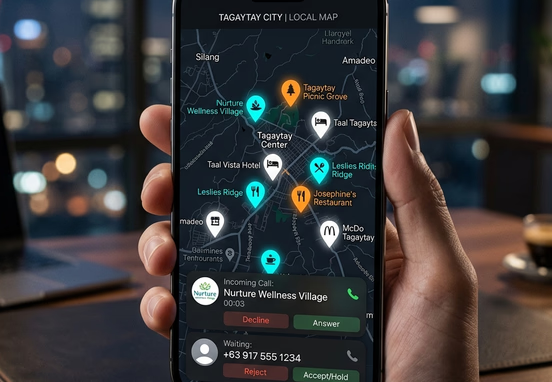
- Map Placement Advertisements: Promoted pins that appear directly inside navigation applications when a user searches for nearby physical destinations, driving immediate foot traffic to storefront locations.
To extract maximum commercial value from these paid placements, your destination landing pages must match this speed and intent. Landing pages built on slow, unoptimized frameworks break the conversion path, showing exactly why lagging page speeds kill local sales and ranks.

Architectural Alignment: Ad Setup Matrix
Launching an ad campaign without properly setting up your targeting parameters results in wasted ad spend. You must align your budget, geographic boundaries, and keyword intent match types to ensure your ads display only to high-value prospects.
| Ad Placement Type | Primary Bidding Metric | Geographic Boundary Precision | Optimal Use Case Scenario |
|---|---|---|---|
| Local Services Ads (LSA) | Cost Per Qualified Lead (CPL) | Highly Granular Postal Code Filtering | Emergency Home/Business Services (Plumbing, Legal, HVAC) |
| Search Ads with Location Assets | Cost Per Click (CPC) | Radius-Based Proximity Targeting | Multi-Location Commercial Entities, B2B Regional Agencies |
| Promoted Map Pins | Cost Per Interaction (CPI) | Direct Metropolitain City Center Bounds | Retail Storefronts, Dental Clinics, Physical Restaurants |
Configuring these parameters correctly shields your budget from out-of-market clicks. For example, a local contractor operating in a specific city shouldn't waste capital displaying text ads to users located fifty miles away who are outside their service zone.
Configuring Your Local Optimization Engine
The foundation of any successful local ad campaign is a fully optimized, verified business listing. Search engine ad networks pull data directly from your public business profile to verify your company's physical location, operational legitimacy, and customer reputation scores.
If your public profile contains conflicting data, missing hours, or an unverified address, the ad network will artificially inflate your cost-per-click. The platform lowers your ad quality score to protect its users from low-quality, untrustworthy business interactions.
- Claim and Verify the Core Profile: Complete the physical validation steps required by the search engine to prove your company operates a legitimate office or service territory.
- Synchronize Name, Address, and Phone Data (NAP): Ensure your business contact data matches your website layout perfectly, right down to the spelling of suite numbers and formatting of telephone lines.
- Architect a Systematic Review Acquisition Funnel: Implement clear, customer-facing systems to secure consistent five-star ratings, which directly improves your paid ad positioning metrics. Learn to deploy a systemic review engine to capture top ratings to outpace competing ad buyers.
- Publish High-Definition Location Imagery: Upload clear photos of your company vehicles, physical office storefront, and corporate staff to build human authenticity before a user clicks your advertisement.

Geo-Targeting Mechanics and Radius Bidding Adjustments
Advanced local ad management involves setting precise geographic adjustments to maximize budget efficiency. Modern search engines allow you to adjust your maximum keyword bids based on how close a user is to your physical operating base.
By applying percentage modifiers to your bids, you can bid aggressively for customers located within a five-mile radius of your storefront, while scaling down your bids for users further away who are less likely to convert.
           [ Evaluate User Distance ]
                       |
                       v
             /-------------------\
            /  Distance <= 5 mi?  \ --- Yes ---► [ Apply Bid Modifier (+25%) ]
             \-------------------/
                       |
                      No
                       v
             /-------------------\
            /  Distance <= 15 mi? \ --- Yes ---► [ Maintain Baseline Bid ]
             \-------------------/
                       |
                      No
                       v
              [ Exclude Session ]
This hyper-targeted budgeting ensures that your marketing capital is automatically directed toward the geographic zones that yield the highest conversion volumes and lowest customer acquisition costs.
Negative Keyword Inclusions to Eliminate Budget Waste
One of the most common mistakes made by beginner ad managers is failing to use negative keywords. Negative keywords allow you to specify exact words and phrases that should never trigger your advertisements.
If your company focuses exclusively on premium corporate installations, you should add negative terms like "cheap," "free," "DIY," or "jobs." This prevents your budget from draining on low-value searches from users looking for budget templates or employment opportunities.
The Critical Role of Match Types in Local Search
Search networks offer different keyword matching options, including Broad Match, Phrase Match, and Exact Match. Utilizing Broad Match in local campaigns often forces your ads to appear for unrelated terms, driving up costs with zero return.
Sticking strictly to Phrase and Exact match options ensures your ads only render when a user types your exact service terms. This precision is essential for managing your campaign profitably over the long term.

Integrating Local Ads with a Broader Organic Playbook
Paid search advertisements are exceptional tools for generating immediate leads, but they should never function as your company's sole digital pipeline. The moment you turn off your advertising budget, your inbound traffic stream drops to zero.
A healthy business blends paid visibility with long-term organic search engine optimization. Combining paid local ads with organic local search strategies creates a dual-presence on search result pages, capturing maximum market share. However, building an organic foundation on restrictive DIY platforms can completely undermine these efforts; understanding how template site builders compromise local search performance demonstrates why high-performance, custom engineering is non-negotiable for true visibility.
Local Ad Architecture Directive: Never send paid traffic from local ads to a generic, unstructured homepage. Always build dedicated, localized landing pages tailored around the explicit service and location specified in the advertisement. If your ad targets "roofing repair in downtown," your landing page layout must display that exact headline instantly to maintain context and prevent bounce drops.
Building a multi-channel presence allows your business to capture cold market attention across every stage of the customer journey. You can learn to master this multi-channel alignment by studying the complete local SEO playbook for business growth, protecting your brand visibility from fluctuating ad costs.
Tracking Local Conversions with Pristine Analytics Data
To measure the true return on investment of your local search campaigns, you must track every conversion pathway with surgical accuracy. Local search users interact with businesses through distinct actions, such as direct telephone calls, map routing clicks, or contact form submissions.
Deploying call tracking software allows you to trace phone inquiries back to the specific keyword and advertisement that generated the call. This data makes it easy to see which ad campaigns are driving real revenue and which ones need optimization.
Consistently monitoring user behavior on your landing pages reveals exactly where paid visitors lose interest or abandon forms. Integrating clean analytical data helps you continuously optimize your digital asset, boosting your chances of hitting a great conversion rate for your hand-coded website.
Maximizing Lead Value via Speed-First Web Engineering
The ultimate performance of your local search ad strategy relies heavily on the rendering speed of the landing page your users hit. A mobile user looking for an immediate service provider will not wait four seconds for a slow, template-heavy website to load on their smartphone.
To extract maximum value from your local advertising spend and beat your competitors to the lead, your website must feature ultra-fast rendering paths, optimized mobile forms, and clean code stability.
Build a high-performing digital asset designed to convert paid local traffic instantly using our professional speed-first design and development services.