

Phase Two Planning: How to Use Initial Feedback to Add Features

The deployment of a new website to a live production server marks the beginning of an asset's operational life cycle, not its completion. The initial version of any digital platform should function as a baseline engineered to gather real-world behavioral telemetry. Attempting to build a perfect, all-inclusive software platform before observing actual human interaction inevitably leads to misallocated capital and over-engineered features.
Operating an online presence with agility requires separating product expansion into distinct, manageable execution cycles. Moving past launch paralysis is easier when organizations realize that an initial platform acts as a validation engine. Companies achieve better market alignment when they choose to how to stop overthinking and launch a business website rather than delaying rollout in pursuit of unverified feature sets.
Once real users begin navigating your application pathways, your primary data collection shifts from hypothetical project briefs to live usage data. This incoming feedback stream must be handled via structured processing systems. Phase two planning translates real user friction points, feature requests, and behavioral drops into a highly optimized development roadmap.
Triangulating User Feedback Streams
An effective optimization process relies on gathering feedback from both quantitative metrics and qualitative user reports. Relying exclusively on support inbox messages can skew your roadmap toward a vocal minority of users whose issues might not reflect the broader audience. Conversely, tracking purely numerical analytics numbers tells you what is happening across your platform without explaining why.
To separate actionable feature requirements from temporary user preferences, technical teams must cross-reference multiple distinct data layers simultaneously. This deliberate triangulation ensures that every development hour spent during phase two yields measurable business value.
- Friction Telemetry: Tracking erratic cursor movements, repeated rapid clicks on non-functional text, and premature form abandonment sequences to pinpoint layout confusion.
- Direct Customer Inquiries: Categorizing inbound technical support tickets, email complaints, and account management queries to identify recurring operational bottlenecks.
- Granular Session Recordings: Reviewing individual user interaction paths to observe exactly where prospective clients stall or hesitate before taking action.
- Structured Post-Transaction Surveys: Deploying brief, automated input triggers immediately following a successful conversion to evaluate the user's perceived path ease.
Extracting these insights requires a clean, active telemetry layer built directly into your application code. Businesses gain clear visibility into these behavioral patterns by mastering the principles of demystifying analytics data and tracking organic visitors, turning raw traffic counts into clear optimization roadmaps.
Separating Global Demands from Isolated Requests
Not every feature request deserves a spot on your secondary development timeline. When a user requests a custom dashboard filter or a unique checkout mechanism, you must evaluate whether that update improves the experience for your entire audience or just satisfies an edge case.
Cross-referencing feature requests against your core analytics tools allows you to verify customer demand. If database logs confirm that less than one percent of your active users interact with a specific tool zone, rebuilding that area should be dropped to a lower priority level.
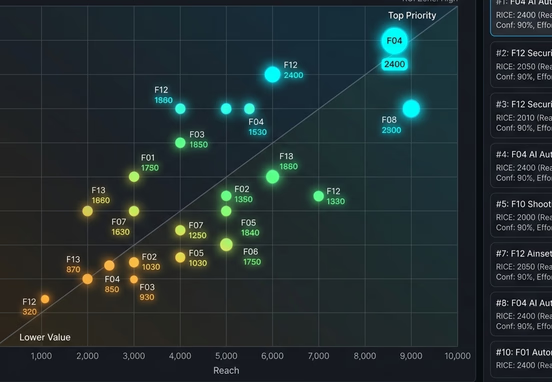
The Feature Prioritization Matrix
Transforming a messy list of customer feedback into an organized engineering sprint requires a strict prioritization system. The RICE framework evaluates potential platform updates by scoring them across four objective variables: Reach, Impact, Confidence, and Effort.
Applying strict mathematical scores to every proposed upgrade removes emotional bias from your product roadmap. This ensures your development budget is continuously directed toward the high-value adjustments that yield the largest returns.
| Feature Candidate | Target Audience Reach (1-10) | User Value Impact (0.25 - 3.0) | Engineering Confidence (Percentage) | Total Development Effort (Person-Weeks) | Absolute RICE Priority Score |
|---|---|---|---|---|---|
| Asynchronous Inline Search | 9 | 2.0 | 90% | 1.5 | 10.80 |
| Multi-Currency Checkout Gateway | 4 | 3.0 | 85% | 4.0 | 2.55 |
| Client Account Portal Dashboard | 3 | 1.5 | 70% | 5.0 | 0.63 |
| One-Click Lead Form Autofill | 10 | 2.0 | 95% | 0.5 | 38.00 |
| Automated Invoice PDF Generator | 2 | 1.0 | 90% | 2.0 | 0.90 |
The variables used to calculate these absolute priority scores are defined through strict data guidelines:
- Reach Metric: An estimation of how many unique website sessions will interact with the modified element over a fixed thirty-day operational window.
- Impact Multiplier: A qualitative assessment of how significantly the update will alter conversion actions, ranging from minimal alignment shifts to complete transactional transformations.
- Confidence Rating: A percentage score reflecting your internal team's certainty regarding their data projections, used to account for speculative assumptions.
- Effort Calculation: The total operational time required by your engineering, design, and quality assurance teams to push the code changes to production.
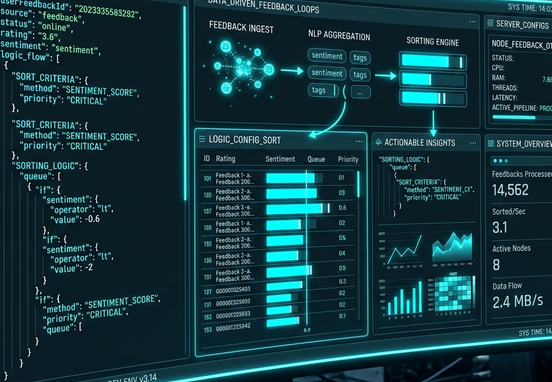
Operational Feedback Processing Logic
Once your feature priorities are locked down, your internal development team needs clear execution protocols to implement changes without breaking existing system stability. This deployment logic can be automated and tracked using basic configuration states within your version control systems.
The following programming script model demonstrates how an engineering team filters incoming feature upgrades based on real-world system requirements and confidence metrics before modifying codebases:
[Incoming Feature Requests]
            │
            ▼
┌────────────────────────────────────────┐
│         EVALUATION ENGINE              │
│  • Evaluate Telemetry Drop-offs        │
│  • Calculate RICE Coefficients         │
│  • Verify Backwards Compatibility      │
└────────────────┬───────────────────────┘
                 │
                 ▼
   /───────────────────────────\
  /    Meets Thresholds?        \
 /     - Confidence >= 80%       \
  \    - Effort <= 3.0 Weeks?   /
   \───────────────────────────/
                 │
        ┌────────┴────────┐
     YES│                 │NO
        ▼                 ▼
┌────────────────┐  ┌────────────────┐
│  APPROVED FOR  │  │  DEFERRED FOR  │
│   IMMEDIATE    │  │   SECONDARY    │
│  ENGINEERING   │  │   EVALUATION   │
└───────┬────────┘  └───────┬────────┘
        │                   │
        ▼                   ▼
 [Feature 109:       [Feature 214:
  Optimized Micro-    Legacy Content
  Forms]              Refactor]
Running your development sprints through structured processing rules keeps your team aligned. This technical discipline protects your platform from the architectural decay that occurs when features are added haphazardly without reviewing baseline system logic.
Engineering Phase Two Features with Clean Architecture
The biggest danger during phase two execution is the accumulation of technical debt. When marketing teams demand rapid feature releases to satisfy immediate user requests, developers are often pressured to copy and paste unoptimized external scripts, heavy third-party plugins, or bloated framework wrappers.
Every unvetted code asset injected into a platform degrades its underlying browser parsing efficiency. If you add interactive features at the expense of core rendering speed, your overall conversion performance will decline, erasing any benefits the new tool was meant to deliver.
Phase two upgrades should always be built using clean, bespoke programming methods. Maintaining raw source code ownership ensures that your application layout remains light, responsive, and secure as you scale your feature set over time.
Maintaining Strict Layout and Component Continuity
Adding new features shouldn't disorient your existing user base. New components, notification modules, and navigation menus must adhere perfectly to your established design system.
Using consistent typographic hierarchies, color palettes, and spacing rules ensures that updates feel native to the original site architecture. Maintaining this layout continuity prevents user confusion and protects your brand authority.
Preserving Data Integrity and State Management
Complex interactive elements—such as customer portals or advanced search filters—require robust frontend state management systems. Unoptimized data loops can cause browser memory leaks and slow down interface interactions on mobile touchscreens.
Hand-coding your state variables allows your application to handle data processing smoothly behind the scenes. This engineering precision keeps elements highly responsive, ensuring your interface performs flawlessly during peak traffic periods.
Feature Deployment Directive: When rolling out complex structural modifications during phase two, always utilize server-side feature flags. Wrapping new tools in remote toggle rules allows you to display updates to a small, controlled group of users first. This isolation helps you verify tool stability and monitor initial conversion responses before rolling out the update to your entire audience.
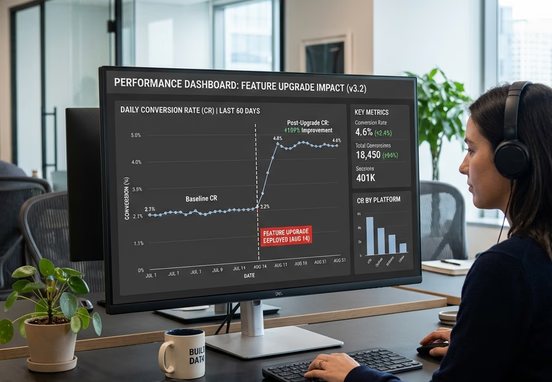
Validating Post-Iteration Conversion Shifts
The ultimate test of a phase two optimization cycle is its direct impact on your company's financial bottom line. An update cannot be classified as successful simply because it deployed without breaking your layout; it must move your core business conversion metrics in a positive direction.
Track your core conversion numbers for several weeks following a feature rollout, comparing the new performance metrics directly against your baseline launch data. This evaluation helps you see if your product updates are working as intended or introducing fresh interaction barriers.
Documenting these performance improvements shows exactly how systematic updates transform your digital footprint from a basic public profile into an active corporate asset. This consistent attention is the key to maximizing website ROI and lifetime value, transforming your online home into a primary driver of sustainable profit growth.
Protecting System Foundations Through Iterative Growth
Achieving long-term digital growth requires moving past static web building habits and embracing continuous, data-backed optimization models. Releasing a focused initial version provides a clean foundation, allowing you to gather pristine behavioral insights directly from your market audience.
Prioritizing your product expansion around verified user friction points prevents your platform from accumulating the heavy tech bloat that paralyzes template-built systems. This focused development strategy ensures that every code optimization actively improves user retention, lowers acquisition friction, and drives business revenue.
Scale your online presence securely with custom, high-performance feature engineering using our professional speed-first design and development services.